Strange Pictures
51 pages • 1-hour read
Uketsu, Transl. Jim RionStrange Pictures
A modern alternative to SparkNotes and CliffsNotes, SuperSummary offers high-quality Study Guides with detailed chapter summaries and analysis of major themes, characters, and more.
Character Analysis
Content Warning: This section of the guide includes discussion of death, death by suicide, animal cruelty, illness, and child abuse.
Naomi Konno/Miura
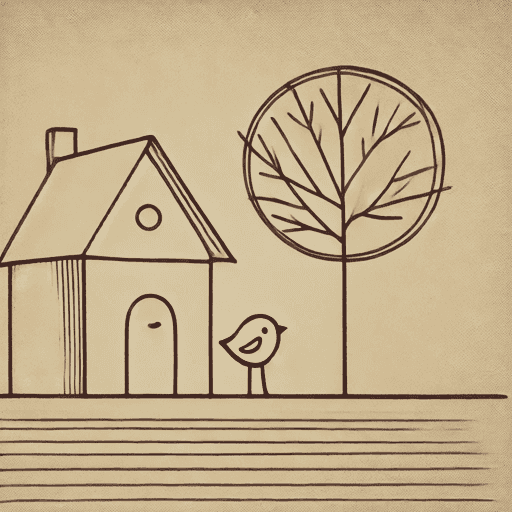
Naomi Konno is a point-of-view character and the killer whose actions connect the various mysteries presented in Strange Pictures. At first, she is just a shadowy presence, but as the narrative goes on, she becomes a more defined and threatening figure. She is first introduced in the Prologue as “Little A,” the 11-year-old child who murdered her abusive mother and who drew the text’s first picture: of a house, a child, and a tree containing a white bird. Although she is not initially named as the mysterious third person in “Raku’s” household (hinted at in his blog), she is in fact his mother and Yuki’s mother-in-law and is living with the couple at the time of Yuki’s death.
Naomi is first named and featured prominently in Chapter 2. In this chapter, she is the protagonist, struggling to raise her grandson, Yuta, and worrying about a stranger who seems to be following her. The chapter frames her in a way designed to elicit sympathy: Her exhaustion, financial worries, and concerns about how she is parenting show her vulnerabilities and her genuine love for Yuta. However, Naomi’s status as a mother—as Haruto’s biological mother and Yuta’s adoptive mother—is central to the story’s consideration of The Violent Contradictions of Parental Love. Naomi is not simply a devoted maternal figure; she is someone capable of extreme violence in the service of her beliefs about motherhood. Naomi is the unnamed wife whom the police briefly interview in Chapter 3 about the death of her husband, Yoshiharu Miura. She is a harsh judge of her husband’s character; later, it becomes clear that she is also his killer. Believing that Miura was unfit to be her son’s father, she murdered him. Her desire to be a mother to Haruto’s child as well drove her to facilitate Yuki’s death in childbirth, and her desire to protect both Haruto and Yuta led her to kill Iwata and Toyokawa and attempt to murder Kumai.
The shifting way that Naomi is presented to the reader—as a child who reacted with violence to protect an innocent animal, as a struggling older woman raising her grandchild after her own child’s death, and then as a cold-blooded killer—mimics the way that the pieces of art in the text shift in meaning as the narrative’s characters acquire more information. Implicitly, her character is thus key to developing the themes of Artistic Creations as an Opaque Window into the Mind and How Perspective Shapes Perception.
Haruto Konno/Miura
Haruto is Naomi’s son, Yuki’s husband, and Yuta’s father. He is first introduced under a pseudonym: “Raku,” the author of the blog that Sasaki and Kurihara investigate in Chapter 1. The entries in this blog characterize Haruto as an enthusiastic, cheerful, and slightly naive young man who is desperately in love with his wife and perhaps too easily molded by the shadowy third figure in their household—later revealed to be his mother, Naomi. Haruto gushes over his anniversary, is abashed when his wife scolds him for eating too much cake, and is over the moon when he finds out that he is about to be a father. He worries a great deal about Yuki’s health and happiness during her pregnancy, but he is quick to follow Naomi’s advice about the complicated pregnancy instead of seeking out a more objective medical opinion.
Haruto’s intense bond with his mother is as responsible as his cheerful naivete for his failures to exercise common sense and independence. Naomi has raised Haruto on her own—following her murder of his father—and devotes herself utterly to Haruto. As a married adult, Haruto lives with his mother and depends on her advice. She is still “the one [he loves] most” (16), even ahead of his own child. This makes him vulnerable to Naomi’s manipulations when she decides to rid the family of Yuki, and it means that when Haruto finally discovers the truth, he is shattered. Instead of taking his child and establishing a life away from Naomi, Haruto dies by suicide, leaving Yuta in the care of the very woman who orchestrated Yuta’s mother’s death.
Yoshiharu Miura
Yoshiharu Miura is Naomi’s husband and Haruto’s father. He is the art teacher whose death is the focus of Chapters 3 and 4. Miura’s death occurs almost immediately at the beginning of Chapter 3, so he is primarily characterized through others’ memories of him.
These memories highlight the gap between Miura’s self-perception and his true nature. Miura thinks of himself as an excellent husband, father, teacher, and friend; he believes that the happiness of his family, students, and friends is his “sole reason for living” and prides himself on “never [asking] for anything in return” (109). In his mind, his sole indulgence is the periodic hiking and camping trips he takes on a mountain near his home. Miura is not the most accurate judge of himself and his impact on the people around him, however. After his death, interviews reveal that Miura was widely disliked by students, that his wife found him to be harsh, self-centered, and insensitive, and that even his closest friend saw Miura as egotistical and callous.
Certain details suggest that these perspectives may themselves be flawed—specifically, overly harsh. For instance, Iwata recalls how kind Miura was to him at school—making sure that both Iwata and his grandfather had regular meals and taking the time to counsel Iwata when Iwata was feeling down. The ambiguity surrounding Miura contributes to the novel’s exploration of unreliable perception.
Yuki Kameido
Yuki is Haruto’s wife, Yuta’s mother, and Naomi’s daughter-in-law. When she is younger, she is a student in Miura’s art club and has an adolescent crush on him. That Yuki is the only person Iwata interviews who has anything positive to say about Miura highlights her kindness. That kindness motivates her to help Miura’s widow and young child after Miura’s death. Years later, Yuki runs into Haruto again when they are both adults, and she ends up falling in love with and marrying him.
Raku’s blog portrays Yuki as a devoted wife who is overjoyed about becoming a mother—until she realizes that Naomi is plotting against her. Yuki is a beautiful woman and a talented artist, but she lacks critical resources to defend herself against Naomi. She has had a falling out with her parents and does not have them to rely on if she chooses to flee her home with Haruto. She is also not confident enough to confront Naomi or confide her suspicions directly to Haruto. Instead, she encodes her beliefs about Naomi in drawings that Haruto must later piece together to understand how his wife died.
Shuhei Sasaki
Sasaki is one of the two college students who appear in Chapter 1, investigating Raku’s blog and the mysterious pictures left behind by Yuki. Chapter 1’s third-person narrator focuses primarily on Sasaki’s perspective and goals, making him the protagonist of this section of the narrative.
Sasaki functions as both an amateur sleuth character and as a foil for Haruto Konno. Sasaki’s persistence in trying various solutions until he understands how the pictures fit together—even as he attends classes, studies, and works to find a job during a difficult economic period—shows him to be curious, clever, and determined. These are all qualities that Haruto lacks. Sasaki is also practical and does not let emotion cloud his understanding of what is best for his long-term future: He feels guilty about abandoning the Paranormal Club and Kurihara, for instance, but he knows that his time is better spent working toward his long-term goals. By contrast, Haruto’s emotions steer his choices. Sasaki senses these qualities in Raku, and although he has empathy for the young blog author, he is quick to criticize things like the blog’s title, believing it to be evidence of Haruto’s “uninspired silliness.”
Kurihara
Kurihara is the second of the two college students who attempt to solve the mystery of Raku’s blog. He is a minor character in Chapter 1, but he makes a reappearance later in the narrative as the young man with the broken leg in Chapter 4. In both instances, his function is to alert more significant characters to aspects of the mystery they have not yet discovered.
In Chapter 1, Kurihara is the one who brings Raku’s blog to Sasaki’s attention in the first place. He shows himself to be even more clever than Sasaki—usually one step ahead in the solution to the mystery of Yuki’s drawings and death. Kurihara is a humble man, however, and he does not always race ahead to show off his skills; often, he subtly leads Sasaki to find solutions for himself. Kurihara also has more time and attention to give to the mystery. Unlike Sasaki, he is not yet at the end of his college career, and classes and the world of work claim less of his attention.
Because of this, Kurihara feels left behind as Sasaki’s life moves on and the Paranormal Club shrinks in size. This implicitly contributes to Kurihara’s understanding of Yuta’s situation after Naomi is finally arrested. When Kurihara is in the hospital with Isamu, he encourages the older man to get treated for his cancer so that Yuta will not be alone in the world. His conversation with Isamu shows compassion for both Isamu and Yuta.
This conversation also reinforces Kurihara’s intelligence and perseverance. He acknowledges having continued to look into Haruto’s life even after Sasaki gave up, and he is the one who is able to alert Isamu to the existence of the Raku blog. He also solves the riddle of the blog’s titular anagram and connects the blog to Naomi Konno’s case—something that not even investigative reporters and police have been able to do.
Miho Haruoka
Miho Haruoka is the nursery school teacher in Chapter 2 who raises concerns about Yuta’s drawing of the apartment building. She is a devoted teacher who worries about the children in her care and loves them “as if they were her own” (77). She is a courteous person, apologizing whenever she believes she has inconvenienced others or been rude or boastful in any way, but she is still willing to confront the children’s parents when she feels it is necessary. She also believes that sometimes it is in children’s best interest to frighten them into behaving, and she is willing to do so if required—making her accusation that Naomi is abusing Yuta somewhat ironic.
Haruoka is a secondary but slightly dynamic character. After her ideas about art lead her into a mistaken accusation of child abuse, she is embarrassed and contrite. She realizes that she has jumped to conclusions and better understands artistic creations as an opaque window into the mind. In this way, her character’s development parallels that of Hagio’s.
Isamu Kumai
Kumai is a veteran reporter who reopens the investigation of Miura’s death in Chapter 3. At first, he simply shows the file to Iwata, the young employee he is in charge of training, but after Iwata is killed, Kumai decides he has to actively investigate. The third-person narrator follows both his and Naomi’s perspectives throughout Chapter 4 as Kumai closes in on Naomi, making Kumai the protagonist of the chapter and Naomi his antagonist.
Kumai was once a determined and skillful reporter, but after a cancer diagnosis he stepped back from his career in investigative reporting. However, his old passion for investigative reporting shows itself again once Iwata begins asking questions about Miura’s murder. He has a strong moral center and believes in justice: After Naomi kills Iwata, Kumai will stop at nothing to expose what she has done. He shows great courage when he deliberately provokes her into stabbing him so that the police can arrest her. He also shows himself to be a compassionate person; although he is tired of fighting his cancer, he agrees to be treated so that he can care for Naomi’s grandson, Yuta, after Naomi’s arrest.
Shunsuke Iwata
Iwata is a 19-year-old newspaper employee whose first attempt at investigative reporting ends with his brutal murder at the hands of Naomi Konno. He functions as the protagonist of Chapter 3. Iwata was a student in the school where Miura taught, and he considered the man a mentor. After Miura’s murder, Iwata was inspired to become a reporter so that he could investigate the case, implying a strong sense of justice and a belief that people have an obligation to those who have helped them.
Iwata is determined and intelligent: In a matter of days, he is able to put together the solution to a mystery that has eluded the police and more experienced reporters for several years. However, Iwata is also young, impulsive, and naive. He thought that he could easily become a reporter if he simply took a job at a newspaper; after a short time in administration, he grew frustrated and approached Kumai to discuss his ambitions. When Chapter 3 opens, he is ready to quit the company to chase a dream of freelance reporting. This impatience lays the groundwork for his death, which occurs because he rushes ahead with his investigation instead of exercising caution, as Kumai counsels.
Tomiko Hagio
Tomiko Hagio is a professor of psychology and a former practicing psychologist. When Naomi Konno was 11, Hagio was assigned to evaluate her. After seeing Naomi’s drawing of herself, her home, and the bird in the tree, Hagio concluded that Naomi longed to be a protector and nurturer and could be rehabilitated into a productive member of society. When the novel begins, Hagio is so confident of this assessment and of the validity of her methods that she uses Naomi’s case as the basis for lectures to her students.
Despite being a flat character who appears only briefly, Hagio is a dynamic character who undergoes a significant shift in her understanding of herself and her work. After learning of the terrible actions that Naomi has taken throughout her life, Hagio realizes that her confidence in her ability to look at art and understand the mind of the artist is problematic. Hagio’s appearances at the beginning and end of the novel frame Naomi’s story and demonstrate how difficult it actually can be to understand others.

Unlock analysis of every major character
Get a detailed breakdown of each character’s role, motivations, and development.
- Explore in-depth profiles for every important character
- Trace character arcs, turning points, and relationships
- Connect characters to key themes and plot points