Strange Pictures
51 pages • 1-hour read
Uketsu, Transl. Jim RionStrange Pictures
A modern alternative to SparkNotes and CliffsNotes, SuperSummary offers high-quality Study Guides with detailed chapter summaries and analysis of major themes, characters, and more.
Summary and Study Guide
Overview
Strange Pictures is a 2025 illustrated novel that blends psychological horror and mystery. It is the English translation of a novel called Henna e, published by Japanese author Uketsu in 2022. Strange Pictures is divided into four parts; each of these parts follows a different protagonist or protagonists as they encounter some facet of the story’s central mystery. Through clues embedded in both the text and its illustrations, the novel invites readers to piece together the story of a central character who is not what she seems and the devastating impact she has had on the people around her. The novel explores themes of The Violent Contradictions of Parental Love, Artistic Creations as an Opaque Window into the Mind, and How Perspective Shapes Perception. Strange Pictures was the first of Uketsu’s three novels to be published in English. Its English translation is by Jim Rion.
This study guide refers to the Harpervia 2025 hardcover first edition.
Content Warning: The source material and guide feature depictions of death, death by suicide, emotional abuse, physical abuse, child abuse, rape, sexual harassment, illness, graphic violence, bullying, and animal cruelty.
Plot Summary
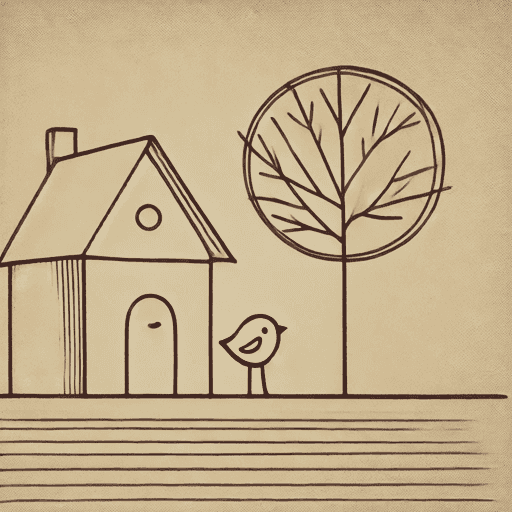
Tomiko Hagio, a university professor of psychology, discusses a drawing with her class. The drawing was made long ago by a former patient, “Little A,” who, at 11 years of age, was arrested for murdering her own mother. It is of a house, a child, and a tree with a bird resting in a hollow in its trunk. Hagio uses the features of this drawing to explain why she was confident that the child could be rehabilitated. Today, she assures the class, Little A is a success story: a happy woman and a mother.
Two college students, Shuhei Sasaki and his friend Kurihara, investigate a strange blog they find online. It is from the perspective of a young husband using the pseudonym “Raku” and tells the story of his wife’s death in childbirth. The blog includes several drawings by Raku’s wife, Yuki. Eventually, the two students realize that these drawings can be layered over one another to create a distressing image that seems to predict Yuki’s death during a cesarean section. They speculate that Yuki may have died due to medical negligence or even murder. Kurihara promises Sasaki that, should he find out anything more, he will be sure to let Sasaki know.
Roughly a year later, a woman named Naomi struggles both emotionally and financially as she tries to raise a young child called Yuta following his father’s death. Naomi’s worries grow when she becomes convinced that a man is following her—and then Yuta disappears. Security footage from her apartment building reveals that the man did not take Yuta. Yuta’s nursery school teacher describes Yuta drawing a triangle with his family name beneath it and then hastily changing the drawing to cover up the triangle. Naomi realizes that what Yuta was drawing is his mother’s grave marker.
Naomi hurries to the cemetery, where she finds Yuta wandering and looking for his mother’s grave. It emerges that Naomi is actually Yuta’s grandmother, although Yuta calls her “Mama.” His birth mother was Yuki Konno—the same Yuki from the blog that Sasaki and Kurihara read. His father was Naomi’s son, Haruto, who used the pseudonym “Raku” when writing his blog. Naomi is relieved to find Yuta and takes him home and puts him to bed. That night, however, the man who has been following them appears at Naomi’s door. Determined to keep herself and Yuta safe, Naomi stabs the man in the belly. As he falls to the floor, she thinks that he looks familiar to her.
In a flashback to 1992, an art teacher named Yoshiharu Miura is murdered while camping on a mountain near his home. Miura is found in the morning, but based on his stomach contents, the police believe that he died at about five o’clock the night before. Along with his body, they find a drawing of the mountain scenery near Miura’s campsite. The three suspects in the case are Miura’s widow, his friend Toyokawa, and one of his students, Yuki Kameido. The case is still unsolved in 1995, when a young newspaper employee, Shunsuke Iwata, asks to be allowed to reopen the investigation.
Iwata interviews Kameido and learns of her suspicions of Toyokawa. She explains that, after Miura’s death, she spent time helping the widow care for her young son; Toyokawa frightened Miura’s wife and made sexual advances on her. Iwata decides to recreate Miura’s movements; on the anniversary of the murder, Iwata hikes up the mountain and camps in the same spot. When he gets there, he realizes that at that time of night, it would have been too dark for Miura to see the scenery he drew. He concludes that Miura actually died in the morning, after his killer forced him to eat a second meal identical to the one he had had the day before, thus confusing the time of death and creating a false alibi.
That night, Iwata wakes to find that he has been tied up in his sleeping bag. He realizes that Miura must have drawn the mountain scene with his hands inside his sleeping bag; it also must have been drawn from memory, not by looking out at the actual scenery. The real killer, Miura’s wife—Naomi Konno—recreates her earlier murder of Miura by forcing Iwata to eat a meal identical to his previous day’s lunch and then battering him to death with a rock. Just before he dies, Iwata creates his own version of the mountain drawing. A few days later, there is a newspaper announcement that Toyokawa has died by suicide after leaving a note claiming responsibility for Miura’s murder.
The novel then returns to Naomi’s confrontation with the “stranger”—actually Isamu Kumai, Iwata’s former boss, who worked on the Miura case himself as a reporter. Diagnosed with cancer, Kumai decided to provoke Naomi into stabbing him so that she could finally be brought to justice for one of her crimes.
Naomi is now in prison, where she reflects on her past. Naomi’s mother became abusive after the death of Naomi’s father; when she threatened to kill Naomi’s pet bird, Naomi instead murdered her. She is thus Little A, the case study in Hagio’s class. Later in life, she married Miura but grew angry about his domineering behavior toward their child, Haruto, and killed him. In Miura’s final moments, he helped fake his time of death by drawing the picture; he knew that his wife was his killer but didn’t want to leave their child without either parent. Naomi would go on to murder Iwata in the same manner, framing Toyokawa for the crime in retaliation for blackmailing and raping her. Finally, she engineered Yuki’s death by replacing her blood pressure medication with salt, triggering a brain aneurysm, all because she wanted to be Yuta’s mother, not grandmother.
Kumai survives the stabbing, and while he is in the hospital, he meets a patient with a broken leg, Kurihara, who never stopped investigating Yuki’s case. He now persuades Kumai to start cancer treatments so that he can become Yuta’s guardian.

Unlock all 51 pages of this Study Guide
Get in-depth, chapter-by-chapter summaries and analysis from our literary experts.
- Grasp challenging concepts with clear, comprehensive explanations
- Revisit key plot points and ideas without rereading the book
- Share impressive insights in classes and book clubs