Strange Pictures
51 pages • 1-hour read
Uketsu, Transl. Jim RionStrange Pictures
A modern alternative to SparkNotes and CliffsNotes, SuperSummary offers high-quality Study Guides with detailed chapter summaries and analysis of major themes, characters, and more.
Symbols & Motifs
Content Warning: This section of the guide includes discussion of death, death by suicide, child abuse, physical abuse, emotional abuse, and animal cruelty.
Horror Within the Everyday
Japanese horror often emphasizes the darkness that can lurk within the everyday things people take for granted. Strange Pictures incorporates this as a motif that runs throughout the story. Over and over, seemingly ordinary people reveal themselves to be hiding a threatening side, conventional activities turn out to be terribly dangerous, and apparently benign objects hide horrific secrets.
Many everyday objects in the story turn out to be something much darker than they appear. Yuki’s blood pressure medication turns out to be salt pills that spike her blood pressure and ultimately contribute to her death. Raku’s blog has a cheerful, innocent tone, but it hides a terrible secret. Six-year-old Yuta’s drawing of his apartment building hides a drawing of his mother’s grave. Miura’s drawing of a beautiful mountainside view is secretly a cover-up of his wife’s involvement in his murder.
Miura’s trip up the mountainside is an example of an ordinary activity that turns out to be deadly. He is simply trying to hike, camp, and enjoy nature, but he ends up getting brutally murdered. Yuki’s pregnancy is another example of this. She is overjoyed and excited about becoming a mother, but she ends up dying in childbirth.
Many characters in the story have hidden dark sides. Naomi is a former midwife and an apparently loving mother and grandmother, but she is also a multiple murderer. Naomi’s own mother gave the appearance of loving and caring for Naomi as long as Naomi’s father was alive, but as soon as the father was dead, her real nature emerged in her ongoing physical and emotional abuse of Naomi. Both the teacher Miho Haruoka and reporter Isamu Kumai’s mother are characterized as people who hide terrible and frightening aspects of themselves. Behind the caring teacher’s public face is the “frightfulness of an ogre” (78), and behind Kumai’s mother’s jolly laughter is “the face of a devil” (210).
The motif contributes to the novel’s tension, as it is never clear which narrative elements may reveal a hidden dark side. Beyond this, however, it supports the theme of The Violent Contradictions of Parental Love, as parenthood itself emerges as the central example of unassuming horror.
Jumping to Conclusions
Strange Pictures features many characters who form firm but mistaken convictions based on limited evidence. Tomiko Hagio believes that Naomi is not a threat based on one drawing Naomi made at 11 years old. Based on Yuki’s drawings, Sasaki and Kurihara believe that Yuki had a psychic premonition of her death and that a doctor murdered her. They assume that Raku’s address to “the one [he loves] most” must be directed at Yuki and that she must have committed some grave offense (16). The police investigating Miura’s death rely too heavily on his stomach contents and jump to the conclusion that Naomi could not have killed him. Miho Haruoka looks at Yuta’s drawing and jumps to the conclusion that Naomi is abusing the child. Several of these examples illustrate the theme of How Perspective Shapes Perception; Hagio, for example, is so confident in her professional abilities that it does not even occur to her to question her reading of the drawing.
The story’s diagrams and its illustrations are also a part of this motif. The mistaken conclusions characters reach based on their interpretations of drawings support the novel’s theme of Artistic Creations as an Opaque Window into the Mind by showing how erroneous these interpretations can be. The story’s diagrams are documents of the characters’ thought processes and often contain the same errors as their thinking—ironically codifying these errors by encoding them into an authoritative-looking format. These diagrams make it especially clear that significant errors can occur when people reach conclusions based on limited evidence.
The Bird in the Tree
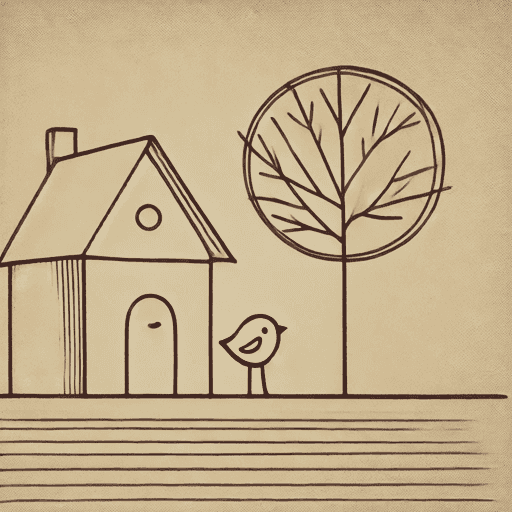
When Naomi is 11, she draws a picture of a bird sitting in a hollow in a tree trunk. This drawing is a part of a psychological exam administered after Naomi kills her own mother. The psychologist in charge of the exam, Hagio, concludes that Naomi is trying to communicate her desire to nurture and protect—to “defend the weak, and to create a safe haven for them to live in” (8). Hagio’s dissection of Naomi’s drawing establishes the bird in the tree as a key symbol within the text, but Hagio’s own understanding of what the bird means is not as nuanced as it needs to be.
Hagio believes that the bird in the tree simply represents Cheepy, the Japanese finch that Naomi keeps as a pet, and that Cheepy symbolically stands in for “the weak.” However, Naomi’s portrait of the bird is pure white with the exception of its beak. In reality, the Japanese finch is a gray bird with a black face and bright yellow beak. The black-and-white drawings in the text cannot convey this full range of colors but could, if desired, convey the bird’s coloration in grayscale. That Naomi’s picture is not a literal depiction of Cheepy foreshadows the limitations of Hagio’s interpretation.
Moreover, the whiteness of Naomi’s bird stands out against the dark hollow in the tree trunk surrounding it and suggests a connection to the whiteness of the clothing that Naomi wears in Yuki’s drawing. White is a symbolically complex color in Japan. In some contexts, it represents purity and innocence. For most of her adult life, Naomi considers her motives for killing other people to be pure. She cannot face the idea that she is not still the innocent child being abused by others—that she herself is now the source of danger. However, white is also appropriate given the truth of who Naomi is because, to Japanese Buddhists, the color white represents death. The bird in the tree is thus a symbol of Naomi herself. Coupled with Hagio’s interpretation, this hints that Naomi’s actions throughout the text are as much self-protection as they are a selfless defense of others.
Naomi’s suffering at the hands of her mother makes her conflation of herself with Cheepy a natural one. She killed her mother when her mother was trying to squeeze the bird to death. For some time, Naomi had felt squeezed to death by her mother’s abusive grip on her. Understanding the bird in the tree as both a symbol of innocence needing protection and a symbol of Naomi herself makes her subsequent actions more comprehensible. As an adult, Naomi repeatedly tells herself that her murders are meant to protect children too weak to defend themselves, but by the end of the story, she is finally aware that her murders were also selfish, meant to defend herself.

Unlock the meaning behind every key symbol & motif
See how recurring imagery, objects, and ideas shape the narrative.
- Explore how the author builds meaning through symbolism
- Understand what symbols & motifs represent in the text
- Connect recurring ideas to themes, characters, and events