Strange Pictures
51 pages • 1-hour read
Uketsu, Transl. Jim RionStrange Pictures
A modern alternative to SparkNotes and CliffsNotes, SuperSummary offers high-quality Study Guides with detailed chapter summaries and analysis of major themes, characters, and more.
Themes
Content Warning: This section of the guide includes discussion of death, death by suicide, bullying, graphic violence, and child abuse.
Artistic Creations as an Opaque Window into the Mind
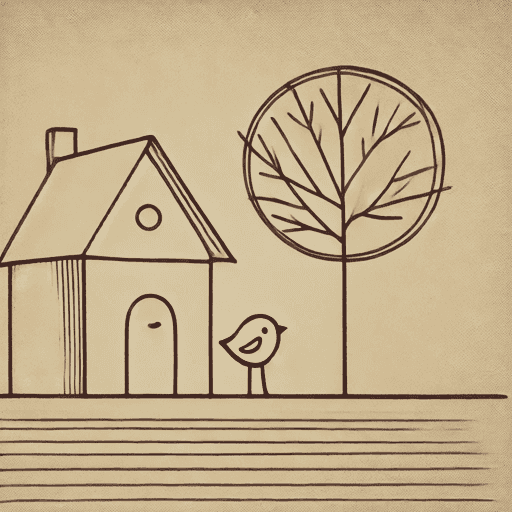
Strange Pictures is structured around the investigation into four main drawings: Naomi’s childhood drawing of the house, child, tree, and bird; Yuki’s drawing of her own death in childbirth; Yuta’s drawing of his apartment building; and Miura’s drawing of a mountainside view. Each drawing is analyzed by people with varying degrees of expertise, but most are only partially understood. The novel posits that artistic creations such as these, upon careful analysis, do offer a glimpse into the mind of the artist, but they are not fully transparent representations of the complexity of the artist’s mind.
In keeping with this, the novel’s investigations are not entirely fruitless; however, they do run up against dead ends. Iwata and Kumai eventually realize that Miura’s drawing is meant to create a false impression of his time of death, but they are never able to understand his intentions for creating it. Sasaki and Kurihara eventually realize how Yuki’s drawing should be put together and see that it predicts her own death in childbirth, but they have no understanding of how she might have arrived at this conclusion or why she would not have spoken up to save herself. Such gaps in understanding point to the ambiguity of human motivations. Pictures provide clues to immediate actions and goals but not to underlying thoughts and feelings.
Tomiko Hagio’s character arc and her misunderstanding of Naomi’s drawing offer the most obvious support for the novel’s contention that artistic representations are at best an opaque window into the artist’s mind. In the Prologue, Hagio claims that “Painting is a mirror of the soul” (5). Her metaphor is intended to suggest that the drawings and paintings she analyzes as part of her work in psychology are clear and accurate representations of a person’s internal world. This belief makes her confident in her interpretation of Naomi’s drawing. She believes that the bird in the hollow of the tree with spiky branches is a symbolic representation of Naomi’s “desire to protect” and her “tendency toward strong nurturing love” (8). Naomi goes on, of course, to kill her husband, a reporter, her husband’s longtime friend, and her own daughter-in-law; she also attempts to murder a second reporter. Although Naomi frames most of these murders as necessary to protect children—Haruto and Yuta—it becomes clear by the time she kills Yuki that her real desire is to protect her own vision of herself as a mother. This points to the flaw in Hagio’s mirror metaphor; art does provide a glimpse of the artist’s mind, but much as a mirror reverses what it depicts, art presents the artist’s mind in slightly transposed form.
Ironically, each drawing itself contains clues that suggest it is not transparent in a straightforward way. Naomi’s drawing features a house with no doors, suggesting that she is deliberately hiding her interior world. Yuki’s drawing is divided into layers so that it cannot be readily understood. Yuta’s drawing is smudged and later turns out to have been constructed and reconstructed in stages to obscure its original intent. Miura’s drawing is, in the end, revealed to be a deliberate falsehood. The presence of these hints underscores the problem of interpretation, as those who see the drawings fail to grasp even that their basic premise—that the drawings are in some sense “straightforward”—is incorrect.
The Violent Contradictions of Parental Love
Throughout the novel, parents and parental figures struggle with their love for the children they are meant to guide and protect. The story shows that the intense love parents have for their children is not always as selfless as it appears to be and (even when it is) can be violent in its strength.
As the center point that ties the various parts of the story together, Naomi’s maternal instinct is the most prominent example of this theme. Naomi clearly loves both Haruto and Yuta. Her son and grandson occupy most of her thoughts and motivate many of her actions. This love is particularly important to her because she did not feel that her own mother genuinely loved her, and she intends to use her motherhood as a way to erase this legacy. This same fact, however, introduces a selfish note to Naomi’s maternal feelings, as well as an element of rage—the same rage that led her to kill her mother. This explains why, when her daughter-in-law becomes pregnant, Naomi feels a deep jealousy, thinking “I want to be a mother forever. I never want to lose the right to that name, Mother” (221). This jealousy eventually spills over into violence as Naomi plots her daughter-in-law’s death, reinforcing the ambivalence of Naomi’s feelings.
Indeed, the irony is that all of Naomi’s worrying and her efforts to protect Haruto and Yuta lead to terrible consequences for her children. Near the end of the novel, she finally recognizes that her deep love for Haruto often prevented her from seeing what was actually in his best interest: “She had surely loved Haruto more than anyone, done more for him than anyone, but in doing so she had stood in the way of his independence. It was as if his umbilical cord had never been cut” (223). Her devotion to the idea of herself as a mother and her all-consuming love for Haruto and Yuta lead to several murders, as well as Haruto’s death by suicide and Yuta’s placement in an orphanage.
The novel suggests that these contradictions are inherent to parenthood. Naomi points out that “Giving birth is not some beautiful sacred rite, as so many men seem to imagine. It is hours of tears and screaming, enduring pain and suffering with death always near, all to force a baby from your body” (192). Here, Naomi depicts giving birth as a brutal and traumatic experience; that mothers endure it for their children’s benefit merely further intertwines violence and selfless love. This ambivalent experience continues as the child grows older. Naomi argues bitterly with her husband about how to raise Haruto and is terrified at the thought of losing custody in a divorce. She snaps at Yuta when he draws on the linoleum and then struggles to collect herself enough to be gentle with him. She worries about the money it takes to raise children. She becomes furious with Yuta’s teacher when the woman mistakenly accuses her of child abuse and is overwhelmed with terror when the child temporarily goes missing. Parenting is thus as much a source of anxiety and anger as it is joy.
The idea that an institution like parenthood—one that society considers not only “normal” but laudable—might have a hidden dark side is typical of Japanese horror, which often emphasizes the hidden psychological terror that can lurk within ordinary domestic scenes. Toward the end of the story, Kumai recalls an incident in which his usually cheerful mother “lost her mind” when another child bullied Kumai (221). He believes that she was seconds from assaulting the other child’s father, and he wonders “what made his own mother and Naomi different?” (221). In the end, he is forced to realize that there is not much—if anything at all—separating a parent like Naomi from any other parent in the world. The mingled fear, pain, and love that define parenthood can spill over into violence at any moment, the novel suggests.
How Perspective Shapes Perception
The story’s illustrations, characterizations, plot, and structure work together to demonstrate that people’s interpretations of the world around them are heavily influenced by their own natures and circumstances. Without wholly dismissing the idea of an objective reality, the novel suggests that accessing the truth requires piecing together multiple perspectives.
The characters within the story undergo radical perception shifts as their perspectives change. Tomiko Hagio is a prominent example of this: Her understanding of Naomi and her art is initially grounded in professional confidence but changes dramatically after she learns of Naomi’s adult career as a serial killer. Similarly, Haruto cannot see his mother for who she really is and cannot understand the danger his wife is in because he remains mired in his childhood perspective. When he finally decodes Yuki’s drawing, his perspective shifts, and he at last understands the devastating truth about Naomi. In both cases, perception changes once the characters learn to step outside their own preconceptions.
Self-perception is, if anything, particularly prone to distortion. Naomi has always seen herself as a wonderful mother who does everything she does to protect the children in her care. Faced with the devastating consequences her actions have had for Haruto and Yuta, however, she has to admit that “she had committed murder for her own selfish reasons” (221). Similarly, Miura believes himself to be a selfless man, entirely devoted to his family, friends, and students, yet his family, friends, and students find him to be self-centered and callous. When Miura sees Naomi looming above him, ready to kill him, he views this as “a sight that [turns] his entire life into a lie” because he suddenly realizes that his perspective and his wife’s perspective are entirely opposite (110).
Chapter 3 literalizes the theme by setting Miura’s murder on a mountainside and making the piece of art being investigated a view from that mountainside. When Iwata is at the newspaper office or at home looking at the drawing, he cannot see its significance at all, and he comes up with several false theories about what it means. As soon as he actually stands on the mountainside, however, his new perspective gives him a more accurate perception of the drawing. In this most obvious example of how perspective shapes perception, Iwata must literally stand in the place of the man he is trying to understand and see the world from his perspective.
Strange Pictures has an unusual structure that supports this theme; Its part-divisions suggest a traditional five-act plot, but these parts are not in chronological order, and the storyline is fragmented into a Prologue and four distinct chapters, each with its own protagonist facing an individual central conflict. The reader—like a detective—must piece together the main story from these seemingly disparate subplots. Each new subplot offers the reader new information and shifts the reader’s understanding of what is really happening at the heart of this novel by inviting them into a different character’s perspective. Only in this way does the truth emerge.

Unlock every key theme and why it matters
Get in-depth breakdowns of the book’s main ideas and how they connect and evolve.
- Explore how themes develop throughout the text
- Connect themes to characters, events, and symbols
- Support essays and discussions with thematic evidence