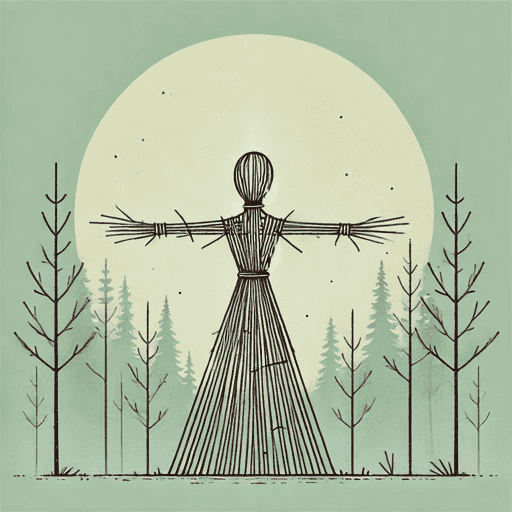
The Empusium: A Health Resort Horror Story
58 pages • 1-hour read
Olga Tokarczuk, Transl. Antonia Lloyd-JonesThe Empusium: A Health Resort Horror Story
A modern alternative to SparkNotes and CliffsNotes, SuperSummary offers high-quality Study Guides with detailed chapter summaries and analysis of major themes, characters, and more.
Chapter 13-EpilogueChapter Summaries & Analyses
Chapter 13 Summary: “Ghosts”
In late October, Thilo’s condition worsens. He is confined to bed and Wojnicz can only visit him sporadically. When possible, he sits for hours beside Thilo’s bed in “a sort of everyday melancholy” (238). He studies the De Blas paintings, becoming increasingly fascinated by the details. Thilo seems resigned to his imminent death. He asks Wojnicz to inherit the De Blas painting stolen from his parents’ house. Gradually, Thilo’s empty seat is taken away from the dinner table.
When Wojnicz begins to feel sick himself, he realizes that he had rarely felt ill until he arrived in Görbersdorf and Dr. Semperweiss “discovered an illness in him” (241). This mystery illness is akin to a mysterious process that is changing Wojnicz from within. At the dinner table, the usual conversations take place. Wojnicz rarely speaks, even when he is addressed. Raimund no longer cooks the meals, as Opitz orders them from the local women. Each night, however, the familiar bottle of Schwärmerei appears “from nowhere” (242), and the men begin to drink from it.
One evening, the guests discuss folklore, legends, and ghosts. August insists that devils exist, whereas Lukas takes up the contrary position. They debate the metaphysical existence of the supernatural. August refers to “all these local Tuntschis and Empusas” (246) as evidence of the power of the supernatural. The conversation is briefly interrupted by the wind blowing open a window. This gives Wojnicz a chance to speak, asking for clarification from Lukas as to why, if devils do not exist, he insists that humans must fight them. Lukas insists that humanity should take control of its devils to eradicate them, which prompts further disagreement from Frommer.
Over the coming days, Wojnicz explores the increasingly familiar forest paths. He visits Thilo twice a day. August seems keen to “take possession” (248) of Wojnicz, so waits for him in the dining room. Proposing that they walk together, he produces a small bottle of Schwärmerei for them to drink together. August hints that he has learned Wojnicz’s secret, noting that “those like you were drowned in the sea” (249) in the ancient world.
At Opitz’s suggestion, the guests take a trip up the mountain. They sit and drink local liqueurs with the innkeeper, whom Opitz treats with polite deference. They eat and talk about the importance of traditions. The innkeeper invites the guests to compare Opitz’s Schwärmerei to his own. Wojnicz tries to describe the differences, but he is distracted by the innkeeper’s explanation of how they prepare a local dish by terrifying young rabbits into having heart attacks. Wojnicz, feeling “the uttermost disgust and despair” (253), steps outside to vomit up his lunch.
Back at the guesthouse, he explores the attic and finds that mushrooms are growing. He gathers these instinctively but returns to his room, determined not to tell the other guests about the bounty he has found.
Chapter 14 Summary: “A Temperature Chart”
The incident with the rabbit hearts prompts Wojnicz to stop drinking Schwärmerei. He feels that the drink disturbs his “nerve function and concentration” (256); he has felt time and space slipping by him in confusing ways. He plans to pretend to drink.
November begins and rain falls. Wojnicz tries to avoid August, Lukas, and Frommer by taking long, solitary walks through the mountain paths in spite of the weather. The Kurhaus building always looms large over him, prompting him to reflect on individual moments from his life, such as the sight of his father in tears. However, he has begun to grow distant from himself and now struggles to relate to memories of his old self. Even when he wonders whether he might ask his fellow guests about his unanswered philosophical questions, he remembers that they have no interest in discussing anything other than their own interests. He is visiting Frau Opitz’s room more often. These visits are different now; he dresses in her clothes, examining himself in her skirt as a way of understanding “this version of Wojnicz” (261). Then, he undresses and exits the room.
As Thilo lies in bed, he seems greatly changed. The jagged line of his temperature chart, he notices, aligns perfectly with the jagged landscape of the mountain range glimpsed through the window. The landscape in this place, Thilo believes, kills people instead of curing them. He tells Wojnicz that his beloved friend György will soon visit. The only people he does not want to see are his parents. He insists that Wojnicz must take the painting that he stole from his family. Wojnicz meets György, then leads him to Thilo’s room. After leaving them alone, Wojnicz passes a nurse who refers to Thilo and György disparagingly as “homosexuals.”
The next day, Thilo is dead. Wojnicz sees strangers attend to the body. He covers himself with his blankets, unwilling to talk to anyone. He remembers his promise to Thilo and fetches the painting. Trying to feign sleep, Wojnicz sees bright lights outside the windows. He blames the effect of the Schwärmerei. Eventually, he dresses and goes outside. He passes the Russian church and studies the artwork.
Back at the guesthouse, he is assailed by August, who is excitedly insisting that György take a glass of Schwärmerei. Wojnicz lies to György, saying that he does not know about any family heirloom Thilo may have left for him.
Chapter 15 Summary: “The Weakest Spot in the Soul”
Wojnicz is once again in Dr. Semperweiss’s examination room. He can delay no longer, as the doctor insists that he strip bare to be examined. He anxiously waits for the doctor to reduce him “to an anomaly” (270), only for Dr. Semperweiss to congratulate him and tell him to dress himself. Dr. Semperweiss talks about the need for Wojnicz to create his own identity. Since, as an intersex person, he does not adhere to society’s expectations, he should create his own story that fits him perfectly. He encourages Wojnicz to treat his anomaly “as the minor ailment” (271) that he has in his lungs. Wojnicz has learned to hide the physical manifestations of his intersex identity. Since the doctor is saving his life, however, he believes that Dr. Semperweiss has a right to know the truth.
Dr. Semperweiss flits between addressing Wojnicz as a man and as a woman. He talks about the human tendency to ascribe genders to most things, particularly in gendered languages such as German and Polish. Dr. Semperweiss urges Wojnicz to define himself by his strengths, not this medical condition that Wojnicz regards as a defect or a weakness. Wojnicz struggles to untangle the complexity of what is happening. He feels distant from himself. He states that he is “not normal” (274) and wonders whether he would do better to die in this small town. His father sent him here to die, he believes. Dr. Semperweiss assures Wojnicz that there are many people like him. Wojnicz, he says, represents the idea that the world is not so simple, nor so black-and-white. Wojnicz is an explosive repudiation of the twin dangers of humanity: Hypocrisy and conformism. He believes that Wojnicz will be well enough to return home for Christmas.
Wojnicz returns to the guesthouse in a state of elation. He passes the café and stops to buy sweets, whereupon he meets Frommer. He joins Frommer, who warns him to “get away from here” (276) as fast as he can. Frommer explains the findings of his investigation. The Tuntschi, Frommer says, are sure to have noticed Wojnicz. The Tuntschi want young men. The locals understand this and, for many years, they sacrificed young men to the Tuntschi. Previously, they did this with people from their own community. Since the opening of the sanatorium, however, there has been a steady supply of sick young men who can be sacrificed to the Tuntschi without anyone noticing, since the tuberculosis makes their deaths easy to explain. This “occasional sacrifice” (281) satisfies the Tuntschi. Frommer has been willing to give up his whole life to find out the truth. Wojnicz and Frommer sit in silence.
Chapter 16 Summary: “A Person in One Shoe”
Raimund leads Wojnicz on a trek through the forest. Wojnicz is hesitant to follow the strange young man, but Raimund insists that Opitz wants to show Wojnicz something “very important” (282). As Wojnicz assures himself that he will return to the guesthouse, Raimund whistles. A group of charcoal burners appear and seize Wojnicz. He immediately knows what is happening. He is reminded of his attempts to make friends with boys in his childhood. At first, they would regard him as one of them until one of them “discovered Wojnicz’s anomaly” (283), whereupon they turned on him.
Wojnicz has almost expected the locals to turn on him and to punish him. He has long believed that he should hide himself. He tries to fight back against the charcoal burners, but they are too strong. He remembers his father’s advice to hide himself away from others and to keep a distance. The charcoal burners force him to drink from a bottle of Schwärmerei. They strip away his clothes, and Wojnicz can visualize his body parts in their exaggerated, anomalous form.
Wojnicz hears strange sounds, coming closer. The faces of the charcoal burners grow pale. They run away, shouting “they didn’t take him” (286). They run back to the town in panic, calling out about the chairs. Wojnicz struggles to free himself. He sees figures emerging around him, “supple figures, part human, part animal” (286). The forest itself seems to come alive as he is surrounded by faces. With great effort, Wojnicz frees a hand. He is shaking and covered in blood. The narrator describes Wojnicz’s struggles, but says that he “froze still when he saw us” (287). Wojnicz is face-to-face with a Tuntschi, which is joined by many others. Wojnicz’s terror fades as he realizes that they mean him no harm. Wojnicz reaches out to touch the face of the Tuntschi, as his “uterus clenches like a fist, but the member swells with blood” (288).
Wojnicz is free. He wanders down the hill, half-naked and blood-soaked, without shoes. He weeps; all he wants is to cover himself. In the town, he sees a crowd of patients from the sanatorium in “a bewildered manner” (289). Among the crowd he sees August, Lukas, and Frommer. The crowd is all men, Wojnicz realizes. The women are all elsewhere. He totters to the guesthouse, feeling “shame and fear that somebody might see him like this” (290). He tries to clean himself, his mind fraught with memories of similar experiences. He refuses to allow himself to cry, refusing to allow his old unhappiness and alienation back into his life.
Above him, he hears a sound. He goes to the small room above his, where Opitz is strapped into a chair to stop himself from joining the procession of men outside. Opitz urges Wojnicz to untie him, though he is shocked to see Wojnicz, who is “meant to be gone” (291). Wojnicz loosens the tightly pulled straps. Raimund tied him up, Opitz explains, because he told him to do so. Wojnicz realizes that the local men of the town tie themselves to these chairs so that they will not be lured outside or swept up in the frenzy.
Wojnicz will not free Opitz until he has the whole story. Wojnicz was chosen for the sacrifice as a last resort. Thilo had been selected, but he died too soon, so Wojnicz was chosen in his place. Opitz asks where is “the harm in condemning a terminally sick person to death to save the fit ones?” (293). Someone from the village has always been killed, Opitz remembers, until the old, sick patients began to arrive for the sanatorium. They were chosen for sacrifice to the Tuntschi, and Dr. Semperweiss was made to forget with the Schwärmerei.
Opitz demands that Wojnicz free him. He must join the procession outside, he says. Wojnicz is saving his life by not untying him. Opitz rants about the sacrifice that saves the whole village and the “ancient order” (293). Wojnicz begins to untie Opitz. As soon as one hand is free, Opitz desperately tries to free himself. He tries to leave the room, still bound to the chair. Wojnicz follows him outside, whereupon he joins the parade of men, some of whom also carry broken strapping on their wrists. Wojnicz calls to Frommer, who cannot seem to respond.
Wojnicz races to the Kurhaus and takes Dr. Semperweiss’s rifle. He fires the gun, but the loud sound does nothing. Wojnicz wonders why he is not submitting to the frenzy in a similar fashion, watching the men walk by in seemingly high spirits. He follows them to the edge of the forest. The men enter the forest as he runs back to the town. There, he finds Raimund strapped into a chair of his own. Wojnicz leaves him. The parade of men disappears into the mists of the forest. Among the crowd, Opitz is chosen and lifted up suddenly. The crowd, soaked in forgetful Schwärmerei, is thankful that they were not chosen to be sacrificed. Opitz’s body falls back to the ground, torn to “bloody shreds” (297).
Snow falls on the town. The men cannot remember how they got home or how they were released from their chairs. A few have scratches and marks to show from their trip into the forest, but they have no memory of what happened. They engage in a large snowball fight. Raimund spends a day greasing his skis.
Meanwhile, Wojnicz tends to his wounds. He notices that children appear in the town; he had never noticed them before. The town is turned into a “fairy-tale picture” (298). Life seems to be carrying on as before. Wojnicz goes to Frau Opitz’s room. He studies himself in the mirror, washes, and then dresses in the dead woman’s clothes. He imagines his future, feeling “plural, multiple, multifaceted, compound and complicated like a coral reef, like a mushroom spawn whose actual existence is located underground” (299). He imagines taking over the running of the guesthouse in Opitz’s place or returning to Lwów.
Dressed in Frau Opitz’s clothes, he exits the house. He takes her passport and, from now on, he will live as Klara Opitz. Wojnicz is helped into her seat aboard a droshky, passing by Frau Weber and Frau Brecht as she leaves the village forever.
Epilogue Summary
After the incident just described, the narrator says, nothing similar ever happened again. Instead, “the war satisfied our cravings” (301). Tuberculosis was also practically wiped out thanks to advances in medical science.
Klara Opitz settled in Munich and served in a hospital in World War I, then disappeared. Rumors persisted that Wojnicz once visited the grave of January Wojnicz, dressed in English tweed. Dr. Semperweiss was killed in World War I. Raimund took over the guesthouse until he died of complications from alcohol dependency. The guesthouse was nationalized and eventually turned into four family apartments. Frommer survived World War I but died in the Siege of Breslau. August August died in Görbersdorf in 1914, as did Longin Lukas. They were buried alongside one another. The narrator assures the audience, “[W]e are always here” (302).
Chapter 13-Epilogue Analysis
In this final section, The Empusium builds to a frenzied climax, directly confronting The Tensions Between “Rational” and “Irrational” by breaking down the blurry boundaries between them once and for all. As Wojnicz realizes what the chairs with straps are used for and why men die at the same time each year, he realizes that the carefully constructed, self-proclaimed “rationality” of the male-dominated sphere in this society is an illusion: The men are also driven by irrational impulses, with their annual sacrifice and wild parades reflecting their repressed fears and desires erupting unchecked. Their inability to control their own behavior—with some of the men even freeing themselves from their restraining bonds as though in a trance, even though they know of the danger that awaits them—reinforces the sense that the male inhabitants’ veneer of rationality is a mere façade.
The breakdown between “rational” and “irrational” is also reflected in the narration. The narrative, plural voice of the novel is an embodiment of the supernatural forces that lurk in the woods: The narrative “we” belongs to the Tuntschi, who come to life and have to be placated. While previously in the story the Tuntschi represented the oppression of women, reflecting the objectification and silencing of women in this society, here they appear as a vengeful force determined to push back against patriarchal oppression by turning the tables on the men of the town. The Tuntschi are no longer passive, sexualized objects; instead, they are powerful and inspire a deep, uncontrollable fear in the men. Their appearance before Wojnicz in the forest in a “part human, part animal” (286, emphasis added) form invokes the tales Wojnicz previously heard about local women escaping into the forest and becoming “feral.” They are now transformed into a symbol of the power and strength of women—qualities that the male inhabitants fear and seek to contain in the forest.
The encounter between Wojnicz and the Tuntschi also resolves the text’s thematic exploration of The Societal Construction of Gender. Wojnicz’s intersex body, which before was a source of anxiety for him, here becomes his protection from the Tuntschi, who recognize his female identity and refuse to accept him as a sacrifice. In acknowledging and accepting him for who he is, they empower Wojnicz, who gains a new perspective on the world. Wojnicz emerges from the failed sacrifice with clarity about who he really is and wants to be. He dresses in Frau Opitz’s clothes, finding that they fit him perfectly. At this moment, the narrator switches the gendered pronouns: Wojnicz emerges as Klara. Furthermore, the ease with which the narrator slips between the shifting pronouns gestures at a simplicity of understanding and empathy that so many of the male characters Wojnicz encountered have lacked.
The climax of the novel is followed by a short epilogue, in which the narrator jumps ahead. Following the incident with Wojnicz, the audience is told, there were no more sacrifices to the supernatural forces in the woods. With the onset of World War I, so many millions of men were killed that the Tuntschi found themselves satisfied. The novel implies that such large-scale bloodshed is also a sign of male irrationality, as it leads to widescale death, injury, and senseless destruction—a marked contrast with the rational, ordered world the men at the sanatorium believed they had been building. In ending with the assurance “we are always here” (302), the Tuntschi also assert the irrepressible female presence that the male inhabitants have continually tried to suppress and marginalize throughout the novel, suggesting that the Tuntschi—and the town’s female inhabitants—ultimately refuse to be entirely erased.
The novel also addresses The Complexities of Identity a final time in leaving the rest of Wojnicz’s/Klara’s life ambiguous and open-ended. Wojnicz/Klara’s character is not fixed: She left the town as Klara, but when glimpsed at his father’s grave, for example, he was dressed in English male clothing. Wojnicz/Klara thus shifts between nationality and gender, living according to his/her own preferences instead of living within the social and ideological restraints previously imposed upon him/her by others.

Unlock all 58 pages of this Study Guide
Get in-depth, chapter-by-chapter summaries and analysis from our literary experts.
- Grasp challenging concepts with clear, comprehensive explanations
- Revisit key plot points and ideas without rereading the book
- Share impressive insights in classes and book clubs