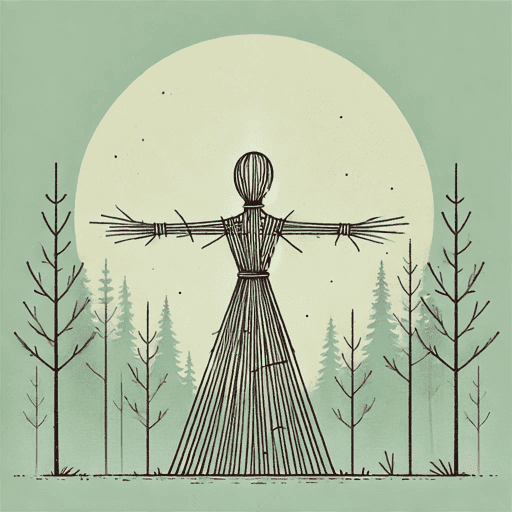
The Empusium: A Health Resort Horror Story
A modern alternative to SparkNotes and CliffsNotes, SuperSummary offers high-quality Study Guides with detailed chapter summaries and analysis of major themes, characters, and more.
Summaries & Analyses
Quizzes
NEWReading Tools
Games
Chapters 1-4Chapter Summaries & Analyses
Chapter 1 Summary: “The Guesthouse for Gentlemen”
Content Warning: This section of the guide discusses death by suicide and misogyny/gender discrimination.
In 1913, Mieczysław Wojnicz, also known as Mieczyś, arrives in a remote town in Lower Silesia. Wojnicz was born in 1889. He is a Polish Catholic, now studying engineering at Lwów Polytechnic. As he walks through the station, he feels that he is being watched. The high altitude, however, helps his “enfeebled body” (3). He is driven to Görbersdorf, a health sanatorium in the town founded by Dr. Hermann Brehmer and run by Dr. Semperweiss. The sanatorium is one of the first facilities to treat tuberculosis. As Wojnicz studies the town from his carriage, he suffers from a familiar coughing fit.
He is met by Wilhelm Opitz, also known as Willi. Opitz is the proprietor of the Guesthouse for Gentlemen in Görbersdorf. Wojnicz will stay in Opitz’s guesthouse until a vacancy opens up in the main Kurhaus facility. The next day, he is awoken by the sound of a bugle. His “various conditions” (7) have bothered him for many years. His father, January Wojnicz, a civil engineer and landowner, managed his son’s afflictions with gravity and tact. January Wojnicz was devoted to his son, but this love was “devoid of any sentimentality or any of the ‘female emotions’ that he so abhorred” (7). Wojnicz has always felt paranoid and insecure. He writes a short letter to his father, mainly about the meals he has eaten on his journey. Following a knock on the door, an unseen woman leaves breakfast for him on a tray. He eats the food and then prepares for his day.
Wojnicz has an examination at the Kurhaus. First, he explores his new temporary home and remembers his old doctor’s efforts to “tackle his apathy” (12). The first person he meets is a fellow guest named Walter Frommer, a theosophist and privy counselor from Breslau. Their “awkward silence” (13) is interrupted by the arrival of Wilhelm Opitz, who entrusts Wojnicz into the care of his young assistant, Raimund, who will take him up to the Kurhaus. They walk through the town, passing two elderly women named Frau Weber and Frau Brecht, as they reach the sanatorium.
In the doctor’s waiting room, Wojnicz reads the available literature and learns more about the unique geography of Görbersdorf that gives the area such restorative qualities. Wojnicz frets about how to hide his “shameful affliction” (16) from the doctor. He meets Dr. Semperweiss, who examines Wojnicz. He diagnosis Wojnicz with a mild case of tuberculosis, which can be cured by the mountain air so long as Wojnicz is willing to “yield to the treatment regime” (18).
Wojnicz learns more about Dr. Brehmer and this treatment regime. He will remain at Opitz’s guesthouse for the time being, while travelling each day to the Kurhaus for treatment. When a vacancy opens in the sanatorium, Wojnicz will be moved out of the guesthouse. By sticking to rules such as regular exercise and no drunkenness, Wojnicz has a good chance of being one of the 75% of patients who “return to good health” (22).
Chapter 2 Summary: “Schwärmerei”
Wojnicz returns to the guesthouse. He is told to record his treatments in a small notebook, including long walks through the mountains and regular meals. The door of the guesthouse is open, and Wojnicz wanders inside. He discovers a human body: It is Klara, Willi Opitz’s wife. She has been laid out on a table after dying by suicide. Wojnicz is petrified, realizing that this is the same woman who—just a few hours earlier—had brought him breakfast.
Opitz appears behind him, explaining that Raimund has been sent to fetch the authorities who will take her body away. Wojnicz is “badly shaken” (29). Klara Opitz, he realizes, reminded him of his nanny, Gliceria. In his memories, Gliceria always appears as a wrinkled old woman. With his mother dead and his father emotionally distant, the young Wojnicz grew very close to Gliceria. His father abhorred any kind of “soft upbringing that encouraged girlishness, mawkishness and passivity” (30). In contrast to his pragmatic, serious father, Gliceria indulged the young Wojnicz. Seeing the dead woman, Gliceria suddenly comes “back to him in all the forms and details that constitute the essence of a woman, such as pleats, wrinkles, frills, bodices, yokes and lace—the entire heathen world of materials designed to cover the female body” (33).
Wojnicz decides to go out. Walking through the town, he passes the small churches and large houses. The town has been redeveloped to cater to the wealthy patrons of the sanatorium. The edges of the town give way to dense forests and mountain trails. Later, Wojnicz returns to the guesthouse for supper. He joins the five other guests, as well as Opitz himself. The narrator introduces the audience to the guests via their shoes, as Wojnicz introduces himself to his fellow diners.
As well as Frommer and Opitz, there is Longin Lukas (a Catholic traditionalist and gymnasium teacher from Königsberg), August August (a socialist-humanist, classical philologist, and writer from Vienna), and Thilo von Hahn (a student of the Beaux-Arts and connoisseur of the landscape from Berlin). They dine at the table where “only a few hours ago the body of Frau Opitz had been lying” (37). August offers his sympathies to Opitz and, in his speech, assures the guesthouse owner that “life must go on” (38).
Opitz apologizes for the food; since Klara was the cook, Raimund has been drafted in to cook this meal. The men discuss the unknowability of women, as well as the differences between men and women. The female brain, Lukas insists, “is quite simply smaller” (39) than male brains. The guests ask Opitz what might have caused his wife’s death, but Opitz does not know. She may have been homesick for her Czech homeland, he suggests. Wojnicz tries to join the philosophical conversation but gags on his food.
Eventually, the meal is put aside and Opitz fetches a bottle of the local liqueur known as Schwärmerei. The men drink Schwärmerei, which is “sweet and bitter all at once” (42). It has a calming, clarifying, intoxicating effect which Wojnicz cannot quite explain. They resume their debate. Thilo becomes bored and retires for the night. Wojnicz continues to drink as the guests top up his glass. When he is “mildly intoxicated” (43), he feels as though the whole room looks different.
The guests continue to talk about women and philosophy. Wojnicz would like to join their discussion about the decline of the West, but he is seized by “the weakness of timidity” (44). Instead, he sits and sighs, which is where the narrator leaves the scene.
Chapter 3 Summary: “Pheasant Distance”
When Wojnicz does leave, he has the feeling that he has “unwittingly ended up in a war of some kind” (45). On the way to his bedroom, he hears strange noises from the attic. As he ponders the sound, Thilo drags Wojnicz into his bedroom.
Thilo is evidently sick; he is pale and trembling. Nevertheless, he warns Wojnicz that this is “a nasty place” (46). He suspects that Klara Opitz did not die by suicide, claiming that “people get murdered here” (47). The town is cursed, he believes, as each year a person is ripped apart in the forest. Wojnicz does not believe his fellow patient, though he is unsure of his disbelief. Thilo shares a box of candies as he talks about his “wretched life” (48). His bedroom, Wojnicz notices, has been converted into a studio. Thilo studies art and landscapes, the evidence of which is scattered around the room.
Still feeling “the strange effect of the Schwärmerei” (49), Wojnicz listens to Thilo talk about the feeling of death and secrecy in the town. In particular, he warns Wojnicz about Opitz, whom Thilo suspects killed his wife. Wojnicz inquires about the other guests. Thilo suspects that Lukas must be a Russian spy, while not everyone may actually be ill, claiming they are simply here to hide. Thilo does not trust August or Frommer. Wojnicz suspects that Thilo is “trying to tell him something else entirely” (51) but he cannot determine what.
Their conversation is interrupted by Opitz. Thilo invents an excuse for Wojnicz’s presence in his room, allowing Wojnicz to slip away. As he leaves, he has a sudden sense that everything is “extremely unreal” (52). Haunted by the image of Frau Opitz’s body, he remembers hunting pheasants with his father. Wojnicz would deliberately miss, pretending as though he was taking part in the hunt but remaining separate at the same time.
Chapter 4 Summary: “Chest and Throat Complaints”
Several days pass as Wojnicz settles into his new routine. Since there is no cemetery in the town, Klara Opitz is buried in a cemetery in a different town. Wojnicz and Opitz’s other guests plan to take part in the funeral procession.
Though Wojnicz is determined to learn more about Frau Opitz’s death, August warns him of the dangers of trying to scrutinize the behavior of women. Wojnicz should not be worried about the woman’s death, August says, because they “disregard death” (59) in the town of Görbersdorf. Dr. Brehmer is buried near the sanatorium that he founded so that, even in death, he can keep a close eye on the facility. The sanatorium is now run by Dr. Semperweiss, who parks his expensive Mercedes saloon outside the Kurhaus where it can be readily admired.
The memorial service takes place almost two weeks after the death. Wojnicz finds the Protestant service to be “quite strange” (61); it is not like the Catholic funerals to which he is accustomed. During the service, his attention is drawn to a tall, beautiful woman in a hat. The sight of her awakens within him “an intense longing for something familiar, yet impossible to define” (62). He remembers his father teaching him that women are fickle and treacherous.
Wojnicz leaves the service early and passes through the whispering crowd. In the cemetery in the nearby town, Wojnicz notes that the “old and crowded” (65) graveyard will soon run out of space for new burials. He thinks of his own mother’s death, shortly after he was born, and thinks about how the dead are remembered in this town. In the graveyard, many of the headstones have the same names, including the surname Opitz. Many of the newer graves, however, are occupied by people from far-flung places. Wojnicz watches Frau Opitz’s coffin being lowered into the grave.
Chapters 1-4 Analysis
The Empusium is narrated from an unnamed, third-person perspective. For the majority of the novel, the narrator remains detached. Wojnicz’s story is told in a conventional fashion, related in the past tense and purely from Wojnicz’s perspective. However, the early chapters hint at the gradual characterization of the narrator. The use of pronouns is important, with the narrator urging the audience to look beyond the steam in the station by saying, “we must look beneath” (1, emphasis added). This use of the first-person plural pronoun, particularly in the present tense, aligns the audience with the narrator. The narrator chooses to focus on Wojnicz, turning him into the protagonist in an active fashion. This use of narrative voice ebbs and flows from the novel, though appears most frequently at the beginning and end of chapters.
As revealed later in the story, the narrator is, in fact, the supernatural force that lurks beyond the pale of the town, embodying The Tensions Between “Rational” and “Irrational” in the text. This force is drawn toward Wojnicz, especially in how his demeanor and personality contrast with the townspeople and the other patients. Wojnicz is something different, and the narrator, as an abstracted representation of something supernatural and inherently different, feels drawn to him. Wojnicz’s role as the protagonist is a product of his uniqueness in the eyes of the narrator: The same condition that has caused his alienation in wider society here makes him worthy of attention, implying that the narrative voice also represents an excluded, marginalized presence.
Wojnicz feels out of place in the small town, as he feels out of place whenever he is among people. Quickly, however, the novel suggests that it is the town itself rather than Wojnicz that is amiss, introducing the theme of The Societal Construction of Gender. In Chapter 2, Frau Opitz’s death by suicide reveals the misogyny and gender discrimination that is rampant among the male inhabitants and patients of the town. Her body is callously laid out on the dinner table: There is no ceremony or affection for her physical form, nor any sentimental concern that this is the same table where the guests enjoy their evening meal. Instead, her death is treated as a mild inconvenience, with August’s comment that “life must go on” (38) suggesting that Frau Opitz’s loss is not of any particular importance. Even Opitz himself spends more time apologizing for the suddenly inferior quality of the catering than he does mourning his wife.
The sexism displayed by the men during their conversation also speaks to the construction of gender and gender roles in this society. Even though Opitz was the deceased woman’s husband, he admits that he does not really know why she might have chosen to die by suicide, with his lack of insight suggesting the lack of genuine emotional intimacy between the spouses. The other men also engage in dehumanizing rhetoric about women by resorting to stereotypes and generalizations, remarking on the supposed “unknowability” of women instead of regarding a woman like Frau Opitz as someone they could have known and understood better, if only they had taken any interest in her as an individual.
The men’s views of women also combine the text’s themes of rationality and gender construction, as the men tend to view women through what they regard as a “rational” lens. Lukas’s insistence that the female brain “is quite simply smaller” (39) invokes the pseudoscience around sex and gender that was common at the time. Wojnicz also recalls his father’s own rigid conceptions around gender, such as his rejection of “the ‘female emotions’ that he so abhorred” (7), suggesting that emotions like tenderness and empathy are inherently “female” while rationality and logic are exclusively “male.” The men in this society thus seek to justify their sexism through the invocation of supposedly rational principles that are, in actuality, prejudices that serve to reinforce their own power and privileges.
Even Wojnicz can only conjure up his beloved Gliceria in terms of physical and outward attributes: She comes “back to him in all the forms and details that constitute the essence of a woman, such as pleats, wrinkles, frills, bodices, yokes and lace—the entire heathen world of materials designed to cover the female body” (33, emphasis added). In this passage, even a known and loved woman like Gliceria is still conceived of primarily as a “female body,” covered in restrictive feminine attire (“bodices, yokes and lace”), thereby depriving her of individuality and personhood.
The funeral of Frau Opitz becomes an opportunity for Wojnicz to discern The Complexities of Identity that exist in the town. Wojnicz was raised as a Catholic in Poland. The Protestant service seems particularly unemotional and unmoving, reminding him of how far away he is from home. Added to this, the procession passes by the Russian Orthodox Church, a clear reminder of the way in which the mountaintop town functions as a melting pot of ethnicity, nationality, and religion.
The contrasting services show the way in which various identities rub up against each other in such a small community and invite comparison. For the young Wojnicz, the effect is that Görbersdorf seems like a town that does not know how to deal with death. They do not even have a cemetery within the town itself, prompting the guests to venture out to a neighboring town just to bury Frau Opitz. It is significant that, for a town that is home to a sanatorium where so many sick people come in search of treatment, Görbersdorf itself seems to want to ignore the specter of death. Thilo’s warnings to Wojnicz, however, suggest that death is always closer than the town is willing to admit, foreshadowing the mystery of annual violent deaths that will unfold later in the novel.

Get in-depth, chapter-by-chapter summaries and analysis from our literary experts.
- Grasp challenging concepts with clear, comprehensive explanations
- Revisit key plot points and ideas without rereading the book
- Share impressive insights in classes and book clubs
Related Titles
By these authors




Featured Collections
Appearance Versus Reality
View Collection
Books that Feature the Theme of...
View Collection
Books that Feature the Theme of...
View Collection
Challenging Authority
View Collection
Fear
View Collection
Mortality & Death
View Collection
Power
View Collection
Required Reading Lists
View Collection
Safety & Danger
View Collection
The Past
View Collection