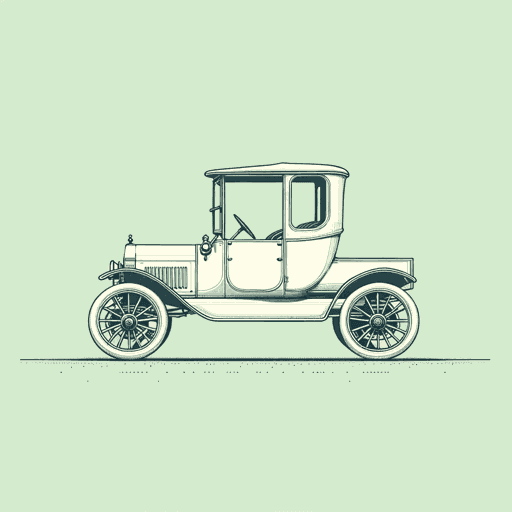
The Flivver King: A Story of Ford-America
100 pages • 3-hour read
Upton SinclairThe Flivver King: A Story of Ford-America
A modern alternative to SparkNotes and CliffsNotes, SuperSummary offers high-quality Study Guides with detailed chapter summaries and analysis of major themes, characters, and more.
Summary
Chapter Summaries & Analyses
Chapters 1-3
Chapters 4-6
Chapters 7-9
Chapters 10-12
Chapters 13-15
Chapters 16-18
Chapters 19-21
Chapters 22-24
Chapters 25-27
Chapters 28-30
Chapters 31-33
Chapters 34-36
Chapters 37-39
Chapters 40-42
Chapters 43-45
Chapters 46-48
Chapters 49-51
Chapters 52-54
Chapters 55-57
Chapters 58-60
Chapters 61-63
Chapters 64-66
Chapters 67-69
Chapters 70-72
Chapters 73-75
Chapters 76-78
Chapters 79-81
Chapters 82-84
Chapters 85-92
Character Analysis
Themes
Symbols & Motifs
Important Quotes
Essay Topics
Tools
Chapters 4-6Chapter Summaries & Analyses
Chapter 4 Summary
Ford makes adjustments to his horseless carriage until he feels confident enough to take it out during the day. Once on the street, his car frightens horses, who “turn, regardless of shafts or wagon-tongues, and bolt for the open spaces” (10). The drivers of horse-drawn wagons become so upset that Ford goes to the mayor to seek a permit to drive his car and obtains the first driver’s license in the United States.
It is summer, and the neighborhood children rush to watch Ford’s horseless carriage as soon as they hear it start. Occasionally, the car stops, and the boys help to push it home. For Abner, this experience “was something he would talk about all the rest of his life” (11).
Ford improves his vehicle through trial and error: since the gas engine tends to melt itself, Ford designs a water-jacket to keep it cool; he also invents a pump to circulate the water and a fan for cooling it.
Ford’s contraption becomes a popular spectacle, heckled by cyclists, occasionally targeted by thieves, and treated more or less politely by the newspapers, who respect Ford because he appears serious and proper and is often accompanied by his wife. However, the city’s businessmen do not regard the car as a viable investment, even though Ford sells the first model for two hundred dollars and builds a quieter, faster second model.
Since other people across the country are also attempting to build a horseless carriage, Ford feels pressure to work faster. When the electric company offers Ford a promotion on the condition that he give up his work on the horseless carriage, Ford resigns his position and devotes himself wholeheartedly to the car.
Chapter 5 Summary
In the summer of 1893, an economic depression causes many people to lose their jobs. The railroads stop buying freight-cars, and the factory where Tom Shutt works closes. Soon the family is forced to move into a single room. Fourteen-year-old Abner leaves school to take a job selling newspapers. Abner is beaten by other newspaper boys for invading their territory. Forced to work outdoors and inadequately dressed for the winter, he has to have one of his frostbitten fingers amputated.
Times are hard: Abner begs for money, his father stands in bread-lines, and his mother walks long distances to soup kitchens in order to feed the family. Three years later, when the economy has improved, Abner, his father, and his brothers find work again. Abner, though physically frail, has “honest grey eyes and a kind disposition” and is “a good moral boy” (14).
Like his father, Abner believes in his country and its institutions, and regards the occasional occurrence of hard economic times as “a law of nature” (14). Like Tom Shutt, Abner believes that any American can succeed if he works hard and leads a moral life. He joins the Republican Party and remains loyal all his life, regarding agitators without sympathy and viewing his government “as something remote and sublime, to be adored, even though it might slay him” (15).
Chapter 6 Summary
Henry Ford struggles to find success in business, since the businessmen who are interested in the horseless carriage conceive of it as a toy for rich men:
as they saw the problem, it was to find some well-to-do person who could afford an expensive toy; they had to find out exactly what kind of toy he wanted, and build it for him and get his money. That was supposed to end it, and there was a tendency to consider him a nuisance if he came around complaining that his expensive toy was out of order (15-16).
For Ford, the horseless carriage is “a useful article for everybody” (16) and keeping it in working order is as important a task as building it. In Ford’s view, it is pointless to ask people what they want; instead, it makes sense to build carriages that can be sold inexpensively and to create demand by allowing people to see these carriages on the road.
Ford attempts to work with the Detroit Motor Company but leaves because he has no control over product design and sales. He goes back to work in his own shop.
At this time, bicycles are wildly popular and are mass-produced; Ford envisions mass-producing his automobile in the same way. Bicycle brands advertise their product by hiring professional riders to compete in races, and Ford decides to imitate their strategy. Since he cannot afford to pay a professional driver, he challenges Mr. Winton (the maker of another car, the “Bullet”) to a race. The race is held at the Grosse Pointe racetrack, and Abner, now a young working man, attends. To Abner’s delight, Ford wins the race.
Chapters 4-6 Analysis
These chapters introduce Abner’s trusting and optimistic attitude toward the government and the economic system. He regards the hard times that occur under capitalism as natural and inevitable and accepts the recession despite its effects on his health. His belief in the American Dream—the ability of any individual, even the poorest, to achieve wealth, success, and greatness through hard work and discipline—will never waver. Similarly, he will always hold a worshipful attitude toward Henry Ford.
Sinclair presents Ford’s ambitions for his horseless carriage in a complex and multifaceted way in these chapters. On the one hand, Ford’s orientation is populist: he wants to produce his cars not for the rich few, but for the masses of common people. Rather than treating his invention as a toy for the elite, Ford thinks of it as a utilitarian object that can improve the everyday life of millions. On the other hand, Ford does not call upon the common people to tell him what they want; rather, he views them as unaware of their own desires and seeks to manipulate those desires by creating demand.
In these chapters, capitalism itself begins to figure as a character. The economic crisis of 1893 creates brutal competition among the neighborhood boys and, because of the frostbite he suffers while selling newspapers, costs Abner his finger. Throughout the novel, competition among workers leads to intense conflict and sometimes to physical injury and violence.

Unlock all 100 pages of this Study Guide
Get in-depth, chapter-by-chapter summaries and analysis from our literary experts.
- Grasp challenging concepts with clear, comprehensive explanations
- Revisit key plot points and ideas without rereading the book
- Share impressive insights in classes and book clubs