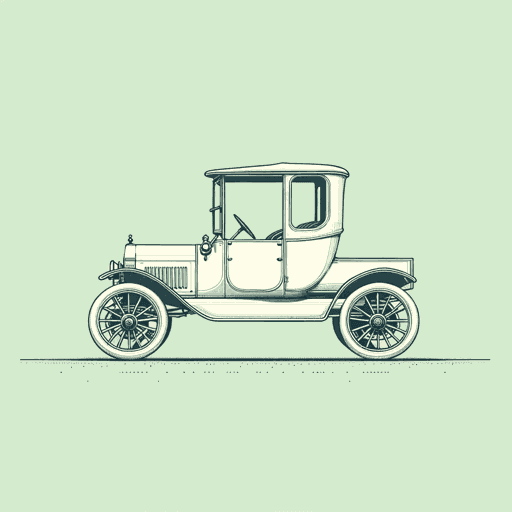
The Flivver King: A Story of Ford-America
100 pages • 3-hour read
Upton SinclairThe Flivver King: A Story of Ford-America
A modern alternative to SparkNotes and CliffsNotes, SuperSummary offers high-quality Study Guides with detailed chapter summaries and analysis of major themes, characters, and more.
Summary
Chapter Summaries & Analyses
Chapters 1-3
Chapters 4-6
Chapters 7-9
Chapters 10-12
Chapters 13-15
Chapters 16-18
Chapters 19-21
Chapters 22-24
Chapters 25-27
Chapters 28-30
Chapters 31-33
Chapters 34-36
Chapters 37-39
Chapters 40-42
Chapters 43-45
Chapters 46-48
Chapters 49-51
Chapters 52-54
Chapters 55-57
Chapters 58-60
Chapters 61-63
Chapters 64-66
Chapters 67-69
Chapters 70-72
Chapters 73-75
Chapters 76-78
Chapters 79-81
Chapters 82-84
Chapters 85-92
Character Analysis
Themes
Symbols & Motifs
Important Quotes
Essay Topics
Tools
Chapters 7-9Chapter Summaries & Analyses
Chapter 7 Summary
Although in 1903 people do not yet believe that the automobile is useful rather than a mere novelty, they are enthusiastic about car races. Ford decides to impress them. He builds a car called “999” with a four-cylinder engine and 80 horsepower, then hires Barney Oldfield, a bicycle racer, to race it at Grosse Pointe. Abner comes to watch the race, which Oldfield easily wins.
24-year-old Abner is in the midst of a crisis: he is frustrated with the nepotistic foreman at his current job at a tool company, and is in love with Milly Crock. To marry Milly and have children, Abner needs money. At the same time, he is an enthusiastic cyclist and admires the speed of Ford’s vehicles. He decides to ask Ford for a job.
Chapter 8 Summary
Ford, who is now 40, is also in the midst of a crisis: though the car is beginning to catch on, and other makers are setting up factories, he is frustrated by his lack of business success. Ford’s friend Malcomson, impressed by the 999’s success on the race track, proposes that he and Ford set up the Ford Motor Company. Malcomson contributes to the start-up costs and the two men find enough investors to start the business.
One day, Abner happens to ride his bicycle past the building now occupied by the Ford Motor Company.
Chapter 9 Summary
Abner parks his bicycle and enters the Ford Motor Company. Ford is, as usual, supervising production. Abner explains that he is one of the children who used to watch Ford work in his shed and help him push his car when it stopped. He tells Ford that he sees no room for further growth at his current job, but believes that Ford’s company will succeed, and asks for a job at the factory. Abner assures Ford that he isn’t seeking charity, but rather honest work, and that he is a hard worker who doesn’t drink and always comes to work.
Ford evaluates Abner and decides that he seems honest and hardworking. These are the two most important traits he looks for in employees:
Skill didn’t matter so much to Mr. Ford as willingness to be taught; for the fars he was planning to make were going to be as much alike as possible, and the work was going to be divided so that each man would have only a few tasks” (24).
Ford offers Abner a job; it is “the happiest moment of Abner’s life” (24) and he thanks Ford and the foreman “with a fervour which might have touched their hearts, had not their energies been so absorbed with the problems of production” (25).
Chapters 7-9 Analysis
When Abner asks Ford for a job, and Ford offers him work, Abner’s response is simple joy and gratitude. The story is a touching one. However, the narrator’s observation that Ford and his foreman are so completely absorbed with the “problems of production” (25) that they fail to notice Abner’s gratitude foreshadows Ford’s increasing obliviousness to his workers. It also hints at the eventual dominance of efficient production and mechanized industrial processes over human needs in the Ford Company. The company is already more focused on business than on the human beings it employs.
Sinclair suggests that the Ford Motor Company is not alone in putting on a false appearance of concern for its workers; its building has a false front that makes it look taller than it is, and “there were many false fronts like that, in buildings and elsewhere in America” (22).
In this chapter, Ford’s evaluation of Abner as honest, hardworking, sober, and reliable seems reasonable; of course, any employer would prefer such an employee over a lazy, dishonest, and drunken one. However, Ford’s judgment has a moral as well as a practical ring to it, and this interaction is a miniature version of the control Ford later exercises over his employees through the brutal service department.

Unlock all 100 pages of this Study Guide
Get in-depth, chapter-by-chapter summaries and analysis from our literary experts.
- Grasp challenging concepts with clear, comprehensive explanations
- Revisit key plot points and ideas without rereading the book
- Share impressive insights in classes and book clubs