The Marvelous Land of Oz
45 pages • 1-hour read
L. Frank BaumThe Marvelous Land of Oz
A modern alternative to SparkNotes and CliffsNotes, SuperSummary offers high-quality Study Guides with detailed chapter summaries and analysis of major themes, characters, and more.
Chapters 1-6Chapter Summaries & Analyses
Content Warning: This section of the guide includes discussion of emotional abuse.
Chapter 1 Summary: “Tip Manufactures a Pumpkinhead”
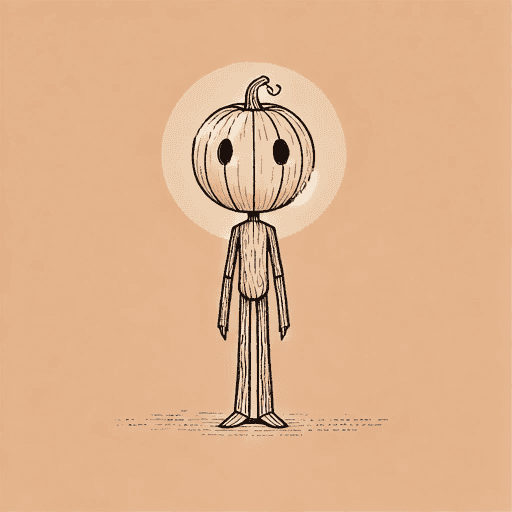
The Marvelous Land of Oz takes place on a continent divided into four countries surrounding the Emerald City. The story opens in the northern Country of the Gillikins and follows a boy named Tip, whom a mean sorceress named Mombi raised at her farm. One day, while she’s out, Tip decides to build a figure to frighten her. He constructs a man-shaped body from saplings with jointed limbs and tops it with a large, carved pumpkin for a head. Dressing the figure in clothes from Mombi’s chest, Tip names it Jack Pumpkinhead.
Chapter 2 Summary: “The Marvelous Powder of Life”
Tip places Jack Pumpkinhead on the road to startle Mombi, but she returns early with a pepper-box filled with the Powder of Life. She spots the figure, but it doesn’t respond when she says hello. Realizing Tip’s trick, she tests the powder on the figure. Jack Pumpkinhead begins to move and speak. Mombi catches Tip spying on her, locks Jack in the stable, and prepares a potion to turn Tip into a marble statue the next morning.
Chapter 3 Summary: “The Flight of the Fugitives”
That night, Tip resolves to flee before Mombi can punish him. He packs food, steals the Powder of Life, and frees Jack Pumpkinhead from the stable. By morning, Jack recognizes Tip as his maker, calling him “father.” Tip decides that they’ll go to the Emerald City to seek refuge with its ruler, the Scarecrow. As they travel, Tip recounts recent Oz history, including the Scarecrow’s rise to kingship. While the Scarecrow rules the Emerald City, the Tin Woodman rules the Winkies, and Glinda the Good rules the Quadlings.
Chapter 4 Summary: “Tip Makes an Experiment in Magic”
As they travel, Jack worries that walking will wear out his wooden joints. While resting on a wooden sawhorse, Jack suggests they could animate it to use as a mount for Jack. Tip recalls Mombi’s words and gestures and uses the stolen powder to bring the Saw-Horse to life.
Chapter 5 Summary: “The Awakening of the Saw-Horse”
The newly awakened Saw-Horse panics because it can’t hear. Tip carves ears from bark and fastens them to its head. Now able to hear, speak, and learn commands, the Saw-Horse is safer to ride after Tip adds a post to its back for Jack to hold. The group resumes the journey and camps for the night nine miles from the Emerald City.
Chapter 6 Summary: “Jack Pumpkinhead’s Ride to the Emerald City”
The next day, the travelers reach a river where the ferryman refuses them passage. They float the Saw-Horse across, following the “road of yellow brick” toward the Emerald City. Tip yells commands for the Saw-Horse to pick up speed, but it interprets the commands as top speed. Tip tries to keep up; however, the Saw-Horse’s tail (a branch) breaks off while Tip is holding it, and he falls behind. Jack Pumpkinhead and the Saw-Horse reach the Emerald City without him. The Guardian of the Gates requires them to wear green spectacles before summoning the Soldier with the Green Whiskers. They escort Jack into the palace to meet the Scarecrow.
Chapters 1-6 Analysis
The opening chapters establish identity as a manufactured and assigned condition, a foundational concept for one of the novel’s main themes: The Malleability of Identity. Tip’s creation of Jack Pumpkinhead is a literal act of construction; he assembles a body from saplings, carves a face, and dresses the figure in scavenged clothes. This process depicts identity as an external project, an assemblage of parts for a specific purpose. Magic does the rest. Jack’s animation via the Powder of Life doesn’t grant him an inherent identity but rather a consciousness that seeks definition from its creator. Based on his origin, Jack logically deduces his relationship to Tip, declaring, “[Y]ou must be my creator—my parent—my father!” (20). This statement retroactively assigns Tip a paternal role he didn’t intend, illustrating how relationships and identities are co-constructed in the novel’s world. Jack’s existence, defined by his wooden joints and perishable head, is a constant reminder of his artificial origins, yet his capacity for logic and loyalty positions him as a being whose identity forms through experience, not just physical composition. This initial exploration suggests that origins and appearances aren’t reliable indicators of one’s true self.
This pivotal moment also introduces another theme, The Moral Ambiguity Inherent in Artificially Creating Life, alluding to the ethical responsibilities that arise from creation. As Jack’s diction progresses from a technical definition (“creator”) to a deeply personal one (“father”), Tip’s role fundamentally shifts from a mischievous prankster to a responsible guardian, solidifying the creator’s moral obligation to his creation. Initially, Jack is an object, a tool for mischief. Mombi’s application of the Powder of Life transforms him into a being, immediately shifting the ethical stakes. Tip’s relationship with his creation evolves from owner to guardian, a change catalyzed by Mombi’s cruel plan to turn Tip into a marble statue: She threatens to “[p]ut [him] in the middle of [her garden], for an ornament” (16). Faced with this threat, Tip recognizes a shared vulnerability with Jack and makes a moral choice to rescue him, acknowledging a duty beyond mere invention. This sense of responsibility deepens when Tip animates the Saw-Horse not out of whimsy but from a compassionate, practical need to save Jack’s joints. The Saw-Horse, like Jack, asserts its own consciousness, demonstrating that life, once granted, can’t be contained by the creator’s original intent. The creature’s inability to hear until given ears underscores the creator’s obligation to not only give life but also equip the creation for existence.
The narrative structure introduces the motif of rebellion and rulership on a personal scale, foreshadowing larger political conflicts. Tip’s flight from Mombi is an act of rebellion against unjust authority. Mombi’s power is arbitrary and cruel; she functions as a de facto ruler, threatening Tip with a monstrous transformation for a minor transgression. Her rule is illegitimate, based on fear of losing power rather than obtaining consent through sound logic. Tip’s escape is therefore a rejection of this oppressive governance, and his decision to journey to the Emerald City represents a quest for the supposedly fair rule of the Scarecrow. This journey frames the novel’s central political question as to what makes a ruler legitimate, subtly introducing The Absurdity of Societal Obsession Over Gender Roles and Power as another primary theme. By juxtaposing Mombi’s despotic sorcery with the promise of the Scarecrow’s wisdom, the novel establishes a dichotomy between illegitimate and legitimate power.
As a magical aid, the Powder of Life symbolizes the arbitrary and consequential nature of creation. The powder is contained in a mundane pepper-box, and the incantations required to activate it are nonsensical syllables. This presentation portrays creation more as a technical procedure that can be replicated than as a sacred act. However, the consequences are significant. When Tip animates the Saw-Horse, he mimics the procedure without understanding its principles, demonstrating that great power can be wielded without corresponding wisdom. The animation brings forth a sentient being with its own perspective, deepening Tip’s responsibilities. Furthermore, the artificial beings’ perception highlights their unique status. Faced with crossing a river, Jack’s response isn’t fear but a logical assessment of his physical properties: “[I’m] sure I ought to float beautifully” (39). This statement captures how their identities are linked to their material composition, yet they use this knowledge to navigate their world with a distinct consciousness.
In addition, these introductory chapters establish a world governed by a whimsical but rigid logic. The geography of Oz suggests an underlying order, yet encounters are often unpredictable. The ferryman’s refusal to grant passage introduces a mundane reality that contrasts with the magical events. Similarly, the bureaucracy of the Emerald City, represented by the Guardian of the Gates, imposes a formal, rule-based structure on the strange new arrivals. Emerald City processes Jack and the Saw-Horse according to protocol, and civic procedure momentarily subsumes their fantastical nature. This juxtaposition of the magical and the mundane generates much of the novel’s humor and social satire, reinforcing the idea that success in Oz depends not just on magic but on ingenuity and an ability to navigate the world’s peculiar systems.

Unlock all 45 pages of this Study Guide
Get in-depth, chapter-by-chapter summaries and analysis from our literary experts.
- Grasp challenging concepts with clear, comprehensive explanations
- Revisit key plot points and ideas without rereading the book
- Share impressive insights in classes and book clubs