The Marvelous Land of Oz
45 pages • 1-hour read
L. Frank BaumThe Marvelous Land of Oz
A modern alternative to SparkNotes and CliffsNotes, SuperSummary offers high-quality Study Guides with detailed chapter summaries and analysis of major themes, characters, and more.
Chapters 7-12Chapter Summaries & Analyses
Content Warning: This section of the guide includes discussion of emotional abuse.
Chapter 7 Summary: “His Majesty the Scarecrow”
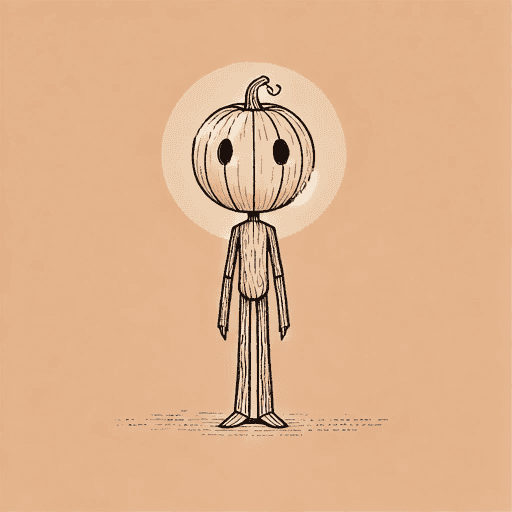
In the palace throne room, Jack Pumpkinhead meets the Scarecrow. Both are surprised by the other’s appearance. As Jack is newly created, he doesn’t understand the Scarecrow’s words. The Scarecrow summons the Soldier with the Green Whiskers to fetch an interpreter. The soldier returns with Jellia Jamb, a palace maid who mistranslates their exchange until the Scarecrow discovers her trick. Jellia reveals that everyone in Oz speaks the same language, resolving the misunderstanding. The Scarecrow and Jack become friends and go to the courtyard to play quoits.
Chapter 8 Summary: “Gen. Jinjur’s Army of Revolt”
Meanwhile, Tip meets General Jinjur, leader of an all-girl Army of Revolt. She explains her plan to seize the Emerald City for its wealth. Her army of girls, armed with knitting needles, marches to the city. At the gates, Jinjur demands surrender from the Guardian of the Gates. He’s intimidated and gives her the keys. The Soldier with the Green Whiskers confronts them but flees when he admits his gun is unloaded. Without resistance, Jinjur’s army captures the Emerald City.
Chapter 9 Summary: “The Scarecrow Plans an Escape”
Jinjur’s army digs emeralds out of the walls as they enter the city, so their progress is slow. Meanwhile, Tip follows The Soldier with the Green Whiskers into the palace, alerting the Royal Army, which interrupts the Scarecrow and Jack Pumpkinhead’s game of quoits (which is similar to horseshoes) to announce the city’s capture. Tip warns the Scarecrow that the rebels want to use his straw for cushions. The Scarecrow decides to seek help from his old friend, the Tin Woodman, and devises an escape using the Saw-Horse. The Scarecrow, Jack, and Tip mount the Saw-Horse, and the Soldier ties them together and unbars a gate. The Saw-Horse bolts through the rebel guards and out of the city, eventually leaping into a river.
Chapter 10 Summary: “The Journey to the Tin Woodman”
The buoyant Saw-Horse paddles to shore. Tip cuts the riders free, retrieves Jack’s floating head from the river, and reattaches it. He then removes the Scarecrow’s soaked straw to dry in the sun before restuffing him. They travel west until nightfall and stop so that Tip can rest, using the Scarecrow as a pillow while the others keep watch.
Chapter 11 Summary: “A Nickel-Plated Emperor”
The party reaches the Tin Woodman’s palace in the Winkie Country, where the Tin Woodman, Nick Chopper (a nickel-plated Emperor), enthusiastically greets the Scarecrow, inadvertently smearing him with polishing paste. The Scarecrow explains his dethronement, and the Tin Woodman vows to help recapture the Emerald City. Palace servants repair the Scarecrow and Jack, and the next morning, the group sets out.
Chapter 12 Summary: “Mr. H. M. Woggle-Bug, T. E.”
As the party travels, General Jinjur summons Mombi for help. Mombi conjures an illusion of giant, whirling sunflowers with faces to block their path, but the group closes their eyes and passes through safely. Soon after, the Saw-Horse stumbles and breaks a leg. As they wonder how to repair it, a large, well-dressed insect approaches and introduces himself as Mr. H. M. Woggle-Bug, T. E. He offers to tell his story while they find a solution.
Chapters 7-12 Analysis
This section uses a satirical lens to thematically interrogate early 20th-century social and political structures, primarily through The Absurdity of Societal Obsession Over Gender Roles and Power. General Jinjur and her Army of Revolt comically critique both patriarchal systems and contemporary anxieties surrounding the women’s suffrage movement. Jinjur’s justification for her coup—“because the Emerald City has been ruled by men long enough” (58)—frames the rebellion in explicitly political terms. However, the novel immediately subverts this ideology by grounding the revolt in materialistic desire and arming the soldiers with knitting needles, domestic tools repurposed as weapons. This satirizes stereotypes of feminine concerns while demonstrating their collective power. The army’s effortless victory, predicated on the Royal Army’s refusal to harm women, further lampoons traditional notions of masculine martial power. The rebellion achieves a farcical coup d’état, suggesting that a simple inversion of gender roles doesn’t inherently lead to better governance. The novel thus critiques the notion that gender should be the primary qualification for power.
The novel continues its thematic exploration of The Malleability of Identity by presenting characters whose selves are demonstrably constructed. The Scarecrow’s identity is reinforced as mutable when he’s unstuffed, dried, and restuffed, and the Tin Woodman enhances his form by nickel-plating himself, treating his body as an ongoing project. Jack Pumpkinhead’s existence is even more precarious, as his identity is literally attached to a perishable head that can be removed and reattached without altering his being. This concept culminates in the arrival of Mr. H. M. Woggle-Bug, T. E. His formal title codifies his identity as a product of external processes: He’s a “Highly Magnified” (“H. M.”) insect who has been “Thoroughly Educated” (“T. E.”) into a gentleman. His name is a summary of his origins and qualifications, presenting a self that is entirely the result of transformation. Through these characters, the novel divorces identity from fixed form, instead defining it through creation, experience, and self-proclamation.
The structure of these chapters enhances the thematic content through parallel narratives and quest archetypes. The events of Chapters 7 and 8 occur concurrently, cutting between the Scarecrow meeting Jack and the advance of Jinjur’s army. This juxtaposition creates dramatic irony, as the reader is aware of the imminent invasion while the ruler is engaged in a comically absurd misunderstanding. The collapse of these plotlines initiates a traditional quest narrative, driven by the motif of rebellion and rulership. The Scarecrow’s dethronement precipitates the heroes’ flight, their journey to an ally, the consolidation of their forces, and the return journey to reclaim the throne. Mombi’s magical illusions, such as the field of whirling sunflowers, present archetypal obstacles that test the heroes’ resolve. This adherence to the quest framework grounds the fantastical elements in a familiar structure, providing an accessible format within which the novel can explore the more radical ideas about identity and gender.
The physical vulnerability of the artificially created characters is a constant thematic meditation on The Moral Ambiguity Inherent in Artificially Creating Life. Created beings (and caring creators) constantly face the fear of mortality, which is the fear of damage or disassembly. Jack Pumpkinhead’s persistent anxiety about his head spoiling parallels humans’ fear of aging and death. The Saw-Horse, animated from lumber, doesn’t feel pain when its leg breaks but expresses injury to its pride, demonstrating a consciousness that includes self-regard. The novel’s moments of physical crisis (Jack’s decapitation, the Scarecrow’s soaking, the Saw-Horse’s broken leg) necessitate repair and underscore the responsibility of “natural” beings like Tip toward their created companions. The Tin Woodman’s pragmatic suggestion that Jack might have his head “canned” to preserve it is a darkly humorous reflection on the tension between compassion and utility. These recurring incidents blur the distinction between caring for a person and maintaining an object.
The motif of language further explores perception versus reality. The meeting between the Scarecrow and Jack centers on a manufactured misunderstanding requiring an interpreter. The maid Jellia Jamb’s mischievous mistranslations briefly empower her as she controls the flow of information. The revelation that the charade is pointless because “[i]n all the land of Oz but one language is spoken” (54) dismantles the illusion, suggesting that barriers to understanding are often self-imposed. In contrast, the Woggle-Bug’s formal, polysyllabic speech is a performance of his “Thoroughly Educated” identity, using language as a tool for self-creation. The novel thus depicts language as a force that can create false divisions, subvert authority, and construct new realities, reinforcing the idea that what characters say is as defining as what they’re (literally or metaphorically) made of.

Unlock all 45 pages of this Study Guide
Get in-depth, chapter-by-chapter summaries and analysis from our literary experts.
- Grasp challenging concepts with clear, comprehensive explanations
- Revisit key plot points and ideas without rereading the book
- Share impressive insights in classes and book clubs