The Marvelous Land of Oz
45 pages • 1-hour read
L. Frank BaumThe Marvelous Land of Oz
A modern alternative to SparkNotes and CliffsNotes, SuperSummary offers high-quality Study Guides with detailed chapter summaries and analysis of major themes, characters, and more.
Important Quotes
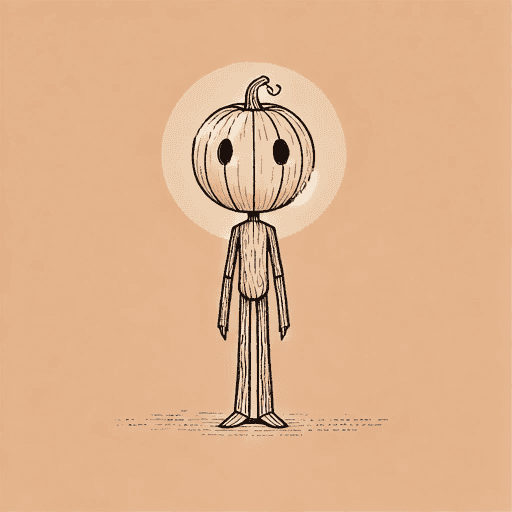
“The face, when completed, could not have been considered strictly beautiful; but it wore a smile so big and broad, and was so jolly in expression, that even Tip laughed as he looked admiringly at his work.”
(Chapter 1, Page 2)
This description establishes the nature of Jack Pumpkinhead’s identity before he’s brought to life. The use of antithesis (contrasting the lack of conventional beauty with the overwhelming jolliness of the smile) highlights how Jack’s core characteristic is an artificial construct, literally carved onto him. This fixed expression predetermines his perceived personality, introducing an early thematic exploration of The Malleability of Identity, in which external appearance dictates internal reality.
“‘Well, that is hard to tell,’ replied Jack. ‘For although I feel that I know a tremendous lot, I am not yet aware how much there is in the world to find out about. It will take me a little time to discover whether I am very wise or very foolish.’”
(Chapter 2, Page 11)
Upon being brought to life by the Powder of Life, Jack’s first philosophical statement subverts expectations of a simple, artificial being. His words demonstrate self-awareness and an understanding of epistemology, distinguishing between innate feeling (“I feel that I know a tremendous lot”) and empirical discovery (“how much there is in the world to find out”). This characterization imbues the newly created being with unexpected intellectual depth, thematically engaging The Ambiguity Inherent in Artificially Creating Life by blurring the line between a made object and a sentient, contemplative being.
“‘I wonder,’ said he, musingly, ‘if it would bring the saw-horse to life.’
‘If it would,’ returned Jack, calmly—for nothing seemed to surprise him—‘I could ride on its back, and that would save my joints from wearing out.’”
(Chapter 4, Page 26)
This exchange marks Tip’s transition from an accidental participant in magic to an intentional wielder of it, mirroring Mombi’s earlier use of the Powder of Life. However, Tip’s motivation isn’t selfish experimentation but compassionate problem-solving: He aims to alleviate Jack’s physical deterioration. Jack’s calm, pragmatic response underscores the normalized view of magical creation within Oz, positioning the animation of an inanimate object as a practical solution rather than a transgressive act.
“‘My friend,’ said Tip, gravely, ‘you’ll never be anything but a Pumpkinhead, no matter how big your ears are.’”
(Chapter 5, Page 31)
Tip’s declaration, delivered in a grave tone, fixes Jack’s identity as immutable, defined entirely by his physical construction. Ironically, Tip’s own identity is far more fluid than he imagines. This line thematically addresses the malleability of identity, simultaneously asserting the concept of a fixed nature for Jack while unknowingly foreshadowing the transformation that awaits Tip himself.
“‘That wooden horse will float,’ said he; ‘and you can ride him across. As for the pumpkin-headed loon who accompanies you, let him sink or swim—it won’t matter greatly which.’”
(Chapter 6, Page 39)
The ferryman provides a dehumanizing perspective on the novel’s artificially created characters. His callous indifference to Jack’s fate, dismissing him as a “pumpkin-headed loon,” starkly contrasts with Tip’s growing sense of fatherly responsibility. This juxtaposition encourages consideration of the moral status of these beings and challenges the idea that something “made” is inherently less valuable than something born.
“‘My name is Jack Pumpkinhead,’ returned the other, smilingly; ‘but as to my business, I haven’t the least idea in the world what it is.’”
(Chapter 6, Page 42)
In his first formal introduction to Oz society, Jack’s statement succinctly captures his existential condition. He has a name and a defined identity, yet he lacks any inherent purpose or “business,” which has thus far been dictated entirely by his creator, Tip. The adverb “smilingly” emphasizes the disconnect between his cheerful, carved expression and his state of uncertainty, illustrating a core thematic question regarding the ambiguity inherent in artificially creating life: whether a created being can possess agency independent of its creator’s intent.
“‘There is this difference between us,’ said the Scarecrow, ‘that whereas I will bend, but not break, you will break, but not bend.’”
(Chapter 7, Page 50)
In an exchange with Jack Pumpkinhead, the Scarecrow uses a carefully balanced antithetical structure (“bend, but not break” versus “break, but not bend”) to define their distinct physical realities. This observation establishes a core philosophical difference between two artificially created beings, suggesting the materials of their construction dictate their very natures. This comparison thematically advances the ambiguity inherent in artificially creating life by giving the characters a clear self-awareness of their own physical limitations.
“‘Because the Emerald City has been ruled by men long enough, for one reason,’ said the girl. ‘Moreover, the City glitters with beautiful gems, which might far better be used for rings, bracelets and necklaces; and there is enough money in the King’s treasury to buy every girl in our Army a dozen new gowns.’”
(Chapter 8, Page 58)
General Jinjur’s justification for her revolt juxtaposes a political statement with materialistic desires. This characterization satirizes the rebellion’s motives, portraying them as a mix of legitimate grievance and stereotypically feminine vanity. Her speech introduces the complex and comically flawed motivations behind the coup, a key aspect of the novel’s exploration of the rebellion and rulership motif.
“‘But should I remain here a prisoner for any length of time,’ protested Jack, ‘I’m liable to spoil.’”
(Chapter 9, Page 68)
Jack Pumpkinhead’s fear of spoiling conveys his unique conception of mortality, highlighting his consciousness and capacity for anxiety despite his artificial origins. This statement is thematically central to the ambiguity inherent in artificially creating life, granting Jack a subjective experience of dread that complicates his status as an inanimate object brought to life. His concern isn’t for the prospect of violent destruction but for that of organic decay, a specific fear that makes his sentience more poignant.
“The wooden body, with its gorgeous clothing, still sat upright upon the horse’s back; but the pumpkin head was gone, and only the sharpened stick that served for a neck was visible.”
(Chapter 10, Page 76)
This descriptive passage provides a stark visualization of the precariousness of a constructed identity. The separation of Jack’s head from his body literally deconstructs his personhood, reducing him to his parts: a costumed frame and a missing center of consciousness. This arresting image thematically illustrates the malleability of identity, demonstrating how easily a “self” can be dismantled when it’s physically assembled from separate pieces.
“Do not, I beg of you, dampen today’s sun with the showers of tomorrow. For before your head has time to spoil you can have it canned, and in that way it may be preserved indefinitely.”
(Chapter 11, Page 88)
The Tin Woodman’s advice to Jack blends a common aphorism with a surreal, practical solution unique to the world of Oz. The suggestion to “can” Jack’s head depicts a core component of his identity as a perishable good, underscoring the novel’s exploration of The ambiguity of artificial life. This juxtaposition of the philosophical and the absurdly literal is a key element of the novel’s tone, addressing existential fears with comical pragmatism.
“But now the sunflowers suddenly stopped their rapid whirling, and the travelers plainly saw a girl’s face appear in the center of each flower.”
(Chapter 12, Page 95)
This moment of Mombi’s magic is a prime example of the transformations motif. She creates a landscape that is both beautiful and hostile. The surreal image of girls’ faces emerging from sunflowers merges the natural with the human, effectively weaponizing femininity and nature to create a deceptive and disorienting obstacle. This imagery demonstrates how Mombi uses her power to twist perception and destabilize others’ reality.
“If the Pumpkinhead is to ride, why not use one of his legs to make a leg for the horse that carries him? I judge that both are made of wood.”
(Chapter 13, Page 109)
The Woggle-Bug’s pragmatic suggestion portrays the characters’ bodies as modular and interchangeable, thematically underscoring the malleability of identity. His logic reduces Jack to his constituent material, suggesting that physical form is functional rather than fixed and essential. This moment emphasizes the constructed nature of many Oz inhabitants, whose parts can be repaired or repurposed like inanimate machinery.
“All magic is unnatural, and for that reason is to be feared and avoided. But I see before us the gates of the Emerald City, so I imagine we have now overcome all the magical obstacles that seemed to oppose us.”
(Chapter 14, Page 118)
After the group endures Mombi’s illusions, the Scarecrow voices a key distinction within the world of Oz between the “natural” and the “magical.” This statement establishes magic as an external, disruptive force that violates the established order, which is central to the transformations motif, in which identities are unnaturally altered. The quote positions magic not as a wondrous phenomenon but as an untrustworthy power, reflecting tension between predictable reality and chaotic enchantment.
“‘The throne belongs to whoever is able to take it,’ answered Jinjur, as she slowly ate another caramel. ‘I have taken it, as you see; so just now I am the Queen, and all who oppose me are guilty of treason, and must be punished by the law you have just mentioned.’”
(Chapter 15, Page 122)
Jinjur’s declaration articulates a political philosophy based on might rather than right, a central idea in the rebellion and rulership motif. By claiming the throne simply because she was “able to take it,” she subverts traditional notions of legitimate succession. Her logic redefines treason as opposition to the current power holder, illustrating how those in control can manipulate language and law to serve their interests.
“The rest of you are not human, and therefore it will not be wicked to demolish you. The Saw-Horse and the Pumpkinhead’s body I will have chopped up for kindling-wood; and the pumpkin shall be made into tarts.”
(Chapter 15, Page 124)
Jinjur’s justification for destroying the travelers explicitly hinges on their nonhuman status, thematically engaging with the moral ambiguity inherent in artificially creating life. Her assertion that demolishing them isn’t “wicked” draws a sharp distinction between killing a person and deconstructing an object, a view that questions the personhood and rights of created beings. This moment exposes the vulnerability of the characters whose artificial existence renders their lives legally and morally disposable to their enemies.
“I am convinced that the only people worthy of consideration in this world are the unusual ones. For the common folks are like the leaves of a tree, and live and die unnoticed.”
(Chapter 16, Page 134)
Spoken by the Scarecrow, this statement concisely articulates the novel’s core philosophy, elevating peculiarity over conformity. The simile comparing “common folks” to unnoticed leaves champions the unique and constructed individuals who populate the story, reframing their strangeness as a virtue. This perspective validates the identities of characters like Jack and the Woggle-Bug, suggesting that their value lies precisely in their deviation from the ordinary.
“‘But how,’ asked the Scarecrow, ‘can anyone count seventeen by twos? Seventeen is an odd number.’”
(Chapter 18, Page 148)
Upon discovering the Wishing Pills, the Scarecrow’s logical observation presents a paradox that renders magical power inaccessible. The instruction to “count seventeen by twos” is a narrative device that places a rational, seemingly impossible constraint on a supernatural solution. This small puzzle illustrates a technique of blending fantasy with rigid logic, forcing the characters to seek clever interpretation rather than a simple application of power.
“‘Thank you,’ returned the Scarecrow, gratefully. ‘I feel like a new man; and although at first glance I might be mistaken for a Safety Deposit Vault, I beg you to remember that my Brains are still composed of the same old material. And these are the possessions that have always made me a person to be depended upon in an emergency.’”
(Chapter 19, Page 159)
This quote thematically engages with the malleability of identity by contrasting the Scarecrow’s drastically altered physical substance (straw replaced with money) with his unchanged consciousness. The Scarecrow’s speech humorously contrasts his new material value (a “Safety Deposit Vault”) with his intellectual value (“Brains”) to assert that his mind, not his physical composition, defines his essential self. This suggests that identity is an internal quality, independent of the external form it inhabits.
“‘Then,’ declared Glinda, ‘the throne of the Emerald City belongs neither to you nor to Jinjur, but to this Pastoria from whom the Wizard usurped it.’”
(Chapter 20, Page 169)
Glinda’s statement reframes the novel’s central conflict, portraying it not as a simple power struggle but as a question of legitimate succession, addressing the motif of rebellion and rulership. Her words provide a narrative intervention, shifting the moral and political focus away from the immediate dispute between the Scarecrow and Jinjur. This moment establishes that true authority derives from rightful inheritance, not from conquest or popular appointment, setting the stage for Princess Ozma’s restoration.
“But before they left the garden the Tin Woodman, who was fond of flowers, chanced to espy a big red rose growing upon a bush; so he plucked the flower and fastened it securely in the tin buttonhole of his tin bosom.”
(Chapter 21, Page 181)
This sentence uses dramatic irony, as the reader is aware that the rose is the transformed Mombi, while the characters aren’t. The Tin Woodman’s simple, innocent action becomes the pivotal event leading to the witch’s capture, demonstrating how a minor character trait (like the Tin Woodman’s fondness for flowers) can unintentionally solve a major problem. The passage exemplifies the transformations motif, showing how an ordinary, seemingly harmless form can conceal a malicious identity.
“But, just as her hand was descending, the Witch, now fairly frantic with fear, made her last transformation, and in the form of a huge Griffin sprang through the wall of the tent […] and in a moment had darted away with the speed of a whirlwind.”
(Chapter 22, Page 184)
This moment marks the climax of Mombi’s attempts to escape, showcasing the transformations motif through a rapid sequence of forms. The shift from subtle disguises to a significant mythological creature highlights her increasing desperation. The imagery of the Griffin physically tearing through the tent wall demonstrates the violent and chaotic nature of her magic, which contrasts with Glinda’s more controlled power.
“‘Yes,’ said the old Witch, nodding her head; ‘that is the Princess Ozma—the child brought to me by the Wizard who stole her father’s throne. That is the rightful ruler of the Emerald City!’ and she pointed her long bony finger straight at the boy.”
(Chapter 23, Page 193)
This passage is the anagnorisis, or critical discovery, that resolves the novel’s central mystery. Mombi’s declarative speech, combined with the dramatic physical gesture of pointing, is the story’s climax, confirming the full fluidity of the protagonist’s identity. The revelation thematically confronts the malleability of identity, demonstrating that core attributes like gender and social status can be magically altered and concealed.
“‘I hope none of you will care less for me than you did before. I’m just the same Tip, you know; only—only—’
‘Only you’re different!’ said the Pumpkinhead; and everyone thought it was the wisest speech he had ever made.”
(Chapter 23, Page 197)
This exchange articulates the central paradox of Tip’s transformation, exploring the continuity of self despite radical physical change. Ozma’s hesitant, fragmented sentence reveals her anxiety about how her friends will perceive her new identity, while Jack Pumpkinhead’s simple declaration offers a concise and emphatic resolution. The narrator’s comment on the wisdom of Jack’s speech uses situational irony to highlight the complex truth contained within his simplistic observation.
“‘You are both rich, my friends,’ said Ozma, gently; ‘and your riches are the only riches worth having—the riches of content!’”
(Chapter 24, Page 204)
The newly restored, legitimate monarch delivers the novel’s final moral statement. Ozma’s declaration resolves the preceding debate between the Scarecrow and the Tin Woodman by redefining wealth as an internal state of being content rather than a state of contentment deriving from material or personal attributes. Through this didactic closing line, the novel presents the explicit thematic conclusion that true prosperity is found in contentment.

Unlock every key quote and its meaning
Get 25 quotes with page numbers and clear analysis to help you reference, write, and discuss with confidence.
- Cite quotes accurately with exact page numbers
- Understand what each quote really means
- Strengthen your analysis in essays or discussions