54 pages • 1-hour read
The Night War
A modern alternative to SparkNotes and CliffsNotes, SuperSummary offers high-quality Study Guides with detailed chapter summaries and analysis of major themes, characters, and more.
Background
Historical Context: The Holocaust
Content Warning: This section of the guide includes discussion of death and religious discrimination.
Adolf Hitler rose to power in Germany in the period after World War I, and under his influence, the Nazi Party grew to be the largest in Germany by 1932. Shortly thereafter, Hitler was appointed chancellor by President von Hindenburg. In 1934, after von Hindenburg’s death, Hitler merged the chancellery with the presidency, assuming the title of Führer, which means “leader” or “guide.” Hitler’s rhetoric centered on establishing Germany as a leading world power made up of ethnically pure and genetically superior Germans, whom he referred to as the “Aryan” race.
Part of Hitler’s plan for German expansion and domination was the extermination of European Jewry; Hitler conceived of Judaism as a race rather than as a religious belief system. He believed that Jews were a lesser, subhuman species: untermenschen, who were determined to achieve world domination at the detriment of all other races, especially the Aryan race.
Initially, murders of Jews took the form of close-range shooting into mass graves. This was carried out by a specialized sub-group of the Nazi army called the Einsatzgruppen. Tens of thousands of Jews in Poland, Ukraine, Latvia, and Lithuania lost their lives in this way. However, this was not considered an expedient solution, and the physical and psychological strain on German troops from this method of killing was considered problematic. Furthermore, by October 1939, the Nazis had control of over 2 million Jews between Germany, Poland, Austria, and the Czech Republic (known at the time as the territories of Sudetenland, Moravia, and Bohemia), and this number continued to grow with German expansion.
The Nazi Party developed the “final solution” to the Jewish “problem”: an intentional, mass extermination of European Jews. A network of 23 main concentration camps and hundreds of satellite camps was created in several countries, but predominantly Germany and Poland. Within the camp system, there were six purpose-built killing centers established in German-controlled Poland: Treblinka, Sobibor, Belzec, Chelmno, Majdanek, and—most notorious of all—Auschwitz-Birkenau. Mobile gas vans were initially used at these centers. Later, permanent gas chambers were built attached to crematoriums. To minimize the psychological cost to German personnel, labor of Jewish prisoners or prisoners of war were often used as the sonderkommandos, the workers in the gas chambers and crematoria.
The deportation from Paris in mid-1942, known as the Vélodrome d’Hiver (or “Vél d’Hiv”) roundup, described by Miri in The Night War, is based on historical fact. Over 7,000 Jews were crammed into the arena without food, water, or access to basic sanitation for days. Eventually, they were loaded onto buses destined for the Auschwitz extermination camp. Approximately 77,000 French Jews and non-French Jews living in France during the 1940s were killed during the Holocaust. In total, over 6 million European Jews were murdered during the Holocaust, which only ceased when concentration camps were liberated by allied soldiers (Berenbaum, Michael. “Holocaust.” Britannica, 13 Feb. 2025).
Historical Context: French Resistance and People Smuggling Across the River Cher
After Germany occupied Paris and most of northern France in 1940, Marshal Philippe Pétain established a separate French state with its government headquartered in the resort town of Vichy. Although Vichy France was collaborating with Germany and operating essentially as a puppet state under German rule, “undesirables” were less likely to be apprehended there before 1943.
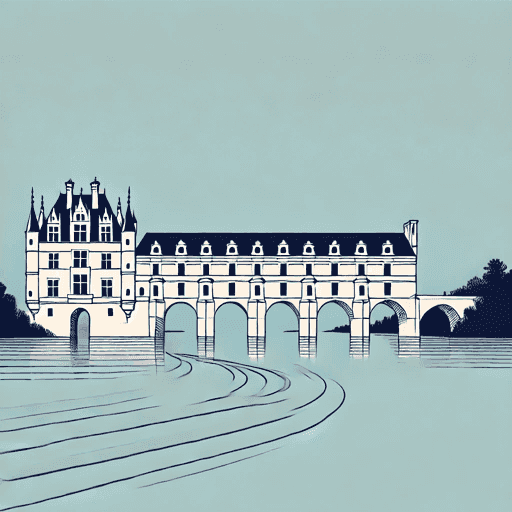
The Château de Chenonceau straddles the River Cher, which became part of the demarcation line between Vichy (French-governed) France and occupied France. The Château de Chenonceau bridge, which was converted to a ballroom by Catherine de’ Medici, was the only one for miles and, therefore, was used by French resistance to smuggle people to safety, including many Jews, as well as downed allied airmen (as is described in The Night War). The steel gate, which is described in the final chapters of the novel, was indeed installed by Nazi guards, who correctly suspected that the bridge was being used for people smuggling. It was removed after World War II.
The demarcation line separating Vichy and occupied France dissolved in 1943 when the German army occupied the entirety of France; Château de Chenonceau was no longer of strategic importance to the resistance (“Bridging the Thickness of the Demarcation Line During WWII.” The Funambulist, 9 Oct. 2014).
Historical Context: Catherine de’ Medici
Catherine de’ Medici was the queen of France by marriage to King Henry from 1547 to 1559. She was then queen mother during the reigns of her three sons, Francis II, Charles IX, and Henry III. The reign of these three kings were highly influenced by their mother and are sometimes collectively referred to as “the age of Catherine de’ Medici.”
Sometimes referred to as “the serpent queen,” de’ Medici had a reputation for being ruthless and calculating. A staunch Catholic, she is often attributed as having initiated the Bartholomew Day Massacre, where between 2,000 and 3,000 Protestants were killed in Paris alone (far more died in subsequent rioting in the provinces). However, conflicting accounts claim that de’ Medici opened her door to Protestants needing refuge during the massacre and tried to steer her sons toward political stability and peace wherever possible.

Unlock all 54 pages of this Study Guide
Get in-depth, chapter-by-chapter summaries and analysis from our literary experts.
- Grasp challenging concepts with clear, comprehensive explanations
- Revisit key plot points and ideas without rereading the book
- Share impressive insights in classes and book clubs