54 pages • 1-hour read
The Night War
A modern alternative to SparkNotes and CliffsNotes, SuperSummary offers high-quality Study Guides with detailed chapter summaries and analysis of major themes, characters, and more.
Important Quotes
Content Warning: This section of the guide includes discussion of death and religious discrimination.
“‘Nothing to worry about, Miri,’ Mama said, in her usual soft Yiddish. She didn’t look up from mending the pocket of my other dress.”
(Chapter 1, Page 5)
Miri’s family is characterized as Jewish through the “soft Yiddish” spoken by Mama. The exposition also characterizes the family’s impoverished circumstances; seeing Mama mending the pocket of Miri’s “other dress” hints that Miri only has two.
“I ran forward and threw myself between him and the soldier.
The soldier pushed me sideways, hard. I fell to the pavement, scraping my knees and biting the inside of my cheek.
The other soldier looked down at me and said, ‘Is this your father, little girl?’
I looked up at the three men. I tasted blood inside my mouth. My arms and legs, my entire body, froze. Only my head could move, and I shook it, to say no.
I shook my head.
‘Well, then.’ The first soldier kicked me aside. He and the other soldier shoved Monsieur Rosenbaum into the back of a police van parked on the street. The van drove away, siren blaring.
We hadn’t seen Monsieur Rosenbaum since.
I should have said yes, he was my father. I should have jumped to my feet. I should have fought them.”
(Chapter 1, Page 6)
Miri unfairly attributes Monsieur Rosenbaum’s arrest to her own inaction, which she bitterly regrets. This blame feeds into Miri’s conception of herself as a cowardly person. However, the description illustrates proactive intervention against armed adult soldiers—she throws herself between Monsieur Rosenbaum and the soldier—which is an undoubtedly brave act. As the novel progresses, Miri comes to recognize her own bravery and correctly attributes the fault to the Nazi soldiers, not to herself. Miri’s brave action in this event also foreshadows her role as a passeur.
“As we stepped into the courtyard I saw something smashed against the cobblestones. Dirt and bright petals and shards of clay pot.
Our red geranium. Fallen from our windowsill six stories up.”
(Chapter 3, Page 17)
Miri’s family’s red geranium is sentimental to the family; it reminds them of their beloved, lush garden in Berlin. Gardens and plants are recurring motifs that bring Miri comfort and joy; therefore, the destroyed geranium carries connotations of death and loss. Its destruction is significant, symbolizing the destruction of the family’s home and way of life. The breaking pot is also relevant in terms of the fact that Miri hears what she thinks is a gunshot and worries that it was a gun fired at her mother. Later, she wonders whether it was the breaking pot she heard; this gives her hope that her mother is alive.
“‘They’re taking people out of the vélodrome,’ she said. ‘They’re loading them into trucks, packed tight. No one knows where they’re going. The people are wretched. They’re suffering. They’re being shown no mercy.’”
(Chapter 9, Page 33)
Sister Félicité describes the horrific treatment of the Jews of Paris in the infamous Vélodrome d’Hiver (or “Vél d’Hiv”) roundup, who were left for days in the packed stadium without food, water, or sanitation before being taken to Auschwitz. The collusion of French authorities in the Nazi program of mass genocide is alluded to in the cruel treatment described by Sister Félicité.
“A hot, heavy smell rose from them, one I remembered from our garden in Berlin, the pungent smell of soil and tomato plants in sun. How wonderful those tomatoes would taste, sweet and warm and tangy. For the first time in days, I felt myself relax.”
(Chapter 10, Page 39)
Gardens are a recurring motif that signifies comfort, safety, and home. Miri’s visceral reaction to the sight and smell of the garden illustrates how it reminds her of her home and family. Wartime rationing is also alluded to; food—particularly fresh food—is scarce, and a lush garden means plentiful food, which is reassuring to Miri.
“A Catholic girl, another student.
She stared at me with a carefully neutral expression. I knew I looked a mess—I’d been wearing the same unwashed dress for a week and hadn’t had a chance to bathe. This girl was perfectly manicured and clean, her pale green dress crisp and fresh, her blond bobbed hair held back from her blue eyes with a pretty barrette. She was tall and pink-cheeked, and she looked well-fed.
She looked like the sort of girl Nazis loved. I felt my stomach twist, the familiar tension return.”
(Chapter 10, Page 40)
Beatrice’s appearance and manner mislead Miri; Beatrice is also Jewish, but her “Aryan” appearance and neatness make Miri think otherwise. A subtle hint of Beatrice’s true identity is given in her “carefully neutral expression,” which illustrates that Beatrice is carefully honing a facade to disguise her true self.
“All those dirty foreign Jews moved in and made such a mess of the neighborhood.”
(Chapter 11, Page 42)
Jacqueline makes an offensive remark about Jews, illustrating the prejudice she has learned from her grandparents. Through Jacqueline’s characterization, Brubaker Bradley illustrates that narrow-minded and uneducated individuals can be susceptible to propaganda and, therefore, condone horrific cruelty, as in the case of many French people during World War II.
“Beatrice’s blond hair swung as she turned to glare at me. ‘What were you muttering?’ she said. ‘I could hear you. It didn’t sound right.’”
(Chapter 11, Page 46)
Miri feels as if Beatrice is watching and policing her. Since she occasionally mutters Hebrew prayers, this scares Miri, lest Beatrice betray her Jewish identity. However, the reader later learns that Beatrice, too, is a covert Jew. Beatrice watches and listens to Miri and warns her to adhere to the correct prayers to protect her.
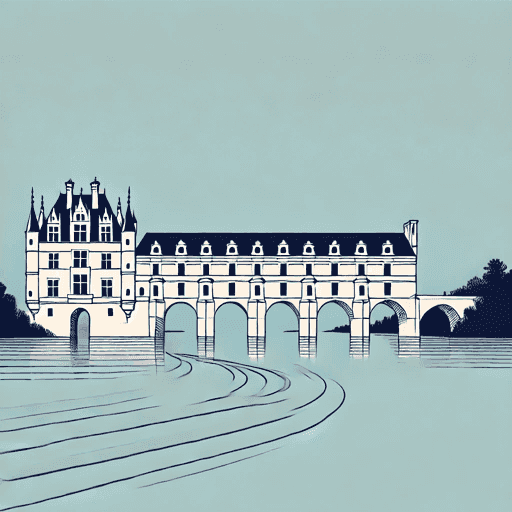
“This front door opens onto Occupied France. The back door opens onto Vichy. It’s the only bridge across the river in either direction for miles. The soldiers are stationed here to keep people from using the castle to escape to the Vichy side.”
(Chapter 12, Page 55)
Miri’s own escape from occupied France, as well as her role as a passeur, is foreshadowed in Sister Dominique’s tour, which emphasizes the proximity of the castle to Vichy France. Sister Dominique is subtly established as an ally when she ensures that Miri knows this pertinent information.
“‘My father was a doctor.’
Was a doctor. Was. Not is. Was her father no longer a doctor? Did her father no longer exist?
Beatrice glared at me as though I’d asked the questions out loud.”
(Chapter 19, Page 62)
Like Miri, Beatrice is reluctant to open up about her past. This is another subtle clue to Beatrice’s Jewish identity; Beatrice fears accidentally exposing herself, so she keeps her defenses up.
“She wore her hair pulled back beneath a dark cap and an old-fashioned cloak over dark full skirts.”
(Chapter 22, Page 67)
Catherine de’ Medici’s old-fashioned and formal clothing is a clue about her true identity—the ghost of a medieval queen. Her severe and haughty manner is also characterized by how she dresses—demurely, neatly, and modestly.
“I had been brave. I could be brave again.”
(Chapter 24, Page 75)
Bravery in the Face of Danger is an important theme; Miri is proud of herself for facing the dark castle and the Nazi guards to ensure the escape of the Jewish woman to Vichy France. Miri had feared that she was not brave enough, but she continues to prove to herself that she is capable and courageous. Tension continues to build toward Miri’s own escape to Vichy France, accompanied by Nora, Beatrice, and Elodie.
“I looked at Beatrice from the corner of my eye. Just a few days ago she’d been the one with all the questions. Now that she knew I had something to hide, she’d stopped asking. At least in front of Jacqueline.”
(Chapter 27, Page 81)
Beatrice sees Miri sneaking out at night, and her curious manner changes completely. She tries to derail Jacqueline’s questions to Miri and doesn’t ask anything of Miri in front of Jacqueline. Once again, Beatrice’s Jewish identity is hinted at. Beatrice has worked out that Miri is Jewish as well and is trying to protect her. Unlike her initial characterization, Beatrice proves herself to be a loyal and trustworthy friend.
“‘I don’t know how to use a scythe!’ I knew what one was, but barely. What did she think this was, the eighteenth century? When peasants brought in their wheat harvests by hand?”
(Chapter 28, Page 85)
Catherine’s reference to scythes is a clue that she’s from a different historical era. Miri strays close to the truth when she reflects on the strangeness of the woman’s request; Catherine is from an era when peasants brought in wheat harvests by hand.
“I stuffed a handful of berries into my mouth, crushed them beneath my teeth, and savored the entire juicy explosion, from the first mouth-puckering tartness to the scrumptious sugary end. I never tasted anything so good.”
(Chapter 29, Page 89)
Food shortages in wartime France are elucidated through the girls’ ravenous enjoyment of the fresh fruit from the castle garden. In particular, for Miri, homegrown fruit and gardens are a motif that connects her to plentiful times and to family, as she is reminded of her family’s garden in Berlin.
“‘You were screaming,’ Rosalie said, from the bed across from Beatrice’s.
‘Words we couldn’t understand,’ added Jacqueline.
In the far corner, Elodie pulled her thumb from her mouth. ‘They were Yiddish,’ she said.
Beatrice’s head swiveled round.
Elodie’s eyes widened. She looked suddenly terrified.
As was I.
Yiddish and Hebrew: two languages only spoken by Jews.
I had been shouting in Yiddish. And Elodie had understood me.
‘Don’t be stupid, Elodie,’ Beatrice snapped. ‘Of course it wasn’t Yiddish. What a ridiculous thing to say.’”
(Chapter 39, Page 114)
Miri’s nightmare threatens to expose her Jewish identity, as well as endangering Elodie, who accidentally reveals her own Jewish identity when she correctly labels the words as Yiddish. Beatrice, also a Jew, tries to protect both Miri and Elodie by dismissing Elodie’s comment. The Cumulative Horrors of Antisemitic Prejudice and Genocide are alluded to in the girls’ panicked attempts to cover up their knowledge of the language, as speaking Yiddish is a clear sign of Jewish identity, and in Nazi-occupied France after the roundup, Jewish identity is akin to a death sentence. The girls’ need to protect themselves through secrecy and evasion and their immense fear at any mistakes constitute a realistic reaction.
“Sister Annunciata said. ‘They call her Monique.’
I covered my face with my hands. ‘That’s not her name.’
‘It’s a pretty name.’
‘She’ll forget everything. She’s too young.’
Sister Annunciata leaned forward. ‘If that happened, would it necessarily be a bad thing?’
I stood up. My thoughts overwhelmed me. I said, ‘I am her family. She is mine.’”
(Chapter 46, Page 132)
Miri is faced with the difficult choice of whether to leave Nora in a safe and happy situation, but without knowledge of her family or her identity, or to risk both their lives by taking her. In asserting that they are each other’s families, Miri conveys her view that Nora’s Jewishness is a powerful and vitally important part of her identity. This gives Miri the bravery to run with her. Jewish Identity as a Source of Strength is referred to as an important theme here.
“Our sergeant summoned the officers from Paris. They’re stepping up security. They’re constructing a gate right now. A steel gate, to go across the first footbridge. Once it’s in place, they’ll lock it and no one will be able to sneak through.”
(Chapter 47, Page 133)
The construction of the gate contributes to the rising tension as the novel nears its climax; Miri must make the crossing with Nora before the gate is constructed; otherwise, they will be trapped on the occupied side of the border. The Nazi guards continue to be characterized as antagonists who threaten to derail Miri’s aspirations to live in safety and freedom.
“‘Now,’ she said. ‘The man you couldn’t save, that was part of the same roundup?’
‘Monsieur Rosenbaum? No. It was two years ago. I was ten.’
She looked grim. ‘I was ten when my uncle’s enemies sought me. Tell me, if they had found me and killed me, would I have been to blame?’”
(Chapter 47, Page 135)
Catherine forces Miri to reconsider her interpretation of the events around Monsieur Rosenbaum’s arrest, which Miri has always taken as evidence of her own cowardice. Both characters invite each other to reexamine the facts of their own lives by drawing analogies between historical and modern events. Miri is forced to concede that she did all she could for Monsieur Rosenbaum and therefore accepts and embraces the fact of her own bravery. This is an important part of Miri’s coming of age, which helps her to realize that she is ready to escape to Vichy France with Nora.
“I was not responsible for this sergeant. I was not responsible for anything the German army did.
I did not start this war.
I never hated people because they were different from me. The opposite—I agreed to help people across the castle bridge before I knew whether or not they looked or spoke or prayed like me. The only thing I truly knew was that they needed help from someone, and it was help that I could give.
I understood then what Catherine and Sister Annunciata had been trying to tell me. I’d done my best all along.”
(Chapter 48, Page 138)
In attributing blame to the Nazis for the actions of the war, including the arrest of Monsieur Rosenbaum, Miri releases the blame and criticism she held toward herself for her own inaction. Freed from this weight, Miri can see events more clearly and fully comprehends her own bravery. Bravery in the face of danger is referred to as a pivotal theme.
“‘Beatrice!’ Jacqueline laughed a little desperately. ‘You know that isn’t true. My grandparents took me to an exposition in Paris before they moved to the country. The Jew and France. I learned all kinds of things. The ways the Jews are harming the country, and how to tell Jews apart from normal people. If you’d seen it, you would understand. Until then I hadn’t realized how horrid Jews were.’”
(Chapter 48, Page 139)
Jacqueline’s narrow-minded upbringing has taught her to view Jews as undesirable enemies. The exposition taught gullible (and likely already prejudiced) Parisians that Jews are responsible for the country’s problems. Propaganda like this encouraged French people to welcome the systemic antisemitism that accompanied Nazi control and to participate in or condone the roundup. This connects to the theme of the cumulative horrors of antisemitic prejudice and genocide.
“Eventually Catherine sighed. ‘I didn’t mean for children to die. But I also didn’t try to stop the riot. I wanted the Huguenots gone, whatever that took.’
I didn’t say anything. Catherine said, ‘There might have been Huguenots who were girls like you.’
‘Or like you,’ I said. ‘Girls without parents to protect them.’
Another long silence stretched between us. Catherine said, ‘Perhaps I would choose differently now.’”
(Chapter 50, Page 145)
Catherine’s views soften and change through her relationship with Miri. Her evolution as a character is illustrated in the fact that, if she could go back in time, she would reconsider initiating the riots that killed so many; previously, she had insisted that it was justified in the pursuit of power and privilege. She becomes a more sympathetic character as Miri forces her to confront the similarities between her own actions in organizing the murder of the Huguenots and those of the Nazis in rounding up and murdering Jews.
“‘Hello, Marie,’ whispered Elodie. In Yiddish.
‘My name is Miriam,’ I said, in Yiddish also. ‘This is Nora.’
‘We’re leaving with you,’ said Beatrice. ‘We need you to get us out too.’
Beatrice said it in Yiddish.
Beatrice was Jewish, like me.”
(Chapter 53, Page 152)
The symbolism of Yiddish shifts at this point; previously, it symbolized danger and exposure, but in this exchange, it comes to symbolize strength and resistance. In speaking Yiddish together and agreeing to escape to the Vichy, the girls assert their right to their own faith and language, as well as their right to live in freedom from persecution; this refers to Jewish identity as a source of strength.
“Several days later, before Raven passed us to another passeur, she paused and raised her hands over my head. ‘Yivarechecha Adonai v’yishmerecha,’ she said.
I looked at her in wonder. Until that moment I had not known that she was Jewish too. ‘Vern heldishe,’ I replied. My mother’s Yiddish. Be brave.”
(Chapter 54, Page 155)
As in the case of the Yiddish exchange between Miri, Elodie, and Beatrice, Raven conveys solidarity and strength in her Yiddish blessing. Jewish identity as a source of strength continues to operate as a pivotal theme; she conveys the message that French Jews are resisting and surviving in spite of the Nazi regime of genocide.
“Before I left, I sang to her, one last time, my mother’s angel song.
‘Hamal’ach Hago’el osi, Hamal’ach Hago’el osi
Mikol rah, Yevarech et han’arim.
Ve’yikarei vahem shemi, Veshem avotai
Avraham veYitschak;
Veyidgu larov, Bekerev ha’aretz.’”
(Epilogue, Page 156)
Miri commemorates her and Catherine’s unique bond by singing for her; Catherine loved hearing Miri’s mother’s song. Furthermore, Miri continues to reclaim the Jewish language, which she had to hide and suppress at the convent for fear of discovery. Returning after the Holocaust and singing aloud in France in Hebrew is a demonstration of Jewish resistance and survival and links to the theme of Jewish identity as a source of strength.

Unlock every key quote and its meaning
Get 25 quotes with page numbers and clear analysis to help you reference, write, and discuss with confidence.
- Cite quotes accurately with exact page numbers
- Understand what each quote really means
- Strengthen your analysis in essays or discussions