The Ritual
64 pages • 2-hour read
Adam L.G. NevillThe Ritual
A modern alternative to SparkNotes and CliffsNotes, SuperSummary offers high-quality Study Guides with detailed chapter summaries and analysis of major themes, characters, and more.
Symbols & Motifs
Ocean
Content Warning: This section includes discussion of death and graphic violence.
The virgin forest is frequently described as an ocean in The Ritual, becoming an important motif in the text that evokes The Clash Between Modernity and Ancient Beliefs. The ocean symbolizes a vast region that is inhospitable to humans. Human-made structures, like tents and houses, are compared to ships on the ocean. The ocean, like the Scandinavian wilderness, is mostly unexplored and unreachable by humans. For example, “Out there, somewhere in the length and breadth of the countless trees and the oceans of invisible ruin and tangle, a great bow or strong limb had been snapped in half” (138, emphasis added). An ocean is a massive amount of space: It is long, wide, and deep. The forest that Luke and his friends travel through is also enormous and beyond their comprehension. They cannot see it all, as much remains invisible and untouched by people.
Humans create structures to exist within the ocean of forest, including tents and houses. Luke describes the tents’ features as ropes used on ships, and torches/flashlights as lights on a ship. While at the old woman’s cabin, Luke describes how “[t]he building listed like a boat in a squall” (390). When Luke is finally in the process of escaping, it feels like the house is not upright on solid ground, but leaning on moving water. Humans, and their creations, are miniscule in comparison to the immense forest and oceans.
When Luke reaches the edge of the forest, he feels like he is escaping from a watery landscape. Beyond the virgin woods, there is “a rocky plane, windswept and misty with rain […] Besides a scattering of small birch trees it was arid, desolate like the bottom of some great ocean that had been drained” (413, emphasis added). In experiencing his emergence from the forest in this way, Luke associates being back in civilization with being freed from the immensity of the forest.
Crosses
In The Ritual, crosses are discomforting and become symbols of evil forces. When Luke and his friends arrive at the black house, Dom says it is filled with “[e]vil Christian shit” (27). The crosses are intermingled with skulls and do not offer a sense of peace; they are a departure from the usual symbolism of Christ dying for humanity’s sins. Hutch does not hesitate to start a “fire using four of the crucifixes as tinder” (43). He has no qualms about destroying these symbols because of their unholy nature. Another reason for this is that the symbolism in the house isn’t simply Christian: There is a combination of “[c]rosses on the walls downstairs and a bloody goat in the loft. A dead man’s hands sown on. Mixing metaphors. Lunacy. Swedish lunacy. It’s the darkness and the long nights” (40). The inversion and mixing of Christian symbolism foreshadow the ancient pagan beliefs of the band Blood Frenzy and the old woman.
The Goat of Mendes, or Baphomet, is pagan or Satanic. Later, the goat/human creature arranges Hutch in a position similar to Jesus on the cross, but mutilated and in the trees. This is an image of pagan sacrifice, rather than of Christianity. Phil, Dom, and the animal from the beginning of the novel are more butchered; they aren’t as clearly in a crucified position. At the end of the novel, Loki and Fenris bind Luke to an inverted crucifix. Fenris tells Luke that he will “die on the cross of the false messiah” (360). Fenris and his friends claim to worship Odin, not the Christian God or Satan. Their inverted crosses and subversion of Christian ideas of sacrifice thus reflect their evil intentions and the threat they pose to others.
Runes
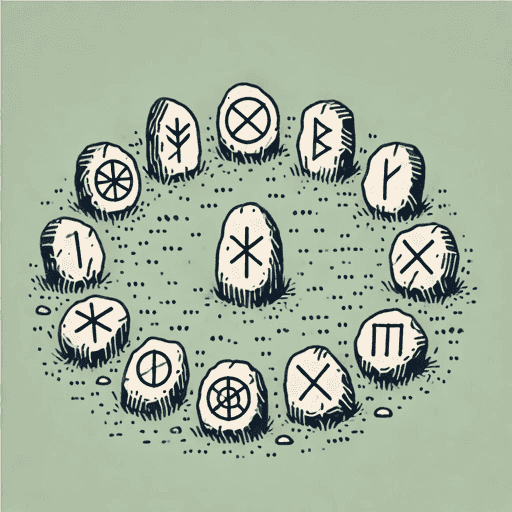
Runes are pagan representations of various qualities used in divination, energy work, and rituals that come from letterforms of old languages. Symbolic runes are combined with Satanic symbols in Fenris and Loki’s tattoos to symbolize evil and the threat the young teens represent. Luke says to Loki,
Your tattoos are a fucking contradiction […] You have a pentagram on your chest, another one on your shoulder, and an upside-down crucifix on your stomach […] But then you also have pagan tattoos. Heathen runes and shit like that. Old Norse runes all over your knuckles, Loki. A Thor’s hammer, I see. Pre-Christian. A different belief system (316-17).
This mixing of symbols reflects how the inverted cross doesn’t summon a pagan god. Loki and Fenris are unsuccessful at their ritual because it is too scattered and eclectic. In the black house, there are both runes and crosses. In the attic, with the stuffed goat/human hybrid, “Cut deep into the wood were childlike symbols and circles, like on the rune stones they had seen in Gammelstad” (39). This mixing of symbolism reflects the tensions between modernity and ancient beliefs, suggesting an older, pagan way of life that Loki and Fenris wish to recreate but cannot fully do so.

Unlock the meaning behind every key symbol & motif
See how recurring imagery, objects, and ideas shape the narrative.
- Explore how the author builds meaning through symbolism
- Understand what symbols & motifs represent in the text
- Connect recurring ideas to themes, characters, and events