The Twisted Ones
54 pages • 1-hour read
T. KingfisherThe Twisted Ones
A modern alternative to SparkNotes and CliffsNotes, SuperSummary offers high-quality Study Guides with detailed chapter summaries and analysis of major themes, characters, and more.
Chapters 1-4Chapter Summaries & Analyses
Content Warning: This section of the guide contains discussion of death, emotional abuse, and illness.
Chapter 1 Summary
The narrator, Melissa “Mouse,” recounts the events that follow retrospectively, hinting that they have deeply traumatized her. Mouse is a 30-something editor whose story began when she agreed to her father’s request to clear out her deceased grandmother’s house in North Carolina; Mouse was recently single and viewed the task as a welcome escape from her life in Pittsburgh. Her grandmother had been a cruel woman predeceased by Mouse’s step-grandfather, Cotgrave, a quiet man who had always been typing. Mouse had been in college when Cotgrave died and missed his funeral, which she later heard was attended by a “bunch of weird people” (4)—a detail that now strikes Mouse as significant.
Mouse disliked her grandmother and did not know Cotgrave well. Nevertheless, Mouse felt a sense of obligation to her father, now in his eighties, so she packed her truck and arranged for her Aunt Kate, who helped raise her after her mother’s death, to look after her house. Mouse and her coonhound, Bongo, drove to North Carolina and spent their first night in a motel, an evening she remembers as her last in the normal world.
Chapter 2 Summary
The morning after arriving in North Carolina, Mouse goes to her grandmother’s isolated house and discovers that she hoarded papers, containers, appliances, etc. The hoarding is so severe that most rooms are impassable mazes of junk. She heads into the nearby town of Pondsboro to pick up cleaning supplies and garbage bags. While there, she also stops at a coffee shop, where the barista confirms her grandmother’s reputation for being unpleasant.
Back at the house, Mouse searches the bedrooms on the ground floor for a place to sleep. She finds one room filled with unnerving baby dolls; her grandmother’s bedroom is also cluttered. To her surprise, the third room, Cotgrave’s, is neat and clean. Inside his nightstand, she finds his handwritten journal. The entries detail his wife’s cruelty and her hiding of a cherished item called the Green Book. Cotgrave references someone called Ambrose and discusses a passage that is stuck in his head that he feels a compulsive need to reread. In lieu of doing so, he writes it down: “I made faces like the faces on the rock, and I twisted myself about like the twisted ones, and I lay down flat on the ground like the dead ones” (31). Mouse is perplexed but begins cleaning out the kitchen, only to find the same phrase stuck in her head. Nevertheless, she doesn’t believe that anything is amiss and settles in for the night.
Chapter 3 Summary
Mouse has decided to sleep in Cotgrave’s room. Without anything else to occupy herself, she reads more of Cotgrave’s journal, learning that her grandmother’s cruelty drove him to sleep in the woods. He hints that he married her because “they” wouldn’t approach her, recalling a conversation with Ambrose in which they speculated that some people were more attuned to “the others.” The journal also contains several repetitions of the “twisted ones” passage; Cotgrave notes that the soothing effects of reading it in his own journal do not last as long as reading it from the Green Book. The text reminds Mouse of Cotgrave teaching her to draw the “Kilroy Was Here” doodle.
Later that night, Mouse takes Bongo outside to use the bathroom. There, he reacts with fear toward a large, carved rock in the yard. Shortly before dawn, Mouse wakes to Bongo barking at what she thinks are deer running through the yard. Meanwhile, a strange knocking from outside silences the frogs.
That morning, Mouse begins bringing items to the county dump, where an attendant named Frank suggests that she contact a commune near her grandmother’s house for help, mentioning the name Tomas. As she continues clearing the house, Tomas himself arrives, asking if she has permission to be there. She explains the situation, and he offers to help her move a heavy microwave, which he says someone named Foxy will like. Before leaving, he cryptically warns her to be careful of “things in the woods” (56), though he then dismisses it as a warning about rabid skunks.
Chapter 4 Summary
That night, Mouse reads more of Cotgrave’s journal, in which his handwriting deteriorates as he writes about being watched by “white people” in the woods, perplexed to find them on this side of the ocean after coming to the US from Wales. There are references to poppets and hills, as well as more repetitions of the “twisted ones” passages; in one place, Cotgrave announces his intention to type up as much of the Green Book as he can remember. Reading the entries, Mouse assumes Cotgrave had dementia. As she reads, she hears more tapping from outside.
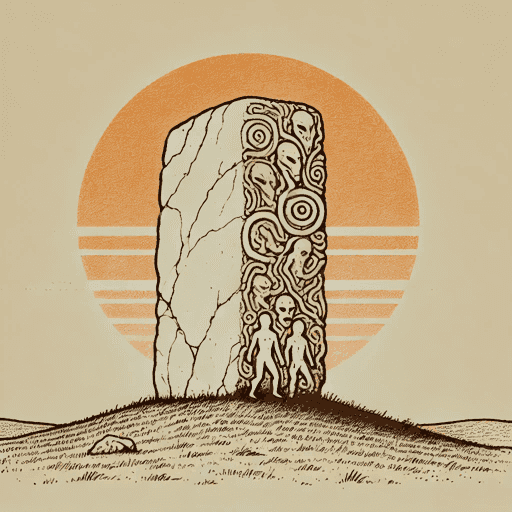
The next morning, Mouse thinks she spots an animal in the yard. On close examination, however, it proves to be the carved rock, which creates an optical illusion of a deer with its head twisted at an unnatural angle. She gets on with her day—cleaning, hauling trash to the dump, and checking her email at the coffee shop.
Later that day, Mouse’s father calls to ask how she’s faring. When she mentions the state of the house, he offers to have it demolished, but Mouse refuses, determined to find the Green Book. She takes Bongo for a walk in the woods near the house and briefly spots a pale-haired woman in hippie-style clothing watching from a distance. Bongo then leads her down a path that becomes a tunnel of interwoven branches, climbing with unnatural steepness. They emerge onto a grassy, treeless hilltop—a feature that should not exist in the area’s geography.
Chapters 1-4 Analysis
The novel’s opening chapters establish a narrative framework that interrogates the act of storytelling, positioning the narrator, Mouse, as a traumatized survivor attempting to impose order on an incomprehensible experience. Her direct address to the reader—“I am going to try to start at the beginning, even though I know you won’t believe me” (1)—functions as more than a framing device; it defines the novel’s conflict as, in part, a struggle for narrative authority. This establishes a key dynamic for the theme of The Thin Veil Between Rationality and Nightmare, hinting that reality and delusion are largely determined by social consensus rather than what is in fact true. However, Mouse immediately abandons any attempt to alter that consensus, saying, “I’m not writing this to be believed, or even to be read. […] Maybe I’m just writing this to get it all out of my head, so that I can stop thinking about it. That seems likely” (2). This foreshadows Cotgrave’s obsessive rewriting of the “litany” from the Green Book and links Mouse’s story to Cotgrave’s actions, suggesting that both are attempts to exorcise nightmarish knowledge. Mouse’s profession as an editor, someone who shapes narratives, adds irony; she is now forced to edit her own life into a story that, by her own admission, sounds “completely barking mad” (1). The retrospective narration also creates a sense of dread, as the reader understands that the ordinary world Mouse occupies is doomed to shatter.
The physical and psychological landscape of the novel is defined by The Unsettling Inheritance of Family Trauma, a theme embodied by the grandmother’s house. The property is not merely a setting but a physical manifestation of the grandmother’s overbearing presence. Each room Mouse enters presents a different facet of her grandmother’s psyche: The living room is a “terrible firetrap” of newspapers, the bathroom a “jumble of ancient shampoo bottles” (14), and one bedroom contains a collection of hyper-realistic baby dolls. This overwhelming clutter mirrors the suffocating nature of the family’s dysfunction, a legacy Mouse’s father has chosen to avoid but that she is forced to confront. The contrast between the hoarded chaos and the pristine state of Cotgrave’s room implies a sanctuary of order, but this proves somewhat ironic. The room contains the secret narrative of his suffering, physically and psychologically sealed off from the grandmother’s influence, but that narrative is itself fragmented and fantastical. This juxtaposition of Cotgrave’s torment at the hands of his wife versus at the hands of the “white people” yokes the novel’s supernatural elements to its exploration of family trauma, suggesting an allegorical reading of the supernatural elements.
The discovery of Cotgrave’s journal also introduces the novel’s structural device of nested texts and establishes the theme of The Double-Edged Power of Narrative. The journal is a “found manuscript,” a staple of Gothic and weird fiction that provides the protagonist with a guide to the impending horror. For Mouse, it is initially a means of understanding the hidden emotional abuse within her family, revealing her grandmother’s cruelty. However, the journal also lures Mouse deeper into a supernatural mystery. The cryptic, repeated litany, “I made faces like the faces on the rocks, and I twisted myself about like the twisted ones, and I lay down flat on the ground like the dead ones” (31), functions as an “earworm” that demonstrates how language can be a conduit for horror. The text is not a passive record but an active agent of the supernatural, ensnaring its reader. Mouse’s initial editorial impulse to correct Cotgrave’s grammar—“[S]he hid the book or she has hidden the book. Pick one and commit” (30)—underscores her vulnerability, as her professional skills become the tools that draw her into a narrative trap.
These chapters build a folk horror atmosphere by emphasizing the isolation of the rural North Carolina setting and introducing elements of local, suppressed knowledge. The woods surrounding the house are a liminal space where the boundary between civilization and something more primal is porous. Kingfisher establishes that in this landscape, one cannot tell if they are “thirty feet from a business park” or in “a thousand acres of uninhabited woods” (11), creating a sense of geographical and psychological disorientation. The introduction of the commune and Tomas’s cryptic warning about “things in the woods” is a classic folk horror trope (56). It hints at a shared, unspoken understanding of local dangers among local residents, a knowledge that exists parallel to the rational world from which Mouse has come.
The boundary between the psychological horror of the house and the supernatural horror of the woods dissolves through the introduction of key symbols that function as uncanny intrusions into Mouse’s reality. The carved rock in the backyard is the first tangible manifestation of the “twisted ones.” It is an object that occupies two realities simultaneously: Up close, it is abstract art, but from a distance, it creates a disturbing optical illusion of a deer with its head wrenched backward at an impossible angle. This visual paradox makes the familiar uncanny, warping a natural image into something monstrous. Bongo’s intense fear of the rock signals its supernatural significance and highlights the unreliability of normal perception. This symbol, along with the strange hollow knocking sound that silences the frogs at night, serves as an overture to the larger horror. The narrative culminates in the discovery of the hill that should not exist, reached via an unnaturally steep, woven tunnel. This geographical impossibility confirms that the laws of nature are breaking down, pulling Mouse from the realm of familial dysfunction into a landscape governed by an alien logic.

Unlock all 54 pages of this Study Guide
Get in-depth, chapter-by-chapter summaries and analysis from our literary experts.
- Grasp challenging concepts with clear, comprehensive explanations
- Revisit key plot points and ideas without rereading the book
- Share impressive insights in classes and book clubs