The Twisted Ones
A modern alternative to SparkNotes and CliffsNotes, SuperSummary offers high-quality Study Guides with detailed chapter summaries and analysis of major themes, characters, and more.
Summaries & Analyses
Quizzes
NEWReading Tools
Chapters 14-19Chapter Summaries & Analyses
Content Warning: This section of the guide includes discussion of sexual content, death, graphic violence, and pregnancy loss.
Chapter 14 Summary
Mouse spends the following day at the commune. However, Foxy is unwilling to bring supernatural trouble to her own home, so that evening, she, Mouse, Tomas, and Skip return to the grandmother’s house. Shortly after they arrive, the deer effigy knocks on the front door. To explain the situation further, Mouse and Foxy show Cotgrave’s manuscript to Tomas and Skip. After confirming its presence, Tomas attempts to film it through the peephole. However, when Skip suggests barricading the windows, Tomas stops filming to help move furniture.
The effigy begins tapping on the windows but eventually wanders off. Nevertheless, the group decides to sit up all night. They speculate on why it hasn’t attempted to break the windows, recalling supernatural beings that cannot cross a threshold uninvited, and dismiss calling the police as useless. They decide to take shifts spending the night with Mouse.
Chapter 15 Summary
The next day, Bongo returns unharmed. Attached to his collar is a note with the word “HELP” and a drawing of the “Kilroy was here” character. Thrown, Mouse wonders if Cotgrave is perhaps alive after all, or if the message came from someone who knew him. She also considers the possibility that the message is a trap set by the holler people but can’t suppress the impulse to respond. She goes to Foxy’s house, where she explains that she intends to go back into the woods with Bongo, asking her to make sure her aunt adopts Bongo if he returns and Mouse doesn’t. After a brief nap, she then drives to the coffee shop to wrap up her work obligations and to research Cotgrave online. She discovers his obituary, which mentions his membership in the Society of the Embers of Dawn.
Mouse calls the Society and learns more about the circumstances surrounding Cotgrave’s death 19 years prior: He may have died of exposure, but by the time his body was found, “the scavengers [had been] at him” (258). The man warns her to stay away from the dangerous holler people. Mouse then types a message for her family and gathers protective hickory twigs from a tree as she leaves the coffee shop.
Chapter 16 Summary
Back at Foxy’s house, Mouse prepares to venture into the woods. Foxy insists on accompanying her, convincing a reluctant Tomas to stay behind. Led by Bongo, Foxy and Mouse find the strange tunnel made of a wicker-like material. As they enter, Mouse feels a supernatural urgency, while Foxy feels a physical force pushing her back.
Inside, they hear the sound of an effigy moving through the woods just outside, pacing them as they begin running. The creature begins to strike the tunnel, shaking the entire structure. Mouse can’t keep track of which side it’s on and wonders if there is more than one effigy: “Oh God, let that be echoes let it not be two of them I can’t handle two of them I can’t even handle one of them oh God” (269). As the attacks intensify, Mouse and Foxy flee through the passage, finally stumbling out of the exit and onto the hilltop.
Chapter 17 Summary
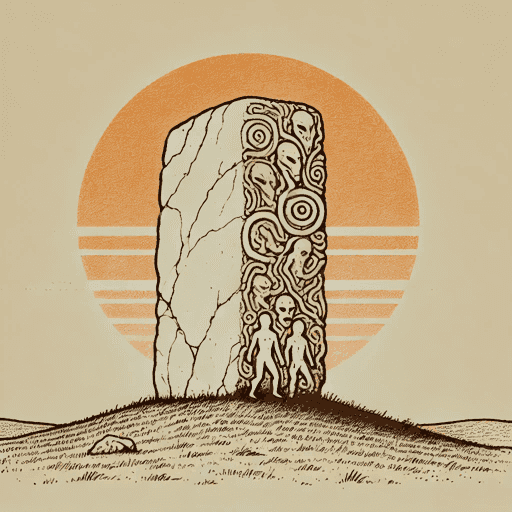
In the otherworldly field’s gray light, Foxy shows Mouse a supernatural injury on her hand; she kept hold of Mouse’s backpack during their flight through the tunnel, and the skin is now raw. Foxy recalls the difficulty she felt moving forward and concludes, “I’m not supposed to come along” (272). They head toward the large white stone, which Mouse feels drawn to, but the spell is broken when a hickory twig in her pocket brushes her hand. She puts on the hickory rosary for added protection and tells Foxy about the odd feeling. They examine the stone and see that one side is carved to resemble two horned beings mating, an image that has a hypnotic, disturbing influence on Mouse.
Foxy pulls her away but admits she, too, felt aroused; they discuss the story of the girl who was impregnated by looking at a stone. A pale woman suddenly appears, claiming she bore children from the stone: “I have borne seven […] Five drew no breaths. Of the other two…but we will speak of that later” (282). She introduces herself as Anna just as another preternaturally tall and pale figure, this one a man, appears. Suddenly, dozens of effigies materialize, circling them. Anna declares that they are trespassers and must follow her deeper into their world.
Chapter 18 Summary
Mouse protests, but the pale man threatens them with death if they refuse to comply. Anna calms Bongo with a magical gesture so that he will not resist going forward. Escorted by effigies, Mouse, Foxy, and Bongo are led through a stone archway that acts as a threshold between worlds. They descend into a silent city of pale stone with huge, nest-like structures protruding from the walls.
Anna explains they are being taken to a holding place to await their fate and leads the group across a vast square and into an opening in a hillside. Inside, they walk down a sloping, winding corridor lit by oil lamps. She leads them to a small stone room, promises to return, and locks them inside.
Chapter 19 Summary
Foxy and Mouse discuss the situation. Mouse admits that while she didn’t expect to survive this adventure, she is nevertheless overwhelmed by the strangeness of their circumstances.
Hours later, Anna enters the cell, closing the door behind her to keep the effigies outside. Abruptly, she drops her magical glamour and reveals a desperate woman begging for help. She has been a prisoner since 1973; she followed a woman who appeared to her while she was high, but that woman has since left. What she calls the “poppets” will not let her leave for more than brief outings. Realizing that Anna is the girl Cotgrave mentioned seeing in the woods, Mouse accuses her of sending the note with Bongo. Anna admits this, explaining that she hoped Mouse had “hidden folk” ancestry from Cotgrave. Anna herself has such heritage, which is why she was brought here. However, her hopes are dashed when Mouse clarifies that Cotgrave was her step-grandfather. Clutching her hickory beads, Mouse briefly sees Anna’s human and inhuman forms simultaneously.
Anna elaborates on her desperation to escape, saying that she can no longer become pregnant: “I can’t do what they want. It’s not working” (310). Mouse tentatively offers to help her leave but questions whether the other holler people will pursue her. In response, Anna reveals that only she and her companion, Uriah, are left of their kind. She warns them that the poppets will soon take them to a place called the Building and urges them to be ready. She reassumes her authoritative guise and leaves.
Foxy expresses deep mistrust of Anna, and Mouse agrees that there is something “off” about her. They discuss the apparent absence of other holler people, wondering who is making the effigies and forcing Anna to become pregnant. Exhausted, they eat the sandwiches Foxy packed and try to rest.
Chapters 14-19 Analysis
The arrival of the note on Bongo’s collar shifts the central conflict from survival to rescue and marks the culmination of the theme of The Double-Edged Power of Narrative. Before this, Mouse’s motivations were defensive and reactive. The note functions as a narrative catalyst, weaponizing Mouse’s personal history with Cotgrave and transforming an abstract supernatural horror into a concrete human crisis demanding intervention. Her act of interpretation compels her to become an active agent, even as she recognizes that the note may not be what it seems: “It didn’t matter that they might not have been asking for me specifically, that it might have been the equivalent of a note in a bottle” (250). Her research into Cotgrave’s death and the call to the Society of the Embers of Dawn are attempts to verify this narrative fragment—or, at least, to verify that Cotgrave is not its author—but she ultimately must act on limited information, choosing a “reading” and sticking to it. Sure enough, the note guides Mouse directly into what will prove to be a trap. This adds another dimension to the novel’s exploration of the dangers of narrative, suggesting that part of that danger lies in narrative’s inherent ambiguity and the consequences of misinterpretation.
The journey through the wicker tunnel and stone archway literalizes the theme of The Thin Veil Between Rationality and Nightmare, serving as a narrative and symbolic crossing of a threshold. This sequence moves the plot from a state of supernatural intrusion into the mundane world to one of total immersion in an alternate reality. The tunnel is a liminal space at the intersection of two worlds, and the journey is marked by supernatural phenomena that defy simple explanation: Mouse’s sudden sense of urgency, the physical resistance Foxy experiences, etc. Foxy’s intuition that “[s]omething doesn’t want [her] along” establishes that this other world has its own esoteric rules of entry and exclusion (267), distinguishing between those with a connection to it, like Mouse, and those without. The crossing is finalized when they pass through the stone archway and the disorienting visual effect of the carved stones ceases. This perceptual shift confirms their arrival in the “voorish dome,” a stable supernatural space separate from everyday reality.
Once inside the voorish dome, the full scope of the novel’s unnatural order begins to emerge, developing the symbolism of the effigies and stones. The effigies are no longer a singular threat but a populace, their bodies constructed from the detritus of both the natural and the human worlds—a form of supernatural hoarding that mirrors the grandmother’s compulsion. That they are assembled from items like broken shovel blades and blown-out tires connects their existence to the decay of the human world, suggesting that they are a parasitic or scavenging form of life living off the remnants of the past. Anna’s use of the term “poppets” to describe the effigies links them to the Green Book but also heightens the suspense surrounding their origins; the poppets described in the diary were creations, but as Mouse and Foxy note, there are no clear creators. The white stone carved with a scene of monstrous procreation provides another link to the Green Book and the story of the diarist’s unnatural pregnancy. The stone’s hypnotic influence on Mouse affirms these legends even before Anna reveals her own pregnancies.
The introduction of Anna destabilizes the narrative by subverting the archetype of the supernatural antagonist, replacing it with a figure of ambiguous morality and nature. She first appears as a powerful, otherworldly queen, an embodiment of the holler people’s menace, but quickly collapses this persona, revealing herself to be a desperate prisoner. However, her manipulative actions cast doubt on this narrative of victimhood: She lured Mouse with the note and orchestrated her capture. Her shifting appearance—the “glamour” that makes her seem human—is a physical manifestation of her narrative deception. Mouse’s double vision of Anna’s two forms while clutching the protective hickory beads confirms that Anna is duplicitous at a fundamental level. Foxy’s immediate and unwavering suspicion serves as an anchor for the reader, validating the sense that Anna’s story is another trap. By presenting a character who is simultaneously victim and predator, the novel dissolves any simple moral calculus, forcing the protagonists to navigate a conflict defined by competing self-serving agendas.

Get in-depth, chapter-by-chapter summaries and analysis from our literary experts.
- Grasp challenging concepts with clear, comprehensive explanations
- Revisit key plot points and ideas without rereading the book
- Share impressive insights in classes and book clubs
Related Titles
By T. Kingfisher