The Twisted Ones
54 pages • 1-hour read
T. KingfisherThe Twisted Ones
A modern alternative to SparkNotes and CliffsNotes, SuperSummary offers high-quality Study Guides with detailed chapter summaries and analysis of major themes, characters, and more.
Chapters 20-24Chapter Summaries & Analyses
Content Warning: This section of the guide includes discussion of death, graphic violence, child death, emotional abuse, and illness.
Chapter 20 Summary
Mouse is woken in her cell by Foxy and Bongo. The doorway is blocked by silent, motionless effigies. Foxy reveals a handgun, and when she aims it, the figures withdraw. Afterward, they discuss the fact that the effigies appeared without either Anna or Uriah, prompting Foxy to wonder from whom they take orders.
Anna arrives and informs them that the effigies are taking them to the Building for a “look,” promising that it will create an escape opportunity. Mouse tries to ask Anna more about the effigies, but Anna becomes irritated, saying she doesn’t know why they act as they do; neither she nor Uriah made them.
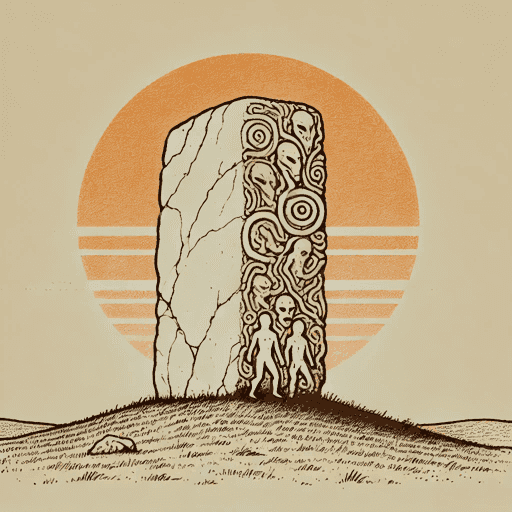
Anna, joined momentarily by Uriah, then escorts them through underground corridors lined with carvings that depict tall figures and smaller ones. Mouse initially believes the carvings depict parents and children but then concludes that they depict a ruling class and a subservient one. One image features a large figure in a burial shroud, mourned by the smaller ones, while subsequent images depict only the small figures. When the group emerges into the city, they pass through a courtyard where the effigies accompanying them perform a ritual around a carved stone; Uriah explains that they are honoring their makers. The group is then led to the Building, a colossal, nest-like mound.
Chapter 21 Summary
Carrying Bongo, Mouse enters the Building. The group ascends a long spiral tunnel with walls carved similarly to those Mouse previously noticed. They emerge onto a rooftop platform overlooking a vast pit filled with detritus where new effigies are being constructed: “The surface rippled like a pregnant animal’s sides, heaving with contractions. Effigies picked their way across the mound like water bugs skating on the surface of a pond, tugging bits loose, binding them together” (338). Putting all that she has heard together, Mouse realizes that the holler people have largely died out and that the effigies are now making themselves.
Anna presents the captives to the assembled effigies, who debate their fate with sharp clicking sounds that Anna translates. She explains that if the effigies do not choose to “keep” Mouse and her companions, they will use them to construct more effigies. She further notes that the creatures, who seek to breed new masters, are unsure whether they can use Mouse for this purpose: “The old ones say that they must wait for better stock. Masters bred from your flesh will be weak, even with the white stone, as mine have become weak. The newer ones say that even those can be used for materials” (340).
Anna turns away, apparently disappointed, and Mouse realizes that Anna hoped that by bringing them to the effigies, she could earn her own freedom. As the effigies continue to debate, Anna leads Mouse and the others toward the Building’s exit. Seizing the chance, Foxy restrains Anna and forces her to cooperate. As they emerge outside, Anna grabs a piece of rebar and kills Uriah.
Chapter 22 Summary
Anna explains that Uriah’s murder will create a diversion, as the effigies are compelled to perform mourning rituals for their “masters.” The group flees through the dead city. When Foxy shoots two pursuing headless effigies, Anna begins crying, and Mouse realizes that her two surviving children were used to create them.
They race up a hillside, fighting off another attack before reaching the hill of white stones, where a massive tide of effigies appears behind them. Their escape through the wicker tunnel is also blocked by an effigy. Foxy shoots it, and Mouse stomps its remains to free Bongo, whom it grabs as it falls. As Foxy enters the tunnel, Anna grabs Mouse and offers her to the pursuers in exchange for her own freedom. Mouse trips Anna with Bongo’s leash, injuring her own wrist as they fall. Foxy then pulls Mouse into the tunnel as the effigy swarm converges on Anna. Foxy fires her last bullets into the mass as Anna’s screams fade. They race down the tunnel, emerging to find the front door of the grandmother’s house standing wide open.
Chapter 23 Summary
As Foxy and Mouse debate what to do, the deer effigy emerges from behind Mouse’s truck. Foxy, Mouse, and Bongo race inside, shutting the door behind them. The effigy begins tapping on the windows. In addition to horror, Mouse now feels confusion, as she knows she is of little use to the effigies. As she stares at it, she realizes that its rib cage looks human and suddenly understands that it is made from Cotgrave’s remains and is trying to reenter its own house.
Just then, Bongo begins to growl at something in the doll room: a new “hoarding effigy” assembled from the junk and doll parts that Mouse left in a bin in her truck. The effigy chases them but slips on a linoleum floor. This gives them time to run upstairs, where Mouse, Foxy, and Bongo barricade themselves in a room. The hoarding effigy begins breaking through the wall, apparently animated by the “gleeful malice” of Mouse’s grandmother. Trapped, Mouse decides to burn the house down. Using Foxy’s lighter, she starts a fire, and they escape onto the porch roof, pursued by the effigy, which is now on fire. They jump from the roof to Mouse’s truck, but the burning creature lands on the hood as Mouse turns the engine on. She accelerates and then slams on the brakes, throwing it off. As they drive away, Mouse sees the Cotgrave effigy calmly lie down beside the other.
Chapter 24 Summary
Foxy drives Mouse to an emergency room. They give Officer Bob a cover story about squatters to explain their injuries and the fire. Tomas picks Foxy up, and Mouse eventually drives home to Pittsburgh with Bongo. She receives Cotgrave’s Green Book manuscript in the mail, stores it in a safe-deposit box, and donates the insurance payout on the house to public radio in Cotgrave’s name.
Mouse does not tell her father what happened but struggles with her trauma—in particular, the knowledge that it was only the hoarding effigy slipping on the linoleum floor that saved her life. However, she finds comfort in Bongo and her hickory beads and stays in contact with Foxy, who is managing her heart condition. Mouse concludes that Foxy must have used her last bullets to kill Anna but resolves never to ask so that Foxy will never have to lie. She hopes that Anna did not survive, as she cannot imagine enduring what Anna did.
Chapters 20-24 Analysis
These final chapters subvert conventional horror tropes by revealing the effigies as an autonomous, post-human system. Mouse’s realization that “[t]hey [the effigies] were making themselves” is a pivot point (338), shifting the nature of the threat from a directed malevolence to an entropic, instinct-driven force. The masters are gone, but their servants remain, continuing a mission whose original purpose is lost. The imagery associated with the Building underscores the alien nature of this threat. Described as a colossal structure resembling a “paper wasp nest” (336), the Building represents a collective, inhuman, and organic mode of evil. Its nest-like construction suggests a hive mind, where individuality is subsumed by an instinctual drive to build and replicate.
Nevertheless, the horror that the Building embodies is not entirely inhuman. The carvings in the underground corridors provide a visual history of not only the effigies’ abandonment but also their desperate attempts to recreate their creators by kidnapping Anna and others with “holler people” blood, and it is through this mission that the novel solidifies the relationship between the supernatural and domestic horror. It is unclear what exactly the relationship between the holler people and their “poppets” was, but the multiple images of ritualized subordination imply that it was exploitative. That the effigies now feel compelled to recreate a past in which they were subservient echoes the psychological dynamics of domestic abuse—a point underscored by the fact that Cotgrave recreates his abusive wife in effigy form and then chooses to die alongside it. The novel’s climax and resolution thus bring the central theme of The Unsettling Inheritance of Family Trauma to a definitive conclusion, externalizing generations of psychological abuse into a tangible, monstrous form. The grandmother’s house, long a symbol of cruelty, transforms from a passive setting into an active antagonist through the creation of the hoarding effigy. This creature, a figure of “papier-mâché of old newspapers, layered like the Building itself, furred with bits of cardboard boxes and old bottles of cleaner” (364), is the embodiment of the grandmother’s malice and Cotgrave’s suffering. Mouse’s decision to burn the house is therefore not merely an escape tactic but an act of catharsis. By destroying the physical structure, she breaks the cycle of trauma, “burying” the past once and for all.
While this act resolves Mouse’s personal haunting, the voorish dome and its Building remain untouched, an enduring feature of a larger, cosmic hostility. The persistence of this other world signifies that while one may conquer the monsters of one’s own family, reality remains perpetually threatened by alien logics that operate just beyond the edge of the woods. The final chapter sees Mouse attempting to cope with The Thin Veil Between Reality and Nightmare, and the narrative offers her two pathways, embodied in the contrasting characterizations of Foxy and Anna. Foxy represents an adaptive resilience rooted in folk wisdom and pragmatism. She confronts the incomprehensible not by trying to rationalize it, but by accepting its existence and preparing accordingly with talismans like hickory beads and practical tools like a handgun. Her worldview allows for the uncanny and is thus better equipped not only to survive it, but to do so with the core of who she is intact. Anna, conversely, is so traumatized by her experiences of the other world that she abandons morality, prioritizing nothing but her own freedom. When Mouse, positioned between these two figures, must ultimately choose a model for her own survival, she rejects Anna’s solitary, amoral path in favor of Foxy’s collaborative one. Her escape is secured not through individual cunning but through teamwork and trust, suggesting that survival in a nightmare world depends on clinging to the communal values of the world left behind.
The climax also completes the novel’s exploration of The Double-Edged Power of Narrative, demonstrating the limits of interpretation. Mouse is drawn into the voorish dome by deciphering nested texts—Cotgrave’s journal, the Green Book manuscript, and Anna’s deceptive note—but neither the texts nor Mouse’s professional skills of analysis and interpretation lead her back out. Knowledge of the effigies’ history or Anna’s motives does not provide a path to freedom. Instead, survival hinges on concrete acts: She uses a dog leash to trip Anna and sets her own inheritance ablaze, actions that are improvisational and physical rather than intellectual. The final fate of the Green Book manuscript—placement in a safe-deposit box—is a symbolic gesture. She neither destroys the dangerous knowledge nor attempts to master it further. Instead, she chooses containment, acknowledging the power of the story while refusing to let it define her reality.

Unlock all 54 pages of this Study Guide
Get in-depth, chapter-by-chapter summaries and analysis from our literary experts.
- Grasp challenging concepts with clear, comprehensive explanations
- Revisit key plot points and ideas without rereading the book
- Share impressive insights in classes and book clubs