The Twisted Ones
54 pages • 1-hour read
T. KingfisherThe Twisted Ones
A modern alternative to SparkNotes and CliffsNotes, SuperSummary offers high-quality Study Guides with detailed chapter summaries and analysis of major themes, characters, and more.
Chapters 5-8Chapter Summaries & Analyses
Content Warning: This section of the guide includes discussion of animal death, graphic violence, and emotional abuse.
Chapter 5 Summary
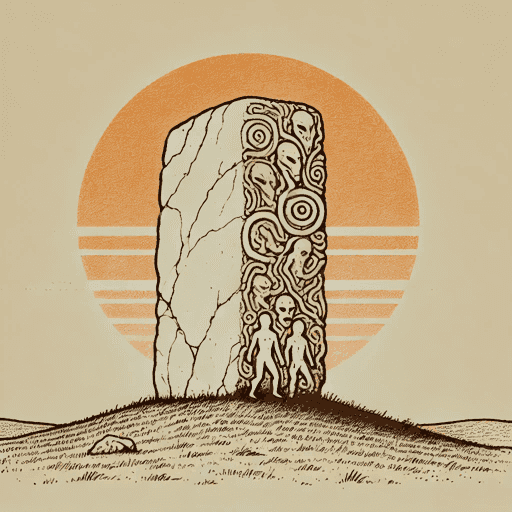
On the impossible Appalachian bald, Mouse notices a strange lack of birdsong. The surrounding trees are also entirely bare, and there are large white and gray stones scattered across the hill. After walking a bit down one side and turning, she is startled to see that the stones are carved with grotesque faces and twisted shapes, more disturbing than the one in the yard. Some stand upright, while others, depicting contorted human shapes, lie flat on the ground. Her phone dies after she takes one photograph.
Bongo leads her to a tall, white monolith surrounded by smaller rocks. Mouse feels an unnatural compulsion to touch it but resists; however, she snaps at Bongo when he refuses to move, which she then realizes was uncalled for. As they make their way back up the hill, she realizes with horror that the stones match the description of the twisted ones from Cotgrave’s journal. She wonders if he carved them himself but can’t believe the man she knew would have done so: “You couldn’t possibly create something like that and then wander around like a normal person, going to the grocery store and worrying about heart medication and paying the water bill, could you?” (94). Recalling the passage about “making faces” like the stones, she attempts to mimic one carving’s expression; her jaw locks open until she panics and forces it shut with her hands. Terrified, Mouse and Bongo flee back to the house. Shortly after, the doorbell rings and Foxy bursts in.
Chapter 6 Summary
Foxy, a tall, older woman wearing mismatched colorful clothes, thanks Mouse for the microwave but then expresses concern that she’s not eating properly, inviting her to dinner at the nearby commune. Before leaving, Mouse reads more of Cotgrave’s journal; the entries describe seeing one of “their poppets” and a strange girl in the woods who he suggests might have been a changeling. He also references hiding the typed manuscript, which he has nearly completed.
At dinner, Mouse meets Foxy and Tomas’s other housemate, Skip. When they ask how she’s faring, she casually mentions the hill and the stones, prompting silence. Eventually, they confirm that the hill exists but warn that it is a dangerous place that sometimes isn’t there. They don’t know who made the stones, but Tomas advises her to avoid the place. She then asks about Cotgrave, whom Skip remembers as a kind man who tended to ramble. No one has heard of Ambrose.
The next day, Mouse searches the house for the manuscript but cannot find it. That night, she dreams of talking to Cotgrave while searching for something; the scene then changes, and she finds herself willingly embracing the monolith, the object she was seeking. Bongo’s barking wakes her, and she sees a deer outside moving with a stooped, unnatural gait. She checks the photograph she took of the stone, but the image is distorted and unusable.
Chapter 7 Summary
The following day, Mouse talks to her father on the phone. She seizes the opportunity to ask about Cotgrave and learns that he died from exposure after wandering into the woods behind the house. He reiterates his offer to have the house demolished, but she is more committed to finding the manuscript and/or Green Book than ever.
Mouse spends the day cleaning and making dump runs; while clearing a room of its dolls, she is startled when one’s eyelids move but then realizes it’s a weighted mechanism. Over the next few days, she settles into a routine that includes having dinner at the commune. Tomas helps her clean her grandmother’s bedroom, but she still finds no manuscript.
By this point, she has largely written off her strange experiences on the hill, but this changes abruptly and dramatically: “[T]hen the next thing happened, and this it was something I couldn’t ignore” (123). After a day of rain, Mouse takes a restless Bongo for a walk, avoiding the path to the bald. Near a cow pasture, they find a gruesome effigy: a deer carcass split open and crucified between two trees, its head replaced with an upside-down animal skull and stones tied to its ribs. Horrified, Mouse and Bongo flee back to the house.
Chapter 8 Summary
After sprinting back to the house, Mouse drives into Pondsboro and breaks down crying in a supermarket parking lot. Enid, the Goth barista from the coffee shop, finds her there and suggests that she speak with a police officer who is a regular customer. Mouse accordingly goes with Enid to the coffee shop and waits for the policeman, Officer Bob.
When Officer Bob arrives, he patiently listens to Mouse’s story about the effigy, agreeing to investigate. At his request, Mouse types up a formal report. She then goes home, where he meets her, mentioning that her grandmother often made false complaints about the commune residents. Mouse, Bongo, and Officer Bob then head into the woods to find the site.
Chapters 5-8 Analysis
These chapters mark a critical transition in the narrative, moving from psychological unease into objective, physical horror. This shift develops the theme of The Thin Veil Between Rationality and Nightmare, demonstrating the fragility of rational order when confronted with the impossible. Mouse’s arrival at the Appalachian bald—a geographical anomaly she can identify but not explain—represents the initial breach of this veil. Her internal monologue documents her attempts to rationalize the experience: “So my options were that I was dreaming, hallucinating, or that Bongo and I had just walked a few hundred miles in twenty minutes” (81). Her cognitive dissonance underscores the central horror: The world is not as it seems, and established knowledge is insufficient. As active entities that exert a palpable influence, the carved stones function as concrete symbols of this encroaching alternate reality. When Mouse feels an unnatural compulsion toward the monolith and her jaw locks while mimicking a carving, the boundary between observer and participant dissolves. The supernatural is no longer a curiosity recorded in a journal but an immediate threat that can violate her bodily autonomy, confirming that the nightmare has permeated her reality. Nevertheless, the incident is subtle enough that Mouse can compartmentalize it even after her neighbors’ warnings.
The introduction of the crucified deer, as Mouse’s narration highlights, marks an escalation that resists such compartmentalization. It shifts the primary source of horror from the uncanny stones to the active malevolence embodied by the effigies motif. The grotesque construction represents a deliberate and hostile artistry. Unlike the stones, which seem to be a feature of the landscape, the deer effigy is a fresh and immediate desecration of the natural order even before it violates reality as Mouse understands it by moving. Its upside-down head symbolizes both its inversion of reality and the psychologically destabilizing effects of that inversion.
Meanwhile, the novel continues its exploration of The Double-Edged Power of Narrative through Cotgrave’s journal, which has an increasingly pronounced supernatural influence on Mouse. When Mouse instinctively acts out Cotgrave’s “litany” on the hill, the narrative demonstrates that the text itself can transmit the horror it describes. This act of imitation, which results in her physical paralysis, illustrates how the story serves as a trap, ensnaring the reader in the phenomena it documents. Mouse’s continued search for Cotgrave’s manuscript thus contributes to the increasingly ominous atmosphere, particularly because, as she herself realizes, her desire to find it is disproportionate and out of character: “I was shocked by my own resistance to the idea [of demolishing the house]. A few days ago I’d been seriously contemplating throwing in the towel. Now, having seen the carved rocks, I wanted to get to the bottom of Cotgrave’s mystery” (115). Such passages serve as subtle metafictional commentary, implicating the reader’s presumed desire to learn the novel’s secrets and suggesting that it, too, could be dangerous.
Through Mouse’s evolving motivations for cleaning the house, the narrative connects the supernatural horror to The Unsettling Inheritance of Family Trauma. Similarly, the revelation that Cotgrave died of exposure implicitly links the grandmother’s malevolence—the cause of his outings—to the physical and supernatural dangers of the woods. The hoarding and clutter motif reinforces this connection; the house is a chaotic space that mirrors the incomprehensible nature of the forces outside. In this context, Mouse’s decision to remain in the house marks a more positive character shift. She breaks from her father’s pattern of avoidance, choosing instead to engage with the inherited horror. At the same time, the parallels the novel establishes between the effigy (described by Cotgrave as a “poppet”) and the grandmother’s clutter (which includes dolls) suggest that some things should remain relegated to the past.
The narrative employs juxtaposition to amplify tension by placing the mundane against the monstrous. This technique grounds the otherworldly horror in a realistic contemporary setting, making the intrusions more jarring. After fleeing the mind-altering influence of the carved stones, Mouse’s terror is interrupted by the prosaic arrival of her neighbor, Foxy. Similarly, after Mouse’s discovery of the crucified deer, her flight from a potentially inhuman killer leads to a crying spell in a supermarket parking lot and a calming conversation with a barista. This oscillation between the horrific and the banal serves a dual purpose. Firstly, it heightens the sense of isolation Mouse feels, as the everyday world continues, oblivious to the threat she has witnessed. Secondly, it forces her to attempt to translate her incomprehensible experiences, as when she struggles to describe the deer effigy in the logical, bureaucratic language of a police report. Mouse’s desperate search for a rational explanation for the effigy, hoping that she might find “a tag that said it was a Halloween decoration […] even a goddamn artist statement nailed to the tree” (128), encapsulates this conflict. The friction between these two realities is a central source of dread.

Unlock all 54 pages of this Study Guide
Get in-depth, chapter-by-chapter summaries and analysis from our literary experts.
- Grasp challenging concepts with clear, comprehensive explanations
- Revisit key plot points and ideas without rereading the book
- Share impressive insights in classes and book clubs