The Twisted Ones
54 pages • 1-hour read
T. KingfisherThe Twisted Ones
A modern alternative to SparkNotes and CliffsNotes, SuperSummary offers high-quality Study Guides with detailed chapter summaries and analysis of major themes, characters, and more.
Chapters 9-13Chapter Summaries & Analyses
Content Warning: This section of the guide includes discussion of animal death, child death, and sexual conten.t
Chapter 9 Summary
Mouse leads Officer Bob into the woods, but they find no trace of the deer effigy; he speculates that it might have been a prank made by “kids.” Mouse recounts this theory to Foxy when the latter drops off dinner at her house, but Foxy expresses skepticism. That night, Mouse wakes again to Bongo’s barking and sees the stooped deer she’d noticed before. The next day at the coffee shop, Enid suggests that Mouse look up the county property records to see whose land the effigy was on. In doing so, Mouse discovers that the hill with the carved stones does not exist on any official maps.
That night, Mouse is once again jolted awake by Bongo barking ferociously. At her window, she sees the deer effigy tapping against the glass with the stones tied to its ribs: “It moved like a living thing, like a great bird, turning the skull head on the hanging folds of neck” (151). Horrified, she realizes that the sound of the stones knocking is the tapping noise she believed to be woodpeckers. After the effigy moves out of sight, Mouse hides in a closet with Bongo, resolving to leave for good in the morning.
The next morning, however, Mouse trips on a bone left on the porch and falls, losing her grip on Bongo’s leash. He bolts into the woods and does not return. Unwilling to abandon her dog, Mouse vows to stay until she finds him.
Chapter 10 Summary
Mouse spends the day calling animal shelters and examining the bone, which is stained with red clay. Uncertain of what else to do and in an attempt to control her panic, she continues cleaning out the doll room, loading bins of junk into her truck. Foxy appears while she’s doing so, startling her and prompting her to burst into tears.
Foxy takes her back to her porch to calm down. There, Mouse confesses everything she has experienced. To her surprise, Foxy believes her, referencing local lore about the “holler people,” beings from a parallel reality who animate effigies made from dead animals. She herself encountered one with a hog’s body and a beehive for a head, as well as a raccoon “held together with cords ’n’ junk” (165). Mouse explains Cotgrave encountered “holler people,” whom he called “white people,” in Wales, and Foxy agrees that they could exist worldwide. She explains that hickory wood offers protection from their influence and gives Mouse a hickory rosary and roots to carry.
Feeling more grounded, Mouse searches the woods around the house for Bongo before returning to her grandmother’s house. There, she moves her mattress into the windowless bathroom to sleep. On the now bare box spring, she discovers Cotgrave’s typed manuscript.
Chapter 11 Summary
Mouse begins reading Cotgrave’s manuscript, a transcription and commentary on a diary known as the Green Book, given to Cotgrave by Ambrose. It was written by a teenage girl, presumably Welsh, who was the daughter of someone Ambrose knew. Mouse tries to estimate the date of the diary’s writing but realizes it could have been any time between the late 18th century and the early 20th, depending on the ages of others involved.
The diary is fragmented and nonlinear due to both narrative style and Ambrose’s incomplete recollections. In it, the girl references possessing secret knowledge—what Ambrose terms the “sin […] of seeking things outside the natural order” (172)—and describes mysterious rituals that Ambrose equates with folk magic. She also recounts meetings with supernatural, ivory-like beings she calls the “white people,” some of whom visited her in her early childhood. There are also several words that neither Cotgrave nor Ambrose understood the meaning of, including “Aklo” and “Alala.”
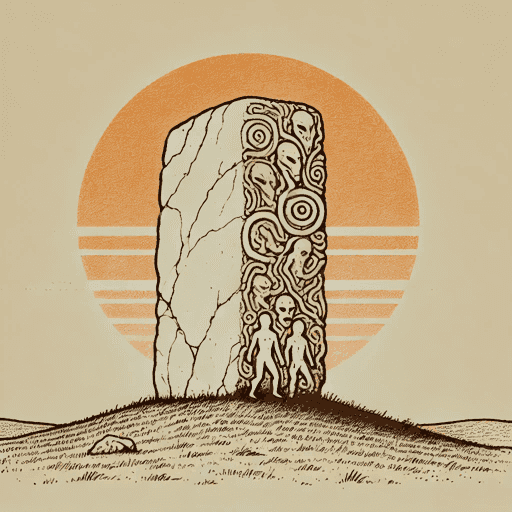
The diary eventually recounts a journey to a hill of twisted, gray stones carved to look like people and animals—a perfect description of the hill Mouse found. She is shocked to read a phrase from the diarist, “I twisted myself about like the twisted ones” (188), which is identical to the litany Cotgrave repeated in his own journal. In his notes, Cotgrave speculates on the terms “voor” and “voorish,” which appear in connection with this place, wondering if they are similar to a glamor enchantment. Stunned by the parallels, Mouse continues reading.
Chapter 12 Summary
As Cotgrave continues to describe what he recalls of the girl’s journey, he wonders how his own experiences are shaping his memory of the text, and vice versa: “It may be that [the manuscript] is tainted by my own experience of the stones. Or perhaps, since I read the Green Book long before I climbed the hill myself, my experience of the stones was tainted by reading the book” (190). The girl’s narrative follows her through briars that sting and cut her. She dances and sings throughout her journey, progressing by a magical stream that she drinks from and arriving at a mossy barrier that she believes marks the boundary between ordinary reality and “Voor,” which she describes as “where the light goes when it is put out, and the water goes when the sun takes it away” (192). She climbs this wall and sees a fantastical hilly land beyond it. The girl’s journey culminates with her finding a mysterious forest and encountering a “wonderful sight.”
The diary also describes several stories the girl heard from her nurse: One is about a woman who died on her wedding night, having apparently married a supernatural being when she visited an evil hollow, while another is about a man who drinks from a cup given to him by a fairy queen. Cotgrave speculates that the nurse was in some way associated with the “white people” and that the girl might have been a changeling.
Foxy arrives with dinner and offers to stay the night. Mouse asks her if she will read the manuscript, and she agrees. They continue, Cotgrave describing various stories the girl’s nurse told her, including one about a figure named Lady Cassap, implied to be one of the “white people”; she has many suitors, whom she kills by means of fashioning poppets. The nurse teaches the girl herself to make poppets and to play “odd game[s]” with them. The girl at times doubts whether her experiences are real but finally has one that convinces her of her truth, though she does not describe it. Afterward, she makes a poppet and returns to the hill of stones, where she was later found dead before a statue of “copulating beings.” She was discovered to be pregnant, an apparent result of the statue’s influence. Ambrose himself destroyed the stone following this. In the final section, Cotgrave confirms he saw the white people in both Wales and North Carolina; he also says that he sometimes sees a girl in the woods behind the house and has tried to tell her of the dangers.
Foxy and Mouse intermittently pause while reading to discuss what they learn. Foxy confesses that she once came across the hill behind the grandmother’s house while hunting; she had followed a deer there, and she speculates that animals are more easily able to slip between worlds. They also discuss whether to destroy the carved stone in the yard.
Chapter 13 Summary
Mouse reflects on the girl’s story, wondering if she simply became pregnant through natural means but struggling to imagine why, in that case, she would have constructed such an elaborate story in her diary. After Foxy finishes reading, she affirms her belief that the story is real, though she doesn’t know much about the “holler people” beyond her own experiences of effigies. Mouse shows her a photo of the bone she tripped on, but Foxy doesn’t know what animal the bone came from.
Unsure what else to do, Mouse and Foxy clear the junk-filled staircase. The upstairs is mostly empty, except for a large, stuffed moose head, which they carry downstairs after Foxy expresses interest in it.
Later that night, Mouse wakes to Foxy telling her there’s something outside. They look out a window and witness the deer effigy in the yard, herding two living deer. Mouse wonders whether destroying the effigy would put a stop to everything that is happening, but Foxy is doubtful. Suddenly, violent banging erupts from the front door. Mouse looks through the peephole and sees the effigy’s grinning, upside-down skull staring back. The effigy slams its body against the door, and when that fails, it taps on a window before wandering off. Unsure if it is gone, Mouse and Foxy wait together in the kitchen for dawn.
Chapters 9-13 Analysis
The introduction of Cotgrave’s manuscript, containing his transcription of the 19th-century “Green Book,” develops the theme of The Double-Edged Power of Narrative. As a professional editor, Mouse is equipped to parse these nested texts, yet her skills in imposing order run up against the fragmented nature of both the Green Book and Cotgrave’s recollection of it. Moreover, the diary is of limited use as a lexicon and historical precedent for the supernatural phenomena Mouse confronts; it constantly gestures outside itself, referencing stories it does not always finish and using words (such as “voor”) drawn from contexts that it does not explain. The effect is therefore not so much to explicate as it is to pull the reader further into a search for meaning. Ambrose’s words about “seeking things outside the natural order” imply that this could be a dangerous search for forbidden knowledge (172)—a parallel to the “secrets” the girl herself discovers. In this, Kingfisher plays with the short story by Arthur Machen that inspired the novel. “The White People” itself features an embedded narrative—the Green Book that appears piecemeal in The Twisted Ones—which the Ambrose character offers as an example of someone who “sinned” by pursuing arcane knowledge. However, the story itself does not become a point of obsession, and thus an incitement to “sin,” as it does in The Twisted Ones.
The passages from the Green Book and complex allusions to “The White People” also clarify the novel’s debt to various horror subgenres. The narrative is largely situated within the folk horror subgenre, using the Green Book as a device to connect the localized American threat to a deeper European folklore with hints of witchcraft, paganism, and fairies. However, “The White People” also anticipates many elements of cosmic horror—in particular, the idea that knowledge of a hidden, ancient world is dangerous by its very nature, eroding the rationality of the person who possesses it. In The Twisted Ones, these genres meet in the woods where the rules of reality break down: The impossible hill is accessed through a woven tunnel, the effigy appears and disappears, and Bongo is lost to its depths. The setting is a permeable membrane between the mundane world and the “voorish dome” of the holler people. Cotgrave’s manuscript, with its echoes of antiquarian horror, serves to universalize the threat, suggesting that the holler people are a fundamental force that manifests in different cultures but represents the same primordial intrusion of the unnatural.
These chapters dismantle the boundaries of ordinary reality by juxtaposing mundane bureaucracy with impossible, supernatural intrusions. Mouse’s initial attempts to manage the escalating horror rely on the tools of a rational world: She reports the effigy to Officer Bob and consults county property websites. The failure of these systems serves to isolate her and develops the theme of The Thin Veil Between Rationality and Nightmare, forcing Mouse to confront the inadequacy of her worldview. The character of Foxy functions as a narrative foil, offering an alternative epistemology rooted in folk wisdom. Her explanation of the “holler people” and a world where hills can appear and disappear—“Sometimes there are, sometimes there ain’t” (164)—provides a framework that, while terrifying, is more functional than Mouse’s collapsing rationalism. This contrast suggests that rationality is not the ability to distinguish fact from fiction as they are conventionally understood, but the flexibility to adopt a new paradigm when the old one proves useless. The hickory beads Foxy provides are a key symbol of this alternate logic: a tangible piece of the “normal” world used as a talisman against the weird.
The loss of Bongo is the catalyst for Mouse’s character development, forcing her to transition from a passive victim into an active agent. Her immediate decision after the effigy appears at her window is to flee—an act of avoidance that mirrors her father’s refusal to deal with the grandmother’s house. This flight halts when Bongo runs into the woods. Her subsequent vow, “Until I had him back, or had proof he wasn’t coming back, I was going to stay” (157), marks a pivotal shift. Her decision connects directly to the theme of The Unsettling Inheritance of Family Trauma. By refusing to abandon Bongo, she implicitly refuses to abandon the metaphorical and literal mess her family has left behind, affirming her responsibility to others. Her growing reliance on Foxy further underscores her shift away from the isolated individualism of her city life—as she wistfully notes, “You could imagine living in Pondsboro and learning people’s names and actually knowing a little bit about their lives. I didn’t have that in Pittsburgh” (125)—toward a community-based approach necessary for survival.
Throughout this section, the deer effigy evolves from a static object of dread into a sentient agent of an alien order. Its escalation as a threat—from a grotesque but inanimate display in the woods, to a tapping presence at the window, to an active predator herding living deer, and finally to a violent force attempting to breach the house—is a convention of the horror genre, meant to gradually ratchet up the narrative tension. The act of herding deer suggests a parody of natural cycles: death pursuing life. However, as a dead thing that is able to move, it also flouts the natural order outright. This, as much as the references to “poppets,” connects it to the Green Book via Ambrose’s musings on “sin”:
Ambrose spoke often of how terrifying it would be if flowers began to sing to us, or a dog to speak, in violation of the natural order. He spoke of such violation as the true form of sin. And yet now there are theme parks where you can go and mechanical flowers will sing, movies where dogs will talk. Have we thus all begun to sin, or have our senses become numbed so that we will no longer recognize true sin when we see it? (192).
Cotgrave’s discussion of the modern world’s normalization of the uncanny hints at how Kingfisher has adapted “The White People” for a contemporary readership. The novel will ultimately link the effigies to the grandmother’s hoarding in ways that are both literal and metaphorical. However, Mouse does not recognize that, in the novel’s schema, they embody a similar kind of “wrongness” until it is almost too late.

Unlock all 54 pages of this Study Guide
Get in-depth, chapter-by-chapter summaries and analysis from our literary experts.
- Grasp challenging concepts with clear, comprehensive explanations
- Revisit key plot points and ideas without rereading the book
- Share impressive insights in classes and book clubs