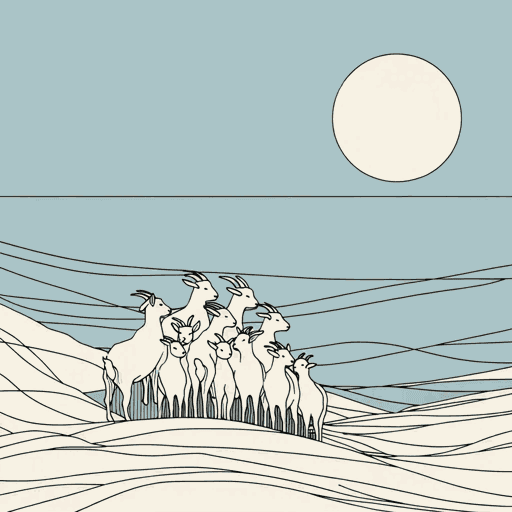
300 Goats
A modern alternative to SparkNotes and CliffsNotes, SuperSummary offers high-quality Study Guides with detailed chapter summaries and analysis of major themes, characters, and more.
Further Reading & Resources
Related Poems
“Famous” by Naomi Shihab Nye (2015)
This link leads to a short film interpretation by Motionpoems of Nye’s poem, “Famous.” The poem is concerned with intimacy, perception, and identity. As in “300 Goats,” one of the themes is that beings are intuitively capable.
“To Jamyla Bolden of Ferguson, Missouri” by Naomi Shihab Nye (2016)
As opposed to “300 Goats,” this poem addresses the inability to protect children, not from inclement environmental conditions in the natural world, but from gunfire. The poem refers to a historical Ferguson categorized by farmland and a time that the speaker remembers nostalgically as safer for children.
“In California: Morning, Evening, Late January” by Denise Levertov (1989)
In this poem of place and the environment, Levertov illustrates a landscape manipulated by human intervention—through which—choked and cemented over—nature somehow persists.
“Iowa City: Early April” by Robert Haas (1996)
Throughout this poem by Robert Haas, the speaker makes a strong attempt to observe the animals of his Iowa neighborhood without imbuing them with too much human quality. In a dream, however, the visiting deer “looked at me with a stilled defiant terror, like a thing with no choices” (Line 18). The poem balances an effort to see the natural world clearly with a desire to know the self.
“The Pond” by Gregory Orr (2002)
In this poem, the speaker describes a scenario in which a neighbor seeks to save baby geese from being eaten by resident snapping turtles. The neighbor baits and catches a few of the predators, but there is evidence that the turtles—and nature—will ultimately prevail.
Further Literary Resources
“Roots: On Language and Heritage: A Conversation with Naomi Shihab Nye” by Kate Long (2009)
This discussion between Kate Long and Nye considers how Nye’s and others’ work use language to connect people across heritage, generations, and political divides. In contrast to the icy field in “300 Goats,” Nye refers to “a field inside our bodies that has no age attached to it, but in a certain light, bears a golden sheen.”
“If He Asks Where He Is, Say Gone” by The Poetry Magazine Podcast (2016)
In this podcast, Poetry Magazine editors discuss poems devoted to ecojustice, including Nye’s “300 Goats.” Additional readings include poems by Brenda Hillman, Danez Smith, and Jane Mead.
“Liminal Encounters: Ethics of Anthropomorphism in the Poetry of Levertov, Szymborska, and Fulton” by Christopher Kelen and Chengcheng You (2019)
This scholarly article discusses the work of three poets and how poetry in general has viewed the relationship between human beings and other animals. It poses a question of whether it is possible for humans to go “beyond the limits of a poetic construction of animals as others.”
‘Naomi Shihab Nye: “Before You Know Kindness As the Deepest Thing Inside…”’ (2016)
Nye appeared as a guest on the podcast On Being with Krista Tippett on July 28, 2016. In this conversation, Tippett and Nye talk about the power of kindness and Nye’s notion that we “think in poems.”
“Why Ecopoetry?” by John Shoptaw (2016)
This article loosely defines ecopoetry as a nature poem, but one that “needs more than the vocabulary of nature.” It is, Shoptaw says, a poetics that attempts to change the way we perceive and behave in the world, for the betterment of the natural environment.

Get in-depth, chapter-by-chapter summaries and analysis from our literary experts.
- Grasp challenging concepts with clear, comprehensive explanations
- Revisit key plot points and ideas without rereading the book
- Share impressive insights in classes and book clubs
Related Titles
By Naomi Shihab Nye