Ozymandias
A modern alternative to SparkNotes and CliffsNotes, SuperSummary offers high-quality Study Guides with detailed chapter summaries and analysis of major themes, characters, and more. For select classroom titles, we also provide Teaching Guides with discussion and quiz questions to prompt student engagement.
Summary and Study Guide
Overview
“Ozymandias” is one of the most famous sonnets in European literature. Written by the English Romantic poet Percy Bysshe Shelley (1792-1822), it was first published in 1818 in the Examiner, a literary periodical that introduced the works of many Romantics, including Shelley and his contemporary, John Keats. Shelley later included the sonnet in his poem collection Rosalind and Helen, published in 1819.
Now one of Shelley’s most recognizable and widely anthologized poems, “Ozymandias” was the result of a good-natured writing contest between friends. Shelley and his houseguest, the poet and novelist Howard Smith, challenged each other to write a sonnet based on a passage from the Roman-era historian Diodorus Siculus. The passage described an Egyptian monument that was ancient even to its author:
One of these [monuments], made in a sitting posture, is the greatest in all Egypt, the measure of his foot exceeding seven cubits. This piece is not only commendable for its greatness, but admirable for its cut and workmanship, and the excellency of the stone. In so great a work there is not to be discerned the least flaw, or any other blemish.
Upon it there is this inscription:—‘I am Osymandyas, king of kings; if any would know how great I am, and where I lie, let him excel me in any of my works’ (The Historical Library of Diodorus the Sicilian, trans. George Booth, volume I, 1814, page 53).
“Ozymandias” represents something of a departure from Shelley’s usual subject matter: the Romantic staples of nature, melancholy, hope, and love. Shelley, like many poets of his age, knew Greek and Latin, and was fascinated by the ancient world, though he tended to write on Greco-Roman topics rather than Egyptian. “Ozymandias” (the Greek name of the Egyptian pharaoh Ramses II) was on trend: Ancient Egypt was popular in England at the time due to archaeological finds from Napoleon’s campaign there in the years 1798 to 1801.
“Ozymandias” has enjoyed popularity since publication, but Shelley himself has seen a more mixed reception. He is alternately lauded as one of the finer English lyric poets and denigrated as the least talented of the so-called “second generation” of English Romantics (Shelley, George Gordon “Lord” Byron, and John Keats). His writings achieved greater fame after he died, inspiring fellow poets like Robert Browning and W.B. Yeats, and political activists like Karl Marx and Mahatma Gandhi.
Poet Biography
Percy Bysshe Shelley was born in 1792. He had happy relationships with his family as a child, particularly with his mother and sisters, but was bullied at school for the nonconformity that would characterize his literary works. Even in these early years, he was an outsider for his socially progressive views, particularly his atheism. These positions were further developed and radicalized at Oxford College, where he studied classics and was eventually expelled in 1811 for his anonymously authored pamphlet, The Necessity of Atheism. Much of Shelley’s literary career centered on politics, which occasionally crept into his poetry as well. His most famous poem besides “Ozymandias” might be The Mask of Anarchy, which was inspired by the murder of nonviolent protestors by British cavalry in the Peterloo Massacre (1819). Shelley was a lifelong proponent of atheism, free love, republicanism, and vegetarianism.
While Shelley was first married to Harriet Westbrook in 1810, his most well-known relationship is his affair with and subsequent marriage to Mary Shelley (née Godwin), who wrote Frankenstein at a lakeside retreat with Percy and their mutual friend, the Romantic luminary Lord Byron. Shelley’s literary and political circle was as creatively stimulating as it was messy; various affairs and interpersonal conflicts characterized his free-spirited (but fraught) personal life. He drowned at the age of 29 in a boating accident in 1822.
Poem Text
I met a traveller from an antique land,
Who said—“Two vast and trunkless legs of stone
Stand in the desert. . . . Near them, on the sand,
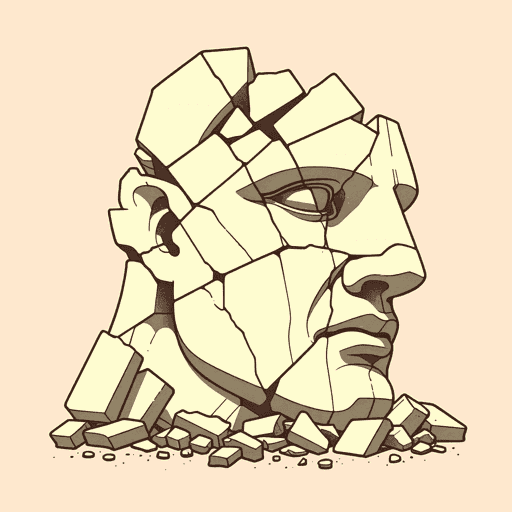
Half sunk a shattered visage lies, whose frown,
And wrinkled lip, and sneer of cold command,
Tell that its sculptor well those passions read
Which yet survive, stamped on these lifeless things,
The hand that mocked them, and the heart that fed;
And on the pedestal, these words appear:
My name is Ozymandias, King of Kings;
Look on my Works, ye Mighty, and despair!
Nothing beside remains. Round the decay
Of that colossal Wreck, boundless and bare
The lone and level sands stretch far away.”
Shelley, Percy Bysshe. “Ozymandias.” 1818. Poetry Foundation.
Summary
The first line of the poem introduces the speaker of the poem, who meets a traveler who has come from an ancient land. Immediately, in Line 2, the traveler begins to describe for the speaker the ruins of a monument they encountered in the “antique land” (Line 1). The ruins take the form of two giant disembodied “legs of stone” (Line 2) standing upright in an unnamed desert; nearby, a half-buried head of stone lies, presumably belonging to the same statue.
The lifelike expression on the statue’s face is frowning, and the haughty sneer of the statue suggests “cold command” (Line 5). According to the traveler, the details of the statue’s face speaks to the talent of its artist, who seemed able to understand and capture the haughty nature of the statue’s subject, a king named Ozymandias. The sculptor’s rendering of the king’s arrogance in inanimate stone impresses the traveler, who explains to the speaker of the poem that the king’s “passions” (Line 6) are immortalized in the crumbling monument, though the pieces of stone are “lifeless things” (Line 7).
The traveler notes that on the statue’s pedestal appear the words commissioned by its subject. The words identify the statue as Ozymandias, “King of Kings” (Line 10). The engraved message orders anyone who considers themselves great to look on what he has done and despair at the obvious power and superiority of Ozymandias.
In the final lines of the poem, the traveler explains that the self-described magnificence of Ozymandias’s works, however, is nowhere to be seen. The broken statue, “that colossal Wreck” (Line 13) is alone, crumbling to pieces in a lonely, sprawling desert where “lone and level sands stretch far away” (Line 14).

Get in-depth, chapter-by-chapter summaries and analysis from our literary experts.
- Grasp challenging concepts with clear, comprehensive explanations
- Revisit key plot points and ideas without rereading the book
- Share impressive insights in classes and book clubs
Related Titles
By Percy Bysshe Shelley