Pride and Prejudice
Pride and Prejudice
A modern alternative to SparkNotes and CliffsNotes, SuperSummary offers high-quality Study Guides with detailed chapter summaries and analysis of major themes, characters, and more. For select classroom titles, we also provide Teaching Guides with discussion and quiz questions to prompt student engagement.
Summaries & Analyses
Plot Summary
Chapter Summaries & Analyses
Volume 1, Chapters 1-3
Volume 1, Chapters 4-6
Volume 1, Chapters 7-10
Volume 1, Chapters 11-15
Volume 1, Chapters 16-18
Volume 1, Chapters 19-23
Volume 2, Chapters 1-6
Volume 2, Chapters 7-11
Volume 2, Chapters 12-15
Volume 2, Chapters 16-19
Volume 3, Chapters 1-3
Volume 3, Chapters 4-10
Volume 3, Chapters 11-14
Volume 3, Chapters 15-19
Character List
NEWCharacter Analysis
Themes
Symbols & Motifs
Important Quotes
Essay Topics
Book Club Questions
Author Insights
NEWQuizzes
NEWReading Tools
Games
Symbols & Motifs
Gossip
The first line of Pride and Prejudice alludes to the townspeople’s gossip about wealthy men, and Mrs. Bennet’s informing Mr. Bennet of Bingley’s arrival at Netherfield demonstrates the quickness with which news travels. Soon, the family knows about the size of Bingley’s entourage and who will attend the Meryton ball; after the ball, the Bennets and the Lucases gather to discuss the event. These little incidents establish the prevalence of gossip, setting the stage for Wickham’s false accusations against Darcy to circulate.
At the Meryton ball, Darcy is decided to be “the proudest, most disagreeable man in the world” (12); later, when the Bingley party leaves Netherfield and Wickham spreads the accusations widely, “every body [is] pleased to think how much they had always disliked Mr. Darcy before they had known anything of the matter” (134). Like Elizabeth, they make these judgments without truly knowing the man, who by his own account does not have “the talent […] of conversing easily” with strangers, for he “cannot catch their tone of conversation” (167).
When Wickham runs away with Lydia and people discover his debts, people “[seem] striving to blacken the man who, but three months before, had been almost an angel of light,” claiming “that they had always distrusted the appearance of his goodness” (272). They regret that he and Lydia will actually marry, for “it would have been more for the advantage of conversation” (287) if Lydia had been turned out of her house or forced to become a prostitute. They take solace in the fact that “with such a husband her misery [is] considered certain” (287). The townspeople thus treat people’s lives as mere entertainment, soaking up drama and spreading rumors despite the effects on its subjects. Their opinion turns again when Jane becomes engaged to Bingley; then, the Bennet family is seen as “the luckiest family in the world; though only a few weeks before, when Lydia had first run away, they had been generally proved to be marked out for misfortune” (325).
Elizabeth learns the dangers of speaking ill of people before gathering the facts, first when she reads Darcy’s letter and then when she speaks with Mrs. Reynolds, who is actually in a position to judge his true character. After visiting Pemberley, Mrs. Gardiner states how much she likes Darcy and asks Elizabeth why she told them “he was so disagreeable” (241). In fact, Mrs. Gardiner herself at first believes the gossip when she “trie[s] to remember something” (138) of Darcy’s “reputed disposition, when quite a lad which might agree” (138) with the accusations; she finally “recollect[s] having heard” (138) that he was “a proud, ill-natured boy” (138). By the time Darcy proposes for the second time, Elizabeth has learned her lesson. She wishes “that her former opinions had been more reasonable, her expressions more moderate” (349).
Dancing
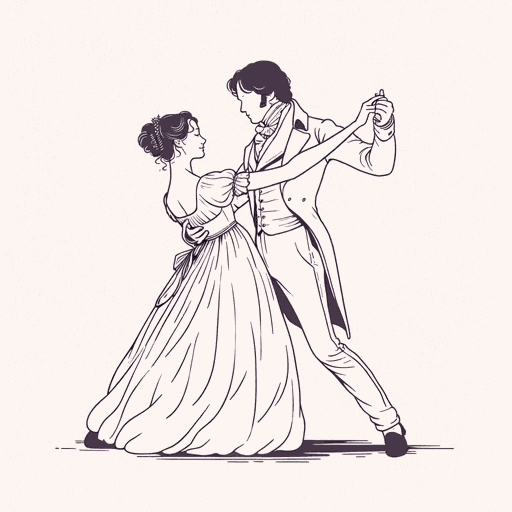
In Pride and Prejudice, dancing is often used to represent one’s sociability. Bingley is believed to be “gentlemanlike,” with “easy, unaffected manners” (11). Described as “lively and unreserved” (12), he dances every dance at the Meryton ball and offers to give a ball at Netherfield. Darcy, on the other hand, “dance[s] only once with Mrs. Hurst and once with Miss Bingley” (12), stating that “there is not another woman in the room whom it would not be a punishment” (13) to dance with, even Elizabeth, who is “not handsome enough to tempt me” (13). If, as the people believe, “[t]o be fond of dancing [is] a certain step towards falling in love” (10-11), it’s no coincidence that as he begins falling in love with her, Darcy asks Elizabeth to dance multiple times—once in the drawing room at Netherfield and again at the Netherfield ball. Elizabeth hopes to dance with Wickham at the Netherfield ball, but he is absent, a subtle foreshadowing of their missed romance later in the novel. Instead, she dances with Mr. Collins and Darcy, the two men who propose to her.
Pemberley
Pemberley, Darcy’s estate in Derbyshire, represents Darcy himself, and it’s only when she visits Pemberley that Elizabeth sees the true Darcy. Pemberley is a “large, handsome stone building,” sitting atop “a considerable eminence” (229). It’s surrounded by streams and woods “without any artificial appearance” (229); the banks of the stream are not “falsely adorned,” and the estate is lush with “natural beauty” (229). Inside, its “rooms [are] lofty and handsome” (230). The furniture is “suitable to the fortune of the proprietor” (230) without being “gaudy nor uselessly fine” (230). It has “less splendor [sic], and more real elegance, than the furniture of Rosings [sic]” (230). Each room offers a view of the beautiful grounds outside, making nature, rather than adornment, the chief draw. Elizabeth views the house “with admiration of his taste” (230).
Darcy, too, is handsome and stately, with a commanding presence. Like Pemberley, he is honest and without adornment; he is bored and disgusted by empty flattery, instead valuing intellect, reading, and sincerity. Just as he and Elizabeth do not “perform to strangers” (167), they both value the honest beauty of nature as opposed to excessive displays of material wealth. Pemberley’s appreciation of nature is perfect for Elizabeth’s “love of solitary walks” (173). Exploring Pemberley is equated with getting to know Darcy, and the more she sees of Pemberley, the more she appreciates its owner.
It’s significant that Pemberley is contrasted with Rosings. Lady Catherine demands having “the distinction of rank preserved” (154) and behaves with condescending “self-importance” (155) that makes Darcy “ashamed” of her “ill breeding” (165). Darcy himself, in speaking to his aunt, prefers frankness to subservience. The contrast between Rosings and Pemberley therefore serves to contrast Lady Catherine—whose “elegance” (230) is merely on the surface—with her nephew, who has true elegance.

Unlock the meaning behind every key symbol & motif
See how recurring imagery, objects, and ideas shape the narrative.
- Explore how the author builds meaning through symbolism
- Understand what symbols & motifs represent in the text
- Connect recurring ideas to themes, characters, and events