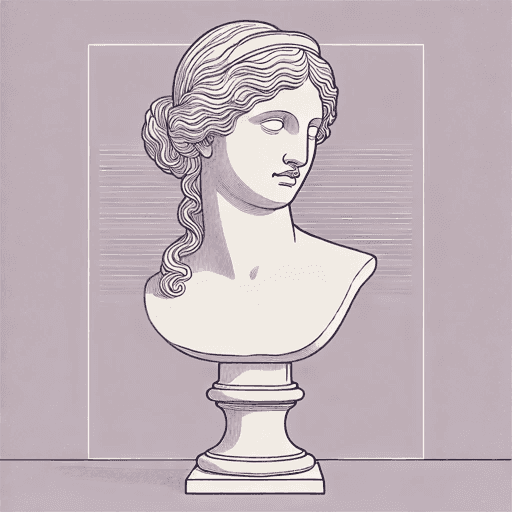
Sarrasine
Sarrasine
A modern alternative to SparkNotes and CliffsNotes, SuperSummary offers high-quality Study Guides with detailed chapter summaries and analysis of major themes, characters, and more.
Character Analysis
Content Warning: This section of the guide includes discussion of sexual harassment, graphic violence, death, gender discrimination, transgender discrimination, antigay bias, and child abuse.
Ernest-Jean Sarrasine
Sarrasine is a young sculptor who was killed during his attempt to murder La Zambinella several decades prior to the events of the frame narrative. He is the protagonist of the main plotline, and events are told with a focus on his perspective. The centrality of this character is evident in the name of the novella, as well as in the fact that he is the only character whose background and upbringing the text details. His infatuation with La Zambinella and misapprehension that the singer is female drive the plot and are the major source of tension and conflict.
Sarrasine is an archetypal Romantic hero: a young man of uncommon genius with an intense temperament who succumbs to a tragic fate of his own making when he devotes himself to a misplaced romantic obsession. His main character traits are a violent temper, an obsessive love of art and beauty, and an excessively passionate nature that lends itself to cruelty. These traits are implied to be innate, informing his behavior and relationships since his earliest childhood and prompting his teacher, Bouchardon, to keep him secluded through his adolescence. Upon his first exposure to sensuality, inspiration, and infatuation at the Italian opera, Sarrasine succumbs to his passions, embodying the theme of The Dangers of Obsession.
Although Sarrasine believes himself genuinely in love with La Zambinella, Balzac implies that he is merely infatuated with an idealized version of the singer that is entirely his own creation. After experiencing La Zambinella’s performances, he places the singer on a pedestal and refuses all evidence or hints that La Zambinella is not in fact the ideal represented by Sarrasine’s sculpture. When the real La Zambinella fails to live up to Sarrasine’s imaginary version by revealing himself to be a castrato, it so destabilizes Sarrasine’s conception of gender and perception of his own heterosexuality that he responds with violence, sealing his own fate.
La Zambinella
La Zambinella is a celebrated castrato opera singer with whom the protagonist Sarrasine becomes infatuated after mistaking him for a woman. He is also the reclusive elderly relative of the de Lanty family who frightens Madame de Rochefide with his deathly appearance. The revelation of his identity, both as a castrato and as the uncle of the Comtesse de Lanty, is the main point of anagnorisis in the novella’s climax. The novella creates suspense and mystery by hiding the truth of La Zambinella’s identity from both the reader and Madame de Rochefide until Sarrasine himself learns the truth. Hints and foreshadowing abound, however—for instance, in the malicious mirth of the other performers and in La Zambinella’s tentative hints that he is not a woman. La Zambinella’s attitude to Sarrasine is primarily characterized by fear of reprisal.
La Zambinella is particularly significant to the theme of The Artificiality of Gender Roles because, as a castrato, he occupies a position between conventional conceptions of masculine and feminine. He performs female roles and embodies many of the “weaknesses” stereotypically associated with women during Balzac’s time, such as timidity, delicacy, and capriciousness. However, there is little evidence that La Zambinella identifies as anything but a man, seemingly only dressing as a woman for work and, at the behest of his fellow performers, in order to prank Sarrasine. It is implied that La Zambinella is in a relationship with the Cardinal, who is euphemistically referred to as the younger man’s “protector,” a socially subversive but not uncommon arrangement for castrati that was often exploitative. La Zambinella makes no secret of his resentment of the childhood operation that rendered him a castrato, as he considers himself both incapable of love and fundamentally broken. Nevertheless, as an elderly man, La Zambinella seems to be attempting to recapture his youthful beauty and allure despite his weakened physical state and implied dementia, sporting gaudy finery and makeup. He also shows marked fondness for Marianina, his young great-niece, whose beauty and singing talent recall La Zambinella’s own youth.
The novella reveals little else about La Zambinella because his tale is related by a narrator whose source of information is suspect and whose motivation is to entertain and seduce rather than to provide an accurate account. Moreover, the narration focuses on Sarrasine’s incomplete and flawed perception throughout, making La Zambinella more an object for his desires than a round character in his own right. This is typical of literary and historical depictions of castrati, who have often been a subject of interest but are almost always presented from an “othering” or even objectifying perspective. Just as artists’ interpretations of La Zambinella, as well as his own work as a performer, obscure his true self, so too do literary representations mold the modern perception of castrato identity. For this reason, La Zambinella is key to the theme of Art and the Impact of Representation on Identity.
The Narrator and Madame de Rochefide
The unnamed narrator and the marchioness Madame de Rochefide are secondary characters and the central figures of the frame narrative. These two characters and their relationship function as a Realist foil to the Romantic figures in the main plotline, presenting a backdrop of more or less socially sanctioned romance against which Balzac explores more overtly subversive expressions of gender and sexuality. However, the fact that the two romances both end in disillusionment—a fate that Madame de Rochefide suggests awaits all love affairs—simultaneously normalizes Sarrasine and La Zambinella’s story while critiquing supposed “normalcy.”
The narrator is an everyman figure belonging to the same upper-class Post-Napoleonic French social class as Balzac and thus functioning as a stand-in for both author and reader. Little is known about his background or personal characteristics, though he clearly thinks deeply on philosophical matters and has an idealized view of attractive women, a trait he shares with Sarrasine. Also like Sarrasine, his primary motivation is romantic pursuit—in the narrator’s case, of the young, beautiful marchioness Madame de Rochefide. She initially seems receptive to his advances, though not yet fully wooed, accompanying him to the de Lanty soiree and grudgingly inviting him to her private rooms. The narrator’s recitation of Sarrasine and La Zambinella’s tale is a bid to sate her curiosity and earn further intimacy and favor. The tactic backfires, however, since Madame de Rochefide is so put off by the story that she rejects the “corruptions” of society altogether and rededicates herself to Christian piety. Ultimately, the parallels between Sarrasine and the narrator (and between Madame de Rochefide and La Zambinella) critique the traditional gender norms that the frame couple embody by placing those norms in a context where they would have seemed strange to 19th-century readers.

Unlock analysis of every major character
Get a detailed breakdown of each character’s role, motivations, and development.
- Explore in-depth profiles for every important character
- Trace character arcs, turning points, and relationships
- Connect characters to key themes and plot points