Sexing the Cherry
Sexing the Cherry
A modern alternative to SparkNotes and CliffsNotes, SuperSummary offers high-quality Study Guides with detailed chapter summaries and analysis of major themes, characters, and more.
Summaries & Analyses
Quizzes
NEWReading Tools
Symbols & Motifs
Content Warning: This section of the guide includes discussion of graphic violence, sexual content, and illness or death.
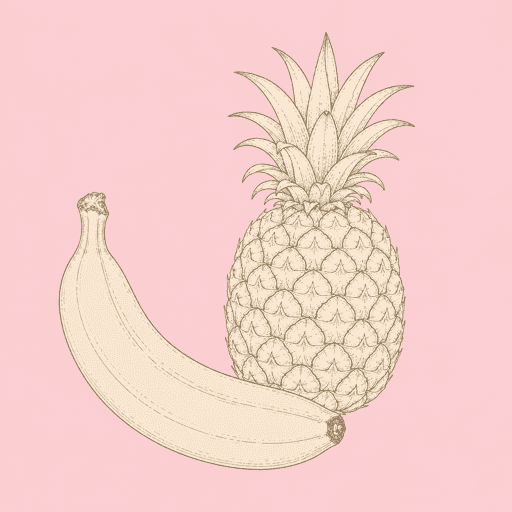
The Banana and the Pineapple
The exotic fruits of the banana and the pineapple function as powerful symbols of other realities and the imaginative boundlessness of the world. As the first of their kind to arrive in 17th-century England, they represent tangible proof of worlds that exist beyond the familiar confines of London. For the young Jordan, seeing the banana is a moment of revelation. The Dog-Woman notes, “This was the first time Jordan set sail” (6), recognizing that the fruit acts as a portal. Jordan’s gaze transports him beyond the grimy spectacle into a vision of a tropical paradise, igniting his lifelong desire for exploration that defines his character. This experience establishes a core idea in the novel that the greatest journeys are often those of the mind, and a single object can unlock infinite imaginative possibilities.
Years later, Jordan’s journey culminates in him bringing the first pineapple to England, an act that solidifies his status as a heroic explorer. The pineapple validates his quest, proving that the fantastical worlds he once imagined are real and can be brought back to transform his own reality. The fruits thus act as catalysts, bridging the mundane and the magical. They symbolize the discovery of new lands and of the mind’s capacity to envision and pursue alternate lives, reinforcing the novel’s argument that reality is far more expansive and wondrous than it appears.
Critically, both the banana and the pineapple are noted as products of Barbados, which was, in the 17th century, recently colonized. In the 1990s, Nicolas Jordan tries to imagine the feeling of seeing a pineapple for the first time and cannot, which is the result of centuries of exploitative relations between Europe and the countries they colonized, even after many of those countries achieved independence. The symbolism of the fruits becomes more complex when this history is integrated into a reading, including the fact that Fortunata is only free on her island far from England. Though the novel largely argues that freedom and liberation come from writing one’s own story, the banana and pineapple imply that that liberation may come at the cost of others’ freedoms.
Journeys and Maps
The recurring motif of journeys and maps explores the search for the self and the unreliability of objective reality. The novel deliberately contrasts the literal, physical voyages undertaken by Jordan and Tradescant with the internal, imaginative journeys that occur simultaneously. Jordan explicitly states his desire to record “not the ones I made, but the ones I might have made” (2), favoring the boundless explorations of the mind over the limitations of a physical itinerary. This distinction is important to the novel’s thematic core, suggesting that identity is crafted through an engagement with countless potential pathways and selves, both real and unreal. These internal travels allow characters to defy the constraints of their immediate circumstances and explore different dimensions of their being.
Official maps become a symbol of a false, constricted reality. Jordan observes that while a map can show a physical location, it can never capture the truth of an imagined place, concluding, “Maps, growing ever more real, are much less true” (77). This perspective challenges the authority of empirical knowledge, arguing instead for the validity of subjective experience. The motif posits that the most authentic exploration of the inner self, a landscape with infinite routes that can never be fully charted, and yet which always yields some new insight on identity. This idea is central to the theme that Time as a Simultaneous Reality, where all journeys and all selves exist at once, accessible through imagination rather than navigation. This motif additionally questions whether any of Jordan’s experiences are real, or if they are all part of the “map” he has imagined for himself.
Weight and Lightness
The motif of weight and lightness illustrates the conflict between the constraints of the physical body and the liberating potential of the imagination. The Dog-Woman’s immense size is the ultimate expression of weight. Her size anchors her in a material reality where she is a feared outcast. However, her body is a source of power that facilitates her survival and allows for her particular brand of Physical Power as a Tool of Defiance. Her weight grounds her, making her a fixed point from which Jordan must depart. She laments, “I am too huge for love” (30), acknowledging how her physical appearance isolates her from conventional human connection and confines her to a solitary existence. She is a mountain, a force of nature, but one that can only physically move freely, held back from social maneuvering.
In direct opposition, lightness symbolizes transcendence and escape. The 12 Dancing Princesses are so light that they float out their window to a magical, weightless city, a secret life free from patriarchal control. Fortunata and her dancers take this concept further, striving to conquer the body entirely and become “points of light” (65) through their art. This transformation represents the ultimate liberation from the material world and its laws, including gravity and societal expectations. Through this contrast, the novel suggests that both heaviness and lightness can provide their own forms of freedom. In the end, though, both Fortunata and the Dog-Woman must remain alone to enjoy their liberation.

Unlock the meaning behind every key symbol & motif
See how recurring imagery, objects, and ideas shape the narrative.
- Explore how the author builds meaning through symbolism
- Understand what symbols & motifs represent in the text
- Connect recurring ideas to themes, characters, and events