Sing, Unburied, Sing
Sing, Unburied, Sing
A modern alternative to SparkNotes and CliffsNotes, SuperSummary offers high-quality Study Guides with detailed chapter summaries and analysis of major themes, characters, and more. For select classroom titles, we also provide Teaching Guides with discussion and quiz questions to prompt student engagement.
Summaries & Analyses
Quizzes
NEWReading Tools
Games
Important Quotes
“[I]t was impossible to not hear the animals, because I looked at them and understood, instantly, and it was like looking at a sentence and understanding the words, all of it coming to me at once.”
(Chapter 1, Page 15)
Jojo’s ability to hear the thoughts of animals is the first indication of his psychic abilities, which in turn reflect the spiritual order at the novel’s center: one in which humans are part of a larger, eternal whole that also encompasses all of nature. The details of Jojo’s power are significant as well. The voices Jojo hears belong to beings who can’t speak for themselves—animals, small children, the dead, etc. This perhaps helps explain the unusual amount of empathy and selflessness Jojo displays throughout the novel; he is uniquely tuned in to suffering that can easily be overlooked by others.
“You don’t know the sergeant come from a long line of men bred to treat you like a plowing horse, like a hunting dog—and bred to think he can make you like it. That the sergeant come from a long line of overseers. You don’t know them trusty shooters done been sent to Parchman for worse than getting into a fight at a juke joint. Just know the trusty shooters, the inmate guards, was sent there because they like to kill.”
(Chapter 1, Page 22)
Pop’s description of what it was like to arrive at Parchman is one of the clearest examples of the way in which past and present racism intertwine in the novel. Although Pop didn’t know it at the time, Parchman essentially functioned like a slavery-era plantation: The labor was forced and unpaid, the workers were (as a result of legal double standards) disproportionately black and harvesting cash crops like cotton, and the men supervising the inmates were often the descendants of plantation overseers. Furthermore, the entire system was based on the implicit threat of violence: Methods once used to keep slaves in line (whips, dogs, etc.) are common at Parchman, and they’re entrusted to white men with a reputation for violence. As a result, Parchman’s primary goal seems to have less to do with criminal justice than with the enforcement of a racial hierarchy. The above passage also illustrates the way in which Ward uses animal imagery to depict the dehumanization of black people and the ways in which that dehumanization can be internalized; as Pop says, the assumption of the sergeants was that inmates could be made to see themselves as “plowing horses” or “hunting dogs.”
“Michael is an animal on the other end of the telephone behind a fortress of concrete and bars, his voice traveling over miles of wire and listing, sun-bleached power poles. I know what he is saying, like the birds I hear honking and flying south in the winter, like any other animal. I’m coming home.”
(Chapter 1, Page 30)
Homecoming of various kinds is a major theme in the novel, with Michael’s release from Parchman offering perhaps the most literal example. In this passage, Ward associates Michael’s journey with the cyclical migrations of birds, thus underscoring humanity’s relationship to animals, the rhythms of the natural world, the passage of time, etc. Ultimately, Ward suggests, all “animals” may be obeying the same instincts and heading towards the same “home”—the greater spiritual reality that encompasses all of them. At the same time, the passage also speaks to Jojo’s estrangement from his father. Michael has been absent from Jojo’s life for so long, first as a result of his drug use and later of his imprisonment, that Jojo no longer thinks of him as his “Pop”; Michael has instead become an abstract figure comparable to “any other animal.”
“She leaned back in her chair, grabbed her hair in a great sheaf, and tossed it over her back. Bishop loves it, she’d said of her boyfriend once. Can’t keep his hands out of it. It was one of the things she did that she was never conscious of, playing with her hair, always unaware of the ease of it. The way it caught all the light. The self-satisfied beauty of it. I hated her hair.”
(Chapter 2, Pages 36-37)
Leonie and Misty’s friendship is based in part on shared experience: Both women are in interracial relationships with men currently in prison. Misty’s whiteness, however, creates an undercurrent of tension within the relationship, as this passage illustrates. Leonie’s “hatred” of Misty’s hair clearly stems from envy; she resents the “ease” with which her friend embodies Western beauty standards. This is one of several moments in the novel that hint that Leonie has internalized much of society’s racism, and that her adoration of Michael perhaps stems in part from a desire to escape her own blackness.
“Given said he was going up to the Kill to party with his White teammates, and Pop cautioned him against it: They look at you and see difference, son. Don’t matter what you see. It’s about what they do.”
(Chapter 2, Page 48)
Given’s murder illustrates just how difficult it is for any individual to break free of society’s long history of racism. As a star football player, Given seems to believe he is somewhat insulated from that legacy; he views his teammates as “brothers” and assumes they feel the same (47). Pop, on the other hand, believes that racism is too deeply rooted to be so easily overcome and is ultimately proven right when Michael’s cousin kills Given for showing him up.
“He said: He old—a old head. I knew what he meant without him having to say more. He would hate that I’m out here with you, that before the night’s through, I’m going to kiss you. Or, in fewer words: He believes in niggers. And I swallowed the fact of his father’s bile and let it pass through me, because the father was not the son, I thought.”
(Chapter 2, Page 53)
Leonie’s relationship with Michael is complex. Michael’s rejection of his family’s racism and the undeniable love he and Leonie have for one another suggest that it may be possible for America to move beyond the destructive legacy of racism. With that said, the relationship is clearly not an entirely healthy one, even setting aside the couple’s drug use. Leonie’s determination to “swallow the fact of his father’s bile” is significant considering the ways Ward uses imagery related to poisoning, choking, vomiting, etc. to suggest the toxic effects of racism. The fact that Leonie voluntarily “swallows” the bigotry of Michael’s family—including the murder of her own brother—is perhaps a sign of self-loathing and self-destructiveness.
“‘[My great-grandfather] [s]aid there’s spirit in everything. In the trees, in the moon, in the sun, in the animals. Said the sun is most important, gave it a name: Aba. But you need all of them, all of that spirit in everything, to have balance. So the crops will grow, the animals breed and get fat for food.’”
(Chapter 3, Page 75)
Although Pop doesn’t share the psychic abilities of characters like Mam, he does subscribe to the same basic worldview, which he here explains to Jojo. These beliefs incorporate elements of traditional African religion and hold that humanity is not superior to or separate from the natural world, but rather part of it. Because the same “spirit” pervades humans, animals, plants, etc., these things exist in relation to one another; an “imbalance” in one will affect the entire system. This is one reason why images of pollution are so common in the novel: The sickness of the natural world reflects the ills that that plague humans, from drug use to racism.
“The man is cooking, moves as easy and sure as a chef, but there is nothing to eat here.”
(Chapter 3, Page 89)
On the way to Parchman, Leonie and Misty stop at a friend’s house as part of a drug deal, and Jojo catches a glimpse of a man cooking meth. His description of the moment is significant, because it links the drug use that pervades the novel to the equally prevalent imagery surrounding eating. The implication is that drug use is a kind of perversion of normal, healthy feeding, which is often tied to caretaking; whereas characters like Mam try to “fill” those they love not only with food but with affection, the presence of drug use serves as a reminder that people can also be filled with toxic and destructive substances and feelings.
“[P]art of me wanted her to leap for me, to smear orange vomit over the front of my shirt as her little tan body sought mine, always sought mine, our hearts separated by the thin cages of our ribs, exhaling and inhaling, our blood in sync. […] I want her to burrow in to me for succor instead of her brother.”
(Chapter 4, Page 98)
Leonie’s response to Kayla’s illness is characteristic of her relationship to her children. It’s clear that she does love Jojo and Kayla, but (as Mam will later put it) “her love for herself […] gets in the way” (234). Here, for instance, her desire to comfort her daughter is mixed with a more selfish desire to have Kayla all to herself (and, implicitly, jealousy of Jojo because of the way Kayla turns to him for comfort). Furthermore, whenever Leonie does try to care for Kayla, she quickly grows impatient with her daughter for behavior that’s normal for a toddler (fussing, being stubborn, etc.). In other words, Leonie seems unable to love her children as they are, or to put their own needs before her own.
“She ain’t never healed nothing or grown nothing in her life, and she don’t know.”
(Chapter 5, Page 107)
Jojo responds to Leonie’s plan to cure Kayla with alarm. Although Mam tried to teach her daughter her own knowledge of medicinal plants and herbs, Leonie has forgotten much of what she once knew; Jojo himself once grew sicker after accepting one of Leonie’s remedies, and he fears the tea she’s planning to brew for Kayla will prove just as poisonous. Jojo’s remark that Leonie has never “healed nothing or grown nothing” is also a symbolic commentary on her failings as a mother; where a character like Mam tries to nourish those she loves with her words and actions, Leonie often fills her children with “little mean things” that “[gather] and [gather] and [lodge] like grit in a skinned knee” (7).
“Come, It said. Rise.
I stood. One of its scales dislodged and floated to the earth, wispy as a feather.
Pick it up. Hold it, It said. And you can fly.”
(Chapter 6, Page 135)
Birds represent an important subset of the novel’s animal motif. In this passage, their ability to fly takes on symbolic importance3, evoking ideas of freedom and transcendence; the snake-bird that approaches Richie in the afterlife is implicitly promising to help him escape not only from the forest he finds himself lost inside, but also from the racism, poverty, and violence that defined his life. At least for the moment, however, the weight of that past proves too heavy to ignore, and Richie “drop[s] from [his] flight” the moment he remembers Pop, “the memory pulling [him] to earth” (136).
“It’s easy to forget how young Jojo is until I see him standing next to the police officer. It’s easy to look at him, his weedy height, the thick spread of his belly, and think he’s grown. But he’s just a baby. And when he starts reaching in his pocket and the officer draws his gun on him, points it at his face, Jojo ain’t nothing but a fat-kneed, bowlegged toddler. I should scream, but I can’t.”
(Chapter 7, Page 163)
The escalation of a routine traffic stop to near violence is a reminder of the parallels between Richie’s era and our own. The policeman initially pulls Leonie over for swerving, but he becomes increasingly suspicious of the family due to factors that have class and racial overtones—Michael’s record of incarceration, Leonie’s unmarried status, etc. The situation comes to a head when the cop pulls his gun on Jojo even though, as Leonie says here, he “ain’t nothing but a fat-kneed, bowlegged toddler.” Like Richie, in other words, Jojo is treated as both dangerous and as an adult by a criminal justice system that treats people of color (and black men and boys in particular) as inherently guilty.
“I am singing nursery rhymes with Kayla while Leonie throws up because I want Kayla to pay attention to me. Don’t want her to see Leonie hunched over and sick, don’t want her to see Michael with that pinched look on his face like he’s going to cry, don’t want her to see Misty running from the station to where they are on the grass with cups of water and her voice high-pitched and her face red.”
(Chapter 8, Page 179)
Jojo’s actions in this passage illustrate the relationship between love and song in a very literal way; he sings nursery rhymes to distract Kayla, hoping to spare her the trauma of seeing the effects of her parents’ drug use. This is similar to the way in which, during his imprisonment in Parchman, Pop would tell Richie stories about his home on the Gulf to distract the younger boy from his suffering.
“‘Home is about the earth. Whether the earth open to you. Whether it pull you so close the space between you and it melt and y’all one and it beats like your heart. Same time. Where my family lived…it’s a wall. It’s a hard floor. Then concrete. No opening. No heartbeat. No air.’”
(Chapter 8, Page 183)
Richie offers the above as partial explanation for why he is returning with Jojo from Parchman. Although Richie has never been to Bois Sauvage, he sees it (at least potentially) as more of a home than the one he grew up in. This is in part because of the people who live there; in the novel, biological family is often unreliable, and the bonds that truly matter—like the one Richie shares with Pop—may not be rooted in blood. More broadly, the passage also suggests a connection between the idea of home and that of a unifying spirit permeating all of reality. Richie’s description of home as a place that “beats like your heart” speaks to this underlying unity, as well as to his own desire to find a space for himself within it.
“How could I know that after I died, Parchman would pull me from the sky? How could I imagine Parchman would pull me to it and refuse to let go? And how could I conceive that Parchman was past, present, and future all at once?”
(Chapter 9, Page 186)
The idea of Parchman being “past, present, and future all at once” offers a dark twist on the novel’s depiction of time as nonlinear. For many of the novel’s characters, the idea that the past, present, and future exist simultaneously with one another is a comforting one; among other things, it suggests death is more of an illusion than a reality. For Richie, however, the coexistence of all times is simply a reminder of the persistence of racism across generations. Although the historical era changes every time Richie wakes up, Parchman is almost always a symbol of violence and oppression: "I watched chained men clear the land and lay the first logs for the first barrack for gunmen and trusty shooters […] I burrowed and slept and woke to the new Parchman again, to men who wore their hair long and braided to their scalps, who sat for hours in small windowless rooms, staring at big black boxes that streamed dreams” (186-187).
“I knew that’s where we were going, knew there was nowhere else for us to go […] But I guess I had an apartment in my head. Once we’re on our feet we’ll get to it, but I had so envisioned it that when I thought about us going home, I only saw that place.”
(Chapter 10, Page 196)
For many of the characters in the novel, home is more of an ideal than a physical location. Here, for instance, Leonie is disappointed by the reality of Michael’s homecoming, which doesn’t live up to the fantasy she had constructed; when she imagined bringing Michael home, she pictured taking him to an apartment away from her parents, with “big whitewashed, carpeted rooms, space, anonymity, and quiet” (196). Although she doesn’t explicitly say so, it seems likely that in this fantasy she and Michael are also childless, since she elsewhere admits feeling that Jojo and Kayla have “[made] those spaces bigger between [the couple]” (153).
“‘Why can’t Pop do it?’ I ask.
‘You my baby.’ She breathes heavy, and the grate cracks and sinks to rusted stillness. ‘Like I drew the veil back so you could walk in this life, you’ll help me draw it back so I can walk in the next.’”
(Chapter 10, Page 216)
Mam’s request in this passage underscores the continuity of life and death in the novel: As Mam describes it to Leonie, dying and being born are part of the same cyclical pattern, and thus a reminder of the fact that time itself isn’t linear. The comparison also casts Leonie in the role of Mam’s “mother,” which is significant considering Leonie’s struggles with parenting her own children. Ultimately, however, Leonie does as Mam wishes despite the grief it causes her, displaying the selflessly giving form of love Mam describes here. In doing so, she also preserves Mam’s own humanity, which pain and suffering threaten to destroy; as Mam puts it a few moments after this exchange, she “leave[s] with something of [her]self” (216).
“Some scientists for BP said this didn’t have nothing to do with the oil, that sometimes this is what happens to animals: they die for unexpected reasons. Sometimes a lot of them. Sometimes all at once. And then Michael looked at me and said: And when the scientist said that, I thought about humans. Because humans is animals.”
(Chapter 11, Page 226)
Michael’s words about the Deepwater Horizon oil spill are significant for a couple of reasons. For one, they underscore the novel’s depiction of the relationship between humans and the natural world; Michael doesn’t view humans as separate from this world, but rather as an “animal” like any other. Second, and relatedly, the passage suggests a parallel between the poisoning of dolphins in the Gulf of Mexico and the threat of violence that looms over people of color (including Michael’s own son). Although the scientists insist the dolphins’ deaths were not in fact the result of human activity, this is clearly a self-serving explanation on the part of BP. Similarly, the systemic racism often at play in police shootings, mass incarceration, public health crises, etc. is relatively easy for those in power to disavow. As a result, the high death rates afflicting communities of color seem like unexplained or “unexpected” flukes rather than the result of human actions.
“Casper, the black shaggy neighborhood mutt, lopes around the corner of the house, freezes in a stop, and barks. You smell wrong, I hear. Snake coming through water. The quick bite! Blood!”
(Chapter 11, Page 231)
Casper’s response to Richie is an indication that Richie (and other ghosts like him) are at odds with the world’s basic spiritual order. If, as Pop says earlier, nature exists in a state of balance, this passage suggests that disruptions in that balance are felt throughout the natural world: Richie’s presence strikes Casper as “wrong” on a visceral level. More specifically, Casper associates this wrongness with violence: “The quick bite! Blood!” The passage therefore foreshadows the attempt Richie will make to claim Mam for himself, while also implying that it’s ultimately violence itself that causes this kind of imbalance; Richie’s own actions are, after all, the result of the violence that was previously done to him.
“I hope I fed you enough. While I’m here. So you carry it with you. Like a camel […] Maybe that ain’t a good way of putting it. Like a well, Jojo. Pull that water up when you need it.”
(Chapter 11, Pages 233-234)
Mam’s words to Jojo in this passage encapsulate the relationship between feeding and caretaking in the novel. Mam describes the love she’s shown to Joseph as a kind of resource he can store the way the body stores fat. Just as camel, for instance, can use its hump to go without food and water, Mam says Jojo can draw on her love for strength even when she herself is no longer there. In this way, love serves as a buffer against some of the violence and injustice of the world at large.
“I know that singing. I have heard it from the golden place across the waters. A great mouth opens in me and wails; I am an empty stomach.”
(Chapter 12, Page 245)
Richie’s response to the sight of Mam comforting Leonie draws together several of the most prominent themes and motifs in the novel. For one, it associates this act of caretaking with the song of heaven, which “comes from the black earth and the trees and the ever-lit sky”—that is, from everything and everyone (241). This suggests that the “understanding and forgiveness and love” Mam demonstrates here are central to the novel’s spiritual worldview: selfless love is (at least in part) what unifies all of reality. Richie, however, has known very little love and is consequently shut out of this moment of communion. To underscore this point, Ward once again draws on imagery related to hunger and eating: Richie is “an empty stomach” because he hasn’t been fed enough care and affection.
“‘He had baby hair on the edge of his scalp, Jojo. Little fine hair he’d had since he sucked at his mama’s tit. Yes, Richie. I’m a take you home, I said. And then I took the shank I kept in my boot and I punched it one time into his neck.’”
(Chapter 13, Page 255)
As violent as Richie’s death is, it’s ultimately an act of mercy; as Pop says, the lynch mob would have “cut [Richie] piece from piece till he was just some bloody, soft, screaming thing,” but Pop spares Richie this pain and dehumanization by killing him first (255). The above passage emphasizes the love that is at the heart of Pop’s actions, highlighting Richie’s baby-like features in order to suggest that Pop is acting as his parent or protector. Meanwhile, his assurance that he will “take Richie home” draws on the different meanings of home and homecoming throughout the novel; on the face of it, Pop simply seems to be telling Richie he’ll help him escape from Parchman, but in reality he’s evoking the religious or spiritual sense of the word.
“‘I can’t,’ I say, and there are so many other words behind that. I can’t be a mother right now. I can’t be a daughter. I can’t remember. I can’t see. I can’t breathe.”
(Chapter 14, Page 274)
In setting aside her own fear and grief to help her mother die, Leonie finally displays the kind of selfless love the novel more commonly associates with characters like Jojo and Pop. Ultimately, however, the strain of her mother’s death proves more than Leonie can cope with. Throughout the novel, she has used drugs in part to avoid her responsibilities as a mother. This passage continues that trend, but also suggests a second reason for her drug use: Her insistence that she “can’t remember” implies that she uses drugs to try to escape the long, traumatic history of racist violence the novel details. However, Ward hints that Leonie’s attempts to ignore the past will prove futile: Just a few moments later, Leonie describes herself and Michael as “pretend[ing] at forgetting,” which suggests that lasting freedom from the past can’t be found through Leonie’s methods (275).
“‘I thought once I knew, I could. Cross the waters. Be home. Maybe there, I could’—the word sounds like a ripped rag—‘become something else. Maybe, I could. Become. The song. […] I hear it. Sometimes. When the sun. Sets. When the sun. Rises. The song. In snatches. The stars. A record. The sky. A great record. The lives. Of the living. Of those beyond. See it in flashes. The sound. Beyond the waters.’”
(Chapter 15, Page 281)
Richie’s actions throughout the novel have been guided by his belief that learning how he died will finally allow him to reach whatever afterlife exists for those who don’t remain “stuck” as ghosts (282). This, however, proves not to be the case: Hearing Pop’s story doesn’t free Richie, and as the novel ends, he’s still only able to see “flashes” of the idyllic land that exists “beyond the waters.” Ward implies that this is because Richie (and the other ghosts like them) are still enmeshed in the violence and hatred that defined their lives; Mam, for instance, describes Richie as “[p]ulling all the weight of history behind him […] [l]ike a cotton sack full of lead” (265). Of course, Richie himself isn’t responsible for that history, but the difficulty he has making peace with it puts him at odds with what he here describes as “the song”—the love and harmony of the world he’s trying to enter. The broken, incomplete sentences Richie uses in this passage further underscore this point; in a novel where song and storytelling are an important motif, Richie’s speech is as disjointed as he himself is.
“Her eyes Michael’s, her nose Leonie’s, the set of her shoulders Pop’s, and the way she looks upward, like she is measuring the tree, all Mam. Something about the way she stands, the way she takes all the pieces of everybody and holds them together, is her. Kayla.”
(Chapter 15, Page 284)
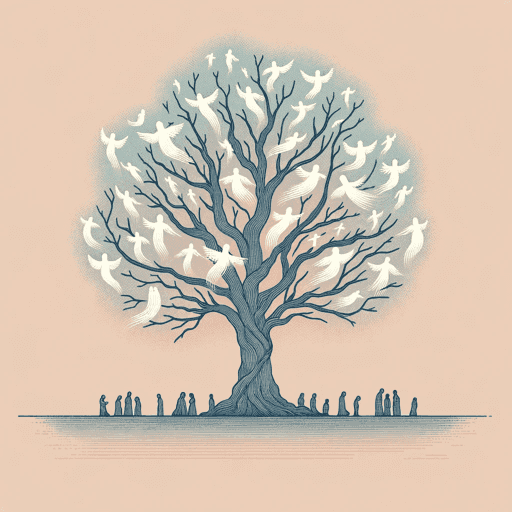
Even more than Jojo, Kayla represents the novel’s hope for the future. Compassionate as Jojo is, there are moments when even he is unable to overcome the legacy of the past; for instance, his bitterness towards Leonie—the result of years of neglect and mistreatment—makes him all too willing to believe the role she played in Mam’s death was not the selfless one it in fact was. Kayla, however, is still relatively untouched by trauma. She remains connected to the past in a way that bridges divides rather than deepening them: As Jojo describes her, Kayla can reconcile the very different “pieces” of everyone who came before her. This is perhaps why her singing is what finally gives the ghosts in the tree some peace: Kayla embodies a future in which the violence and injustices of the past aren’t forgotten, but are transformed into something better.

Unlock every key quote and its meaning
Get 25 quotes with page numbers and clear analysis to help you reference, write, and discuss with confidence.
- Cite quotes accurately with exact page numbers
- Understand what each quote really means
- Strengthen your analysis in essays or discussions