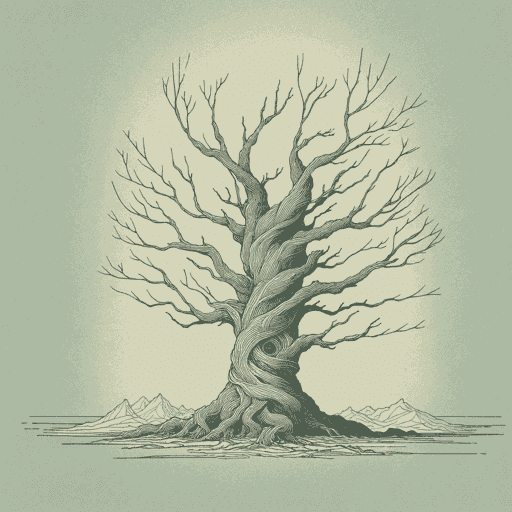
The Eye of the World
The Eye of the World
A modern alternative to SparkNotes and CliffsNotes, SuperSummary offers high-quality Study Guides with detailed chapter summaries and analysis of major themes, characters, and more.
Summaries & Analyses
Author Insights
Quizzes
NEWReading Tools
Robert Jordan on The Eye of the World
In his own words: quotes and insights from the author.Why he wrote it
Ten years before a single wordThe entire series began with a single question Jordan sat with for a decade before he wrote anything down. He was dissatisfied with how fantasy handled the chosen-one premise: the hero accepts the mantle, the prophecy clicks into place, and everyone falls in line. He wanted to know what that moment actually felt like from the inside.
It all started with wondering what it was really like to be tapped on the shoulder and told that you are the savior of mankind. Ten years of thinking about that, and I began writing.
In an audio interview from around 1997, he spelled out the genre convention he was reacting against. His alternative was rooted in how rural communities actually work: a stranger arrives with a cosmic claim, and the villagers offer a beer, a smile, and a quiet exit through the back door.
I wondered what it was really like to be tapped on the shoulder and told, ‘You were born to be the savior of mankind.’ I didn’t think it would be very much the way it is in so many books where someone pops up and says, ‘Hi, I was born to be the savior of mankind and here’s the prophecy,’ and everybody says, ‘Oh, well, let’s go then.’ [paraphrased from audio]
A second, separate line of thinking had to do with how knowledge erodes across time and space. Jordan was working out the mechanism that would make his world feel genuinely ancient: the Third Age characters don’t have access to clean history any more than we do, and the series’ mythology is built on that structural blur.
I was thinking about the distortion of information over distance, whether distance in space or in time, and how that applied to both history and legends. The further you are from an event, the less likely you are to know what really happened.
Before a word of the first chapter existed, Jordan already had the final scene written in his head. The four years of drafting were, in his own account, the work of connecting two fixed points: who these people are when we meet them, and who they have become by the time the series closes.
I know the last scene of the last book, I’ve known it from the beginning, I just have to get there.
That backward architecture gave the book its shape. The ending was the destination; everything in The Eye of the World is the first step toward it.
How he wrote it
Physics, Tolkien, and an Old Testament gripJordan opened the book in deliberate Tolkienesque register, with the Two Rivers standing in for the Shire and a wandering stranger arriving with news of a wider world. That resemblance was not imitation but instruction: he was giving readers a known landmark so they would feel steady enough to follow him somewhere new.
In the first chapters of The Eye of the World, I tried for a Tolkienesque feel without trying to copy Tolkien’s style, but that was by way of saying to the reader, okay, this is familiar, this is something you recognize, now let’s go where you haven’t been before.
That opening move was part of a broader creative habit. Jordan consistently chose premises his readers already thought they understood, then engineered the moment when the familiar map stops matching the territory.
I like taking a familiar theme, something people think they know and know where it must be heading, then standing it on its ear or giving it a twist that subverts what you thought you knew.
His physics degree from The Citadel left a visible mark on channeling, the book’s system for wielding the One Power. Where most fantasy magic operates by authorial fiat, Jordan designed his to behave like a branch of engineering: bounded, learnable, and subject to consequences when misapplied.
My knowledge of physics influenced channeling to the extent that I have attempted to treat channeling as if it were a form of science and engineering rather than magic. You might say that the Laws of Thermodynamics apply in altered form.
He rejected the notion, common in writing-craft discussions, that characters eventually seize control from their authors. His position was the opposite: the author is the only god in the room, and the characters move only when he decides they do. What actually grew beyond his control was not the cast but the sheer volume of story the world demanded.
My characters do what I want. When it comes to my writing I’m an old testament god with my fist in the middle of my characters’ lives. They do what I want them to do. The difficulty has been that the story turned out to be larger than I thought it was, quite simply.
Rather than drafting a full manuscript and then revising it, Jordan wove rewriting into his daily forward progress. When he finished a session, he went back through what he had already written before moving ahead, so that by the time he reached the final page, the text behind him had been refined many times over.
I do my rewriting while I am doing the writing. When I hit the end, I only allow myself to give a final polish. I keep going back while I am writing and rewriting the previous stuff.
The Eye of the World took four years to reach that final polish. His editor and wife Harriet McDougal later confirmed the timeline: four years of words on paper before the manuscript was finished.
The personal thread
Vietnam and the question he couldn’t put downJordan served two tours in Vietnam as a helicopter gunner before he became a writer, and he was direct about what that experience left behind. The moral problem at the heart of the entire Wheel of Time sequence was not something he invented at a desk; it was something he carried home.
My time in Vietnam certainly has affected a certain moral vision… One of the central themes in ‘The Wheel of Time’ is the struggle between the forces of good and evil. How far can one go in fighting evil before becoming like evil itself? Or do you maintain your purity at the cost of evil’s victory? I’m fond of saying that if the answer is too easy, you’ve probably asked the wrong question.
That same moral seriousness drove his choice of genre. By the early 1990s, literary fiction had largely abandoned the possibility of clear ethical stakes, and Jordan found that evasion dishonest. Fantasy, for him, was not an escape from hard questions but the form that let him confront them without hedging.
In fantasy it is possible to talk about right and wrong, good and evil, with a straight face. In so much else of literature, everything has begun to be rendered in shades of gray. It isn’t that I don’t believe there are gray areas, morally and ethically, but not everything is murky.
What he wants us to sit with
A world still turning after the last pageJordan built gender equity into the world’s deep history rather than into its politics. In the Wheel of Time, women hold institutional power through the Aes Sedai, the female-only order that controls channeling, and men are the ones whose power is tainted and feared. He wanted that arrangement to feel so old it required no argument.
I simply decided to write in a world where the feminist struggle occurred so long ago that no one even remembers it.
He knew readers would finish the book and wonder whether the story resolved, given that nine more volumes would follow. His answer, on record, was that he designed the first volume to hold its own weight regardless of what came after.
The Eye of the World has a completeness to it so that unlike the other books it really can stand alone. So, even if you decide not to read on, it makes sense on its own.
The cyclical structure of the series, the Wheel turning through ages with no final age, was not decoration. It was a claim about what fiction is for. Jordan wanted readers to close the last book of a 14-volume series and feel not that a world had ended but that it was continuing without them.
When I finish the Wheel of Time, I hope to leave the reader feeling that this world is still chugging along out there somewhere, still alive and kicking.
That ambition begins in The Eye of the World, in the prologue’s first line: the Wheel of Time turns, and ages come and pass. The Third Age is already one layer down from something older, and the reader arrives not at a beginning but mid-rotation.