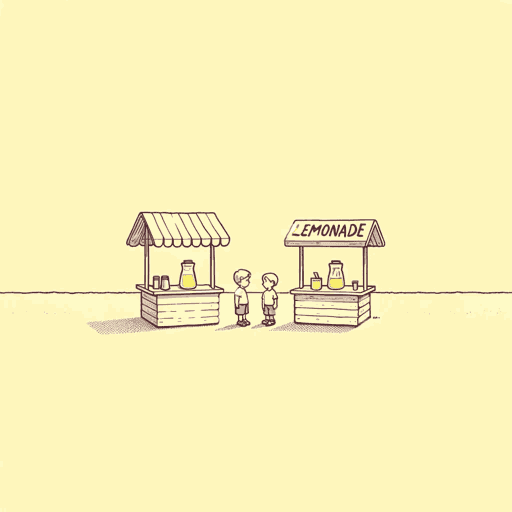
The Lemonade War
The Lemonade War
A modern alternative to SparkNotes and CliffsNotes, SuperSummary offers high-quality Study Guides with detailed chapter summaries and analysis of major themes, characters, and more. For select classroom titles, we also provide Teaching Guides with discussion and quiz questions to prompt student engagement.
Summaries & Analyses
Author Insights
Quizzes
NEWReading Tools
Jacqueline Davies on The Lemonade War
In her own words: quotes and insights from the author.Why she wrote it
A title that arrived before the storyThe book began with a phrase, not a plot. Davies was watching her two sons quarrel over a lemonade stand when the title locked into place. What she kept from that moment was not the argument’s specifics but the emotional charge underneath it, the raw thing that fiction could sustain long after the real dispute had dissolved.
My two sons got into an argument about a lemonade stand when they were Evan and Jessie’s ages, and that idea—of a Lemonade War—popped into my head and wouldn’t leave. Of course, the final story is entirely different than the real-life argument that inspired it. After all, the real-life argument fizzled out after just a few minutes. But that’s how it is for writers of fiction who draw on events and ideas from everyday life. You keep the emotion or impulse that caused the spark, but then you have to use craft and experience to create a story that sustains the reader’s interest over an entire book.
 deborahkalbbooks.blogspot.com, “Book Q&As with Deborah Kalb: Q&A with Jacqueline Davies”
The choice to write about siblings rather than friends was deliberate. Davies believed that proximity and love are precisely what make a conflict escalate beyond repair, and that the harder dramatic question is not how a war starts but how people who genuinely care for each other find their way back.
I’ve long believed that the people we love the most can lead to the most explosive disagreements! And once you find yourself in the middle of a war, how do you find your way back to the place of love?
 smack-dab-in-the-middle.blogspot.com, “Interview with Jacqueline Davies, Author of The Lemonade War”
The economics woven through every chapter were not planted there for educational effect. Davies had been running money-making schemes since she was ten, long before any teacher or librarian told her the book could anchor a unit on supply and demand. When educators later built curricula around it, she was genuinely caught off guard.
I was interested in making money when I was a kid. I started making, when I was 10 years old, I would make decoupage plaques out of scrap pieces of wood that my dad had and old greeting cards... I was always interested in schemes for making money. And so that was just me. It was super organic. [paraphrased from audio]
How she wrote it
Nineteen days, alternating heads, one unnamed conditionThe first draft arrived at unusual speed. Davies has described the first book as the outlier in her career, the one that came in a single compressed rush rather than through the longer, more resistant process she typically navigates. The source material was partly lived experience and partly something she could not fully account for.
The first book in the series was unusual in that I wrote it very quickly; the first draft took just 19 days to complete. So the ideas for that story unfolded very quickly. A lot of the ideas came from things that had actually happened in my childhood or in the childhoods of my three kids. But some of the ideas just bubbled up out of that deep, dark unconscious place where thoughts and feelings dwell, just below the surface of articulation.
 stoneagetechie.blogspot.com, “The Stone Age Techie: Interview with Jacqueline Davies, Author of The Lemonade War Series!”
The structure was never decorative. Alternating chapters between Evan and Jessie were the mechanical form of the book’s argument: that every conflict has an interior logic on both sides, and a reader who inhabits each in turn cannot simply pick a winner. Davies described the effect in a video interview for The Comics Multiverse, explaining how the reader is continuously repositioned.
The first chapter is from Evan’s point of view. We kind of [are] inside his head, we’re inside his heart, we see what he’s thinking and feeling. And then the second chapter is Jesse’s, and then back and forth... So at every point along the way, you’re kind of seeing the other character from one character’s point of view, and then it switches and you’re inside that character seeing it the other way around. [paraphrased from audio]
Jessie displays traits that readers and educators frequently associate with Asperger’s Syndrome, but Davies never names the condition in the text. The decision was partly self-implicating: she has said she recognizes herself somewhere on that spectrum. The reader mail that followed confirmed what the unlabeled approach made possible.
I can’t tell you how many letters I’ve received from parents of autistic kids who thank me for writing the books without trying to turn them into some kind of lesson on autism. They’re so grateful to have a book to share with their children and others that presents a character with Asperger’s that isn’t about Asperger’s.
stoneagetechie.blogspot.com, “The Stone Age Techie: Interview with Jacqueline Davies, Author of The Lemonade War Series!”The series itself was an accident of reader pressure. Davies considered the disappearance of $208 near the end of the first book a minor plot device. After a year and a half of school visits in which children refused to let the question drop, she returned to her editor. That insistence from young readers produced what became a six-book series.
They all wanted to know, where did that money go? And I tried to explain, the money’s not, the money’s not important... And they said, yes, it is. It’s really important. We want to know what happened to it. [paraphrased from audio]
The personal thread
Every character is a corner of the same soulDavies grew up as a middle child in a family that moved often, which put her on both sides of the older-younger sibling dynamic before she ever invented Evan and Jessie. She has said that experience was not background color but the actual raw material for the characters.
To create the characters of Evan and Jessie, I mostly used my own childhood experience of being a middle child in a large family. I honestly don’t think I could have written the characters of Evan and Jessie if I hadn’t grown up experiencing what it’s like to be a younger sister and an older sister.
deborahkalbbooks.blogspot.com, “Book Q&As with Deborah Kalb: Q&A with Jacqueline Davies”She extends that self-implication beyond the protagonists. In a conversation about the graphic novel adaptation, she named a principle she applies to every character she writes, including Scott Spencer, the boy positioned as the story’s antagonist.
All my main characters are like me! In one way or another. There’s a part of me that’s like Evan, and there’s a part of me that’s like Jessie. But here’s the thing: there’s also part of Scott Spencer (who’s the ‘villain’ in the story) that’s like me, too. I think that if an author can’t find some small corner of their soul that connects to each character, they probably shouldn’t be writing that character.
What she wants us to sit with
How you find your way back from a warThe lemonade stand competition gives the book its plot, but Davies has been consistent about what she was actually trying to think through. The entrepreneurial contest is the arena; the question underneath it is whether love survives the kind of anger that turns siblings into opponents.
I wanted to think about... what do we do when we get stuck in a place of anger and hostility, how do we find our way back to a place of cooperation and love in this case, because they’re a brother and sister, and they really do love each other. [paraphrased from audio]
School visits have given her years of data on where the book lands with children. She asks the same question in every auditorium, and the response has never changed.
Brothers and sisters have been fighting since the beginning of time, and they’ll continue until the end of time. I visit a lot of schools and always ask the students if they’ve ever gotten into an argument with a brother or sister. Every time, the auditorium erupts with their response!
deborahkalbbooks.blogspot.com, “Book Q&As with Deborah Kalb: Q&A with Jacqueline Davies”The entrepreneurial thread has produced a consequence Davies did not anticipate: children who read the book and then ran their own small fundraising businesses, donating proceeds to animal shelters and to Alex’s Lemonade Stand Foundation, a charity that funds pediatric cancer research. For her, those stories carry the book’s real argument about what children are capable of.
It warms my heart every time I read a newspaper article or see a local TV news clip or hear from a classroom about kids reading the book and then raising money for a charity. Big or small, local or national, it’s so important that we teach our kids—through experience and doing—that caring for each other and our communities is the greatest thing we can do, and that every one of us has the power to make a real difference.
smack-dab-in-the-middle.blogspot.com, “Interview with Jacqueline Davies, Author of The Lemonade War”