The Measure
The Measure
A modern alternative to SparkNotes and CliffsNotes, SuperSummary offers high-quality Study Guides with detailed chapter summaries and analysis of major themes, characters, and more.
Summaries & Analyses
Author Insights
Quizzes
NEWReading Tools
Nikki Erlick on The Measure
In their own words: quotes and insights from the author.Why they wrote it
A question carried for years before it became a novelThe book began not with a plot but with a lifelong preoccupation. Long before the pandemic cleared Erlick’s schedule, they had been sitting with questions about fate and agency that no single conversation or essay had resolved. Fiction, they decided, was the only container large enough to hold them.
I’ve always been drawn to big questions: How much control do we have in our lives? How much power we have over our destiny? In our happiest moments and our most challenging times, it’s easy to wonder: Was it fate that led me here? I wanted to see if I could tackle these big questions in the form of a story, because I’m someone who has always turned to stories and to books to help me make sense of the world and navigate its many complexities.
Erlick needed a frame for what they were attempting, and they found it in a single line from Stephen Sondheim. The quote didn’t tell them what the book would be about; it told them what the act of writing it could accomplish, and that was enough to keep going.
There’s a quote that I really love from Stephen Sondheim that art is an attempt to bring order out of chaos. I thought about that a lot while I was writing because I wanted to see if I could take the chaos of life and destiny and these unanswerable questions and try to turn them into art.
The concept of strings measuring a life came from Greek mythology, specifically the three Fates believed to spin, measure, and cut mortal threads. But Erlick needed one more element before the premise worked: a way to make the knowledge optional. That second requirement sent them to a second myth entirely.
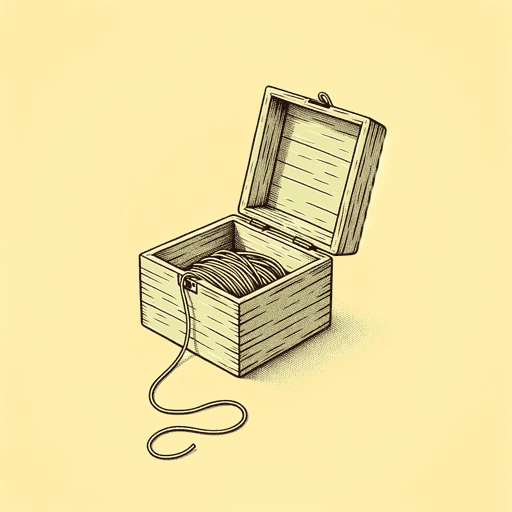
The decision to have the strings arrive in a box for each person came a little bit later, when I realized that I wanted people to have a choice of whether or not they would look at their string. Even if the characters’ fates are pre-determined in one sense, they still retain a sense of power and agency when it comes to choosing whether or not they wish to know, and then, of course, choosing how to use that knowledge. The box itself was inspired by another famous Greek myth, that of Pandora’s Box, as the ultimate test of willpower: Can you resist the temptation to look?
The premise predates the pandemic by years. What March 2020 provided was not the idea but the hours. When Erlick lost their travel writing work and moved back in with their parents, a project that had existed only in the margins of a busy career suddenly had room to become a book.
[paraphrased from audio] unemployment meant now there were “10, 12 hours a day that I would have been working on my day job, that I now can work on this passion project that I haven’t had the time for before.”
How they wrote it
Eight voices, one per day, and a loose outline that fought backThe novel that reached readers as a sweeping ensemble piece started as something far more contained. Each time Erlick added a character, it was because a gap in the world demanded filling: a profession that changes how you think about death, a political figure who could exploit collective fear, two soldiers whose friendship fractures along a single piece of information.
For a book that now has a large ensemble, the story was actually conceived with far fewer characters. I first imagined it as a love story between a person with a long string and a person with a short string, but the more time that I spent in this world, the more I kept thinking about different types of people and wondering how they would respond to this extraordinary scenario.
Managing eight simultaneous first-person threads without letting the voices bleed into one another required a structural discipline Erlick imposed before sitting down to write each day. The rule was simple and, apparently, non-negotiable.
I did try to write only in one character’s perspective per day.
Keeping the voices separate during drafting turned out to be the easier problem. Revision forced a harder reckoning. The manuscript Erlick first sent to an agent ran around 200 pages; by publication it was 370, and the path between those two numbers cost Erlick considerable effort they might have saved.
I had a very loose outline for this novel—I knew the essentials of the beginning, middle, and end—but I ultimately wrote my way through to a lot of decisions. During the revision process, I realized that having a more detailed outline to refer back to would probably have saved me a lot of headaches!
The novel’s discrimination arc, in which short-stringers face profiling, military exclusion, and political scapegoating, could have read as purely speculative. Erlick grounded it deliberately in documented history, pulling from real treatment of real groups so the invented prejudice would carry actual weight.
I tried to draw inspiration from many different traditionally marginalized groups in our society. The treatment of the short stringers within the military draws upon the history of the LGBTQ+ community within the military. The profiling of short stringers as potentially being dangerous or terrorists certainly draws upon the profiling of Muslim Americans.
Erlick’s years filing travel pieces across nearly a dozen countries left a direct mark on the book’s geography. The Verona sequences, where characters encounter letters written to Shakespeare’s Juliet from strangers around the world, grew from a specific memory Erlick had been looking for a way to use since they first stood in that city.
My scenes in the book that are set in Verona are based on my real travels and my love of that city. I had very powerful moving experiences there. Especially in seeing the letters that everybody writes from all around the world to Juliet. I always thought maybe there’s a way I could put this into a book because it’s such a unique, special place.
The personal thread
The one darling they refused to killEditors routinely press debut novelists to cut scenes that feel personally precious but do not pull narrative weight. Erlick accepted most of those notes. One they refused: a prayer card that passes from Jack’s grandfather to a fellow soldier named Javier. The scene’s survival was non-negotiable because the story behind it was not invented.
[paraphrased from audio] it was the one “darling” they couldn’t kill.
The prayer card traces back to an event in Erlick’s own grandfather’s life during World War II, a story the family still passes down. Keeping it in the novel was, among other things, a way of keeping it.
The choice to have the boxes arrive when characters turn 22 reflects something Erlick thought carefully about before settling on a number. Ages 18 and 21 are loaded with specific legal and cultural meaning in the United States, and the phenomenon in the novel is global. Twenty-two was the answer to a question about what age feels like the true threshold between receiving a life and deciding what to do with it.
[paraphrased from audio] old enough to weigh consequences, young enough for the knowledge to still shape how someone lives.
What they want us to sit with
Lives of equal weight, measured differentlyThe novel tracks how quickly a society can turn a biological difference into a basis for exclusion. Erlick wanted that arc to feel true rather than cautionary, drawn from the same patterns that have repeated throughout history. But they also wanted the book to refuse fatalism about those patterns.
[paraphrased from audio] the realistic ways that we do behave as people, while making sure to “keep that kind of hope and optimism alive that we don’t have to always repeat the same mistakes.”
The title carries a second meaning that the novel builds toward deliberately. To measure a life is not only to count its length. Erlick wanted each of the eight characters to model a different answer to what a full life looks like, so that no single answer could claim authority over the others.
I do hope there is an overarching message that we can all ‘measure’ our lives in our own way, finding fulfillment and meaning and happiness in the way that feels right to us. Living life to the fullest means something different to each character in this novel, the same way it does to each one of us. Despite the differences that may exist between us—and despite the amount of time we’ve each been given—everyone’s life has equal impact, value, and purpose.
Erlick has said that books have always been the tool they reach for when the world becomes difficult to navigate. The hope expressed here is that the novel works in both directions: that reading about fictional strangers changes how a reader treats the real ones waiting outside the book.
My great hope is that, when we finish a book, we return to our ‘real’ lives with the same sense of open-mindedness and curiosity and compassion for those around us, whatever their story may be.