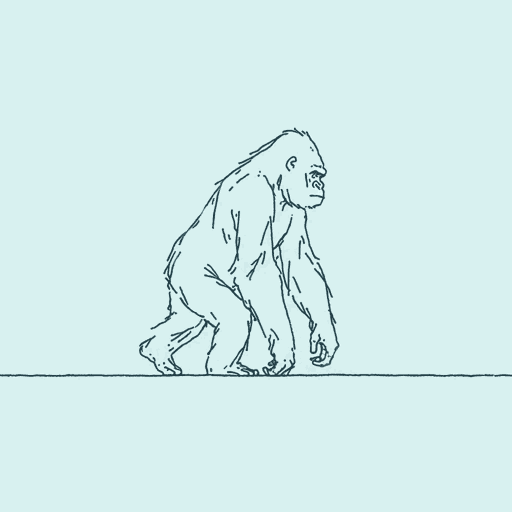
The One And Only Ivan
A modern alternative to SparkNotes and CliffsNotes, SuperSummary offers high-quality Study Guides with detailed chapter summaries and analysis of major themes, characters, and more. For select classroom titles, we also provide Teaching Guides with discussion and quiz questions to prompt student engagement.
Summaries & Analyses
Author Insights
Quizzes
NEWReading Tools
Katherine Applegate on The One And Only Ivan
In her own words: quotes and insights from the author.Why she wrote it
A newspaper clipping, twenty years in a drawerThe book began with a single newspaper headline: “Gorilla Sulks in Tacoma Mall as His Future Is Debated.” Applegate clipped it, dropped it in her idea box, and tracked the real legal and animal-rights campaign that eventually moved Ivan from the B&I Shopping Mall to Zoo Atlanta in 1994. What kept her returning to the clipping, year after year, was not curiosity but something closer to grief.
I found his story so heartbreaking, and I followed it in the media over the next few years, waiting to see what happened. Ivan had been isolated in the mall for 27 whole years, and people finally began to understand that animals in captivity require the presence of others of their kind.
Watching Ivan’s story from a distance eventually curdled into something sharper. By the time she sat down to write, the emotion driving her was not just sorrow but disbelief at what had been allowed to go on, and for how long.
What motivated me in Ivan was that I never imagined that an animal could be mistreated like that for so many years. Humans are capable of such horrific behavior and yet can have so much compassion.
Applegate described Ivan’s real story as “touching and bizarre,” and it was the bizarre part that stalled her for years. She got halfway through a manuscript and stopped, convinced the premise was unsellable. She wrote a note to herself that she still keeps on her desk.
My problem here is: Am I giving up on Ivan or not?
She pulled the manuscript back out. The turning point, as she later described it, was simple: she wanted to know what happened.
How she wrote it
Cockroaches, a rainy day, and a hole in the cageBefore she wrote a word of fiction, Applegate drove to Tacoma. Ivan’s cage inside the B&I Shopping Mall was still standing, and she spent time at the Tacoma Public Library combing through records of the case. She then traveled to Zoo Atlanta with manuscript in hand, hoping to finally see the gorilla whose story she’d been carrying for nearly two decades. He never appeared. Gorillas born in Africa reliably avoid cold and wet, and that day was rainy.
In the end, I was so happy that he was able to choose where he wanted to be. That’s something that had been taken from him when he spent all those years in a cage.
Her first complete draft was not a novel at all. She sent her editor Anne Hoppe a long, essentially journalistic account of Ivan’s real life. Hoppe’s reply arrived quickly: “Katherine, this is beautiful, but I can’t sell a pamphlet.” [paraphrased from audio] That sent Applegate back to the form she’d always intended: Ivan telling the story in his own voice. Finding that voice, though, turned out to match her own instincts as a writer.
I wanted his voice to convey that calm dignity that I associate with gorillas. And I tend to write short, brief snippets—I lean toward the chamber music end as opposed to the symphony end of things. I realized that Ivan’s voice was a good match for me. He is a gorilla of few words.
The spare, short chapters were not only a function of Ivan’s personality. At the Miami Book Fair, she explained that the prose style was a deliberate structural choice tied directly to what Ivan’s life had actually contained.
short...poetic...sparse because I was trying to reflect the life that this animal had lived. [paraphrased from audio]
Ivan alone in a cage needed someone to talk to, and the real mall offered nothing useful. Applegate tried a cockroach first, small enough to slip through the bars, then a rat, before she gave herself permission to do what fiction actually allows.
You know what? I’m writing fiction here. Put a hole in the cage and let a little dog go in there. [paraphrased from audio]
The dog who came through that hole, Bob, was modeled on her own dog Stan, whom she described as “really bratty.” [paraphrased from audio] The human character Julia required no invention at all.
One character in the novel required almost no imaginative work. Applegate’s daughter had a specific and direct request.
My daughter’s name is Julia, and she wanted to be in a book.
 thesecretdmsfilesoffairdaymorrow.blogspot.com, “The Secret Files of Fairday Morrow: Author Interview with Katherine Applegate”
What she wants us to sit with
The word humans don’t haveEven after the Newbery Medal and the Disney adaptation, Applegate remained uncertain whether anyone would reach for a novel narrated by a gorilla. That uncertainty had shadowed the manuscript from the beginning, and it never fully lifted until readers responded.
I truly wasn’t sure anybody would even read the book. It seemed like such a stretch to imagine that young readers would want to read a story from the point of view of a gorilla.
The novel’s most explicit statement about captivity appears in a single line where Ivan observes that humans have more words than they need and still have none for what he is. Applegate named that line as the book’s moral center, but she went further, connecting it to something she finds personally intolerable.
I think if you’re looking for one sentence that distills the book, that sentence does it perfectly. I hate to witness animals in captivity—or see circus elephants paraded down the streets. When animals are caged, it’s a loss of what they are.
Applegate has a specific theory about why Ivan’s situation resonates so immediately with children rather than adults. The powerlessness Ivan feels inside the mall is not abstract to a ten-year-old: it maps onto a power structure children navigate every day.
I think it has to do with powerlessness and with the kind of hierarchy that kids endure every day, where these grownups are not making sense and the world doesn’t make sense, and animals are basically suffering the same fate.
When she names what she most hopes readers carry away, she moves between the personal and the political. One hope is for Ivan as a character: that readers see what endurance cost him and what belonging finally gave him. The other is more concrete.
I hope they realize that it takes a lot of courage to stay true to yourself in grim, lonely circumstances, and will take heart that Ivan found a place where he belongs. At the end of the day, I’d love to see children stop begging their parents to go to the circus. That’s what would make me most happy.
Behind both hopes is a conviction about what fiction can do that a pamphlet cannot: move a reader so completely into another life that the reader’s own assumptions about that life never fully recover.