Where I Was From
Where I Was From
A modern alternative to SparkNotes and CliffsNotes, SuperSummary offers high-quality Study Guides with detailed chapter summaries and analysis of major themes, characters, and more.
Summaries & Analyses
Quizzes
NEWReading Tools
Part 1, Chapters 1-5Chapter Summaries & Analyses
Content Warning: This section of the guide includes discussion of death, racism, and genocide.
Part 1, Chapter 1 Summary
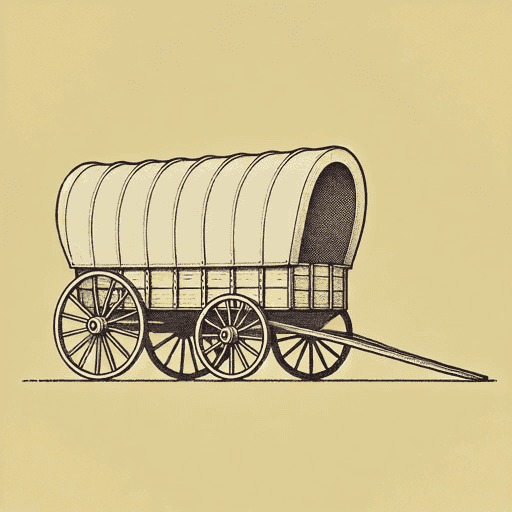
Didion traces the western migration of her family through her matrilineal line, beginning with her five-times-great-grandmother, Elizabeth Scott Hardin, who moved from the Virginia/Carolina region to Arkansas when she married her husband, Colonel Benjamin Hardin. Didion knows very little about this couple, aside from embellished stories about their bravery on the harsh frontiers. She has some of Elizabeth’s recipes, which were passed down by her daughter and Didion’s four-times-great-grandmother, Nancy Hardin Cornwall. Nancy and her family, including her husband Reverand Josephus Adamson Cornwall, continued to move West in 1846, heading for Oregon alongside the infamous Donner-Reed party.
Didion has an applique—a type of needlework—Nancy worked on during this crossing, as well as a photograph of a cabin known as Cabin Creek where the family stayed while stuck in the Willamette Canyon. Another heirloom of this crossing, a potato masher, was placed on display at the Pacific University Museum in 1957, which Didion admits she hasn’t visited.
Didion shares an anecdote from Nancy’s daughter Narcissa about the winter at Cabin Creek and the family’s interactions with Indigenous Americans in the area. Didion relates another story from the daughter of Elizabeth Anthony Reese, her great-great-grandmother who also made the western crossing. The daughter recalls how her brother died from illness, and the family were lucky to have a trunk to bury him in before the caravan moved on.
Didion reflects on her ancestry of radical women who learned to live off the land in pursuit of an unknown end, and whose eccentricities continued to be passed down. Nancy’s son Joseph remembers his mother as having an ever-full well of energy, since her life was a constant stream of activity. Didion describes another photograph, this time of her grandmother Edna Magee Jerrett near a mining camp. Edna lived in Oregon in a house full of global curiosities; unlike her ancestors, she had expensive taste and an “extravagance of spirit” (10). Didion remembers Edna giving her unusually expensive gifts as a child, and she recalls a story about Edna’s tearful refusal to work at a cannery during World War II. Edna’s life was still littered with tragedy, as her siblings and their children suffered many health complications, but it was also tinged by restlessness. Didion lists several heirlooms she received after Edna’s death, including stocks she was told to cash in and use to treat herself.
Didion never knew her paternal grandmother, Ethel Reese Didion, aside from the short, oft-repeated memories of her father and great-aunt, who described Ethel as “nervous” and “different.” In one picture from 1904, Ethel stands among her cousins at the Florin Grange Picnic just south of Sacramento. Ethel’s family bought the farm in Florin for $2 an acre after a turbulent crossing. The whole family was involved in the farm operation and selling their products in Sacramento. The farm eventually grew and changed its ownership to a family corporation, the Elizabeth Reese Estate Company. Didion remembers her parents arguing about selling their shares of the farm, as her mother was more than happy to leave California.
Part 1, Chapter 2 Summary
Didion shares an excerpt from a speech she made at her 8th-grade graduation in 1948 titled “Our California Heritage.” In the speech, Didion declares that the early Californians who built their great state were different from other settlers, as they were more ambitious and adventurous. She implores her classmates to continue in their tradition, to not become complacent, and to always keep seeking something more. Didion concedes that she didn’t recognize the speech’s irony until much later: Most of her classmates’ families were recent transplants with little connection to the state’s past. As she matured, Didion researched questions she had about Californian identity, and she claims this book is her means of sorting out her confusions.
Part 1, Chapter 3 Summary
Beginning her investigation into California’s self-identity, Didion examines the Sacramento River. This immensely long and wide river floods its valley annually, making the surrounding lands almost uninhabitable, but this didn’t stop people, like her great-great-grandfather William Kilgore, from settling in the region.
Didion remembers seeing lithographs of “high water” during the 1850s and 1860s, which showed citizens travelling to and from their homes and businesses by raft and boat. She quotes historian Charles Nordhoff, who explains that this unproductive land was sold by the state for $1 an acre on the condition that the owners would reclaim the land within a year, and at that point, the state would reimburse them. Though this endeavor made the Sacramento Valley a thriving community, concerns over water levels remained constant throughout Didion’s life. Statistics show the sheer amount of infrastructure erected by the federal government to deal with the River, including miles of levees and canals, and countless pumping plants, dams, bridges, and gauging stations.
Didion notes the irony of California’s perception of itself as self-sufficient when coupled with its dependence on the government to help develop it. California as a place, even when it was a Spanish state, attracted entrepreneurial people who sought quick money rather than patient labor. As an example, Didion describes how four astute men dreamed up the railroad that connected the state to the rest of the country, but it was federal taxes that paid for the construction and the land. California’s agriculture sector is also heavily subsidized. Farmers plant crops that aren’t profitable using astronomical quantities of water because the state and federal governments shoulder most of the cost. One exemplary case is farmers who plant Japonica rice, whose plants require extended underwater submersion during California’s drought months. This rice isn’t popular in the United States, and Japan has banned its imports, making the effort and expenditure virtually pointless.
Part 1, Chapter 4 Summary
Didion quotes Josiah Royce, a key member of Harvard philosophy department’s “golden period,” on his reflections about being from Sacramento. Royce was always told that his community was “new,” but everywhere he looked, there were signs of people who had lived there before him. Rather than examine these contradictions, Royce’s eventual conception of California was founded on the abstract moral of “loyalty,” despite his other conjectures that Californians were those who shrugged off their homes for adventures out west.
Didion sees that this reinvention of California is especially present in stories of the crossing to the West. For travelers, this crossing was a kind of death and rebirth—a complete rejection of one’s previous life, a confrontation with the wilderness, and a birth into a new, prosperous land. Didion quotes Royce’s mother’s recollection of their crossing, which echoes this sentiment. Didion finds that “the crossing story” is a genre with its own standard conventions. One prominent element is the strange, omniscient perspective from which the stories are told. She quotes a story of Josephus Cornwall’s departure, where at one moment the story follows Josephus, at another it follows his mother, and at no point is there a third person witnessing this interaction to acquire such details. In another example from Josephus’s infancy, a story relates how baby Josephus was spared from a mad dog’s attack, though no one saw this happen. Didion observes that Californian children hold onto these stories as their cultural heritage, but these unverifiable and colorful stories lead to a skewed self-perception.
The names of places along the crossing also became common in California’s lexicon. Items from the crossings, like the Cornwall family potato masher, came to be viewed like relics. Didion explains this veneration with an excerpt from Jack London’s The Valley of the Moon, where Saxon Brown holds her mother’s corset and senses in its fabric her mother’s journey and hardships. Despite this reverence, Didion notes that, for travelers, there was a necessary lack of sentimentality about getting rid of one’s personal items—no matter how precious—to keep moving forward. This was due to the strict timelines of the crossing, as the daunting Sierra Nevada mountains had to be crossed before the winter snow came. The Royces, for example, had to abandon their wagon to make it through the mountains before snowfall.
Like belongings, the sick and dead were also “jettisoned” with a similar lack of emotion. Didion quotes William Kilgore’s diary about crossing the Sierra Nevada, which quickly details the burial of a traveler amid extensive data on a mountain’s elevation. In another story, Nancy Cornwall’s son Joseph recalls how a young woman, whose mother died earlier on the crossing, was buried in the middle of a road; the party then drove over her grave with their wagons to conceal it. Didion also relates a more harrowing tale from Bernard J. Reid about those parties who were less willing to keep the weak among their ranks. Reid recalls finding a 17-year-old girl and her sick brother abandoned along the trail in their oxen-less wagon. Their parents died two days earlier, and the party was too scared to wait for the brother to recover lest they couldn’t reach the Sierra Nevada before snowfall. Didion asks whether such sacrifices of one’s humanity complicate the “redeeming” quality of the crossing.
Part 1, Chapter 5 Summary
Despite growing up in Sacramento, Didion claims that, like many Californians, she had trouble understanding her place in the state, and the state’s larger place in the country. She quotes Josiah Royce’s similar sentiments, a conundrum of identity that moved him away from the West to Harvard.
Novelist and journalist Frank Norris tried to tackle these questions through an epic literary trilogy which followed the trail of wheat from California across the country. Norris published the first book, The Octopus, in 1901 after having spent the summer on a wheat farm in San Benito County. He drew on several historical events from the region, including the 1893 capture of a rogue brakeman and an 1880 shootout between ranchers and federal agents over eviction orders.
As inspiration for the novel’s protagonist, Presley, Norris recreated a popular newspaper poem from 1899 about worker exploitation. In The Octopus, the poem makes Presley famous, and he receives an invitation to dine with “the Railroad King.” At the same time as Presley’s rise, a widow and her daughter—victims of the railroad’s evictions—descend into poverty. Presley meets the destitute daughter, and his lavish dinner becomes tainted by premonitions of riots. Later in the novel, a railroad agent dies in the cargo hold of a ship, drowned in wheat. Didion explains that the titular octopus is at once the Southern Pacific Railway and “indifferent nature” (45), which Norris characterizes as similarly monstrous and unstoppable forces.
However, Didion argues that The Octopus is not a straightforward anti-corporate tale. The ranchers, who see themselves as fighting against exploitation by corporate overlords, are all recent transplants who migrated to the region precisely because the new railroad created a flourishing market for wheat. The farmers don’t care about the land; they care about how much profit they can get out of it before moving onto their next project. Didion suspects that these characters would’ve easily joined the corporate side of the railway given the opportunity. Thus, she sees that the conflict in the book is actually between members of the same class who cannot perceive this sameness because of their individualist self-perceptions.
Didion closes the chapter with passages from the United States Bureau of Reclamation’s website concerning the San Joaquin valley. The Bureau quotes Norris’s desolate depiction of the region in The Octopus and claims that the state simply added water to make it a flourishing area. In one lengthy passage, however, Didion exposes just how much infrastructure, government money, and time has been dedicated to land reclamation. Much of this infrastructure, Didion explains, was taxpayer-funded, but serves primarily corporate growers.
Part 1, Chapters 1-5 Analysis
This section introduces the symbol of heirlooms through the theme The Romanticization of History and the Land. Didion catalogues the items her female ancestors passed down through the generations, such as the potato masher from Nancy Hardin Cornwall’s crossing. As time passes, this seemingly mundane item becomes imbued with immense significance, acting as a symbol of the family’s survival and longtime inhabitance of California. The potato masher is deemed so important that one of Didion’s cousins puts it on display in a museum. Didion explains that such ordinary items from this period are treated like “relics of those who had made the redeeming journey” (31) and thus are venerated and respected. Didion was taught to view herself and her path through life in relation to these items and the stories they signified, a habit she later classifies as unproductive.
Didion connects the Californian tendency to look back romantically at their pioneer past with the crossing story, which becomes a motif in the text. Didion performs a close reading of these crossing stories to unearth the real, often immoral actions and beliefs of the early settlers. For example, she explores the idea of rebirth and redemption in these tales. She questions, “For what exactly, and at what cost, had one been redeemed?” (37). Didion concludes that the act of leaving behind one’s home and family—or dragging them along on the treacherous journey—for ambitions of rapid success on the Californian frontier was one of such selfishness that the hardships of the crossing were supposed to cleanse the traveler of this sin.
Didion argues that beneath the heroic language of these stories lies a lack of humanity and selfishness in the name of survival. Didion gives several examples of travelers quickly leaving behind their dead so the caravan can keep on schedule, such as a party that left an ailing sister and brother alone on the empty plains because they were slowing down progress. Didion asks whether such a rejection of one’s humanity makes these people worthy of their “redemption”: “Such memories might have seemed difficult to reconcile with the conviction that one had successfully met the tests or challenges required to enter a new life” (36). This willingness to “jettison” the weak persists covertly in the Californian identity and, to Didion, is the root of much of the state’s conflicts.
It is important to note, however, that Didion, while proclaiming her intention to interrogate some of the idealized mythologies around California and its past, nevertheless still tends to whitewash or sidestep some of the most unsavory aspects of California’s history. Most notably, she does not really address the violent persecution and killing of Indigenous peoples during the Gold Rush era and throughout the 19th century, in what came to be known as the California Genocide (See Background). Didion draws attention to the callousness of the pioneers in abandoning sick members during the caravan journeys and offers a moral critique of this behavior, but does not apply the same critical lens to how these pioneers also often displaced and persecuted the Indigenous peoples of California as they settled in. Such omissions reveal the limitations and biases of Didion’s perspective and approach.
Didion also uses her family history to introduce the theme of The Role of Personal Experience in Shaping Political Understanding. Didion extracts from her personal recollections and inherited family stories the myths she was taught about what being Californian meant. For example, Didion was taught about her ancestors’ willingness to tackle any activity for their survival, with her family claiming such qualities were hereditary. She includes her graduation speech to illustrate how entrenched this belief was, telling her young classmates, “We can’t stop and become satisfied and content. We must live up to our heritage, go on to better and greater things for California” (17, emphasis added). It is looking back at this speech and the irony of it being given to a group of recent migrants to the region—those with literally no connection to California’s past exploits—that prompts Didion’s investigation into California’s political identity.
Didion also declares the purpose of her book is to investigate The Contradictions of Californian Identity, namely California’s vision of itself as self-sufficient while also relying heavily on the federal government. Didion highlights the lithographs people have in their homes of “high water” in Sacramento, which they believe demonstrate the “unfettered individualism” (23) that made them believe they could manipulate and overcome the inhabitable land. She follows this with a lengthy list of all the civic works that were erected to ensure the Sacramento River was contained and wouldn’t interfere with the growing community, which “was largely borne, like the cost of controlling or rearranging many other inconvenient features of California life, by the federal government” (23). She claims that Californians ignore this fact in favor of stories of individual ingenuity, and tends to frame dependence on governmental aid or investment in general as a “problem” in California throughout the text.
However, Didion’s insistence that California relies on government support even in the modern era ignores the fact that California now tends to contribute significantly more to the federal government than it receives back in any form of federal aid or investment: According to 2024 statistics, “Californians paid about $275.6 billion more to the federal government than they received” (“Which States Contribute the Most and Least to Federal Revenue?” USA Facts.org, 3 Nov. 2025). Didion’s reasoning is thus somewhat unclear on this point, as what she frames as “dependence” could more logically be construed as the state receiving back in terms of investment a small part of what they have already contributed on the federal level, at least in the contemporary era.

Get in-depth, chapter-by-chapter summaries and analysis from our literary experts.
- Grasp challenging concepts with clear, comprehensive explanations
- Revisit key plot points and ideas without rereading the book
- Share impressive insights in classes and book clubs