A Year of Marvelous Ways
A modern alternative to SparkNotes and CliffsNotes, SuperSummary offers high-quality Study Guides with detailed chapter summaries and analysis of major themes, characters, and more.
Summaries & Analyses
Quizzes
NEWReading Tools
Part 3Chapter Summaries & Analyses
Content Warning: This section of the guide includes discussion of death, death by suicide, suicidal ideation, rape, mental illness, and graphic violence.
Part 3, Chapter 14 Summary
Francis Drake awakens in the woods, severely ill, injured, and wishing to die. Marvelous Ways finds him there near death and moves him to shelter. At dusk, she returns with a lantern. In his delirium, Drake perceives her as an owl due to her yellow coat and large glasses. She leads him to a river, strips off his soiled clothes, and washes him with violet-scented soap. Terrified of the water, Drake refuses to go deeper than his knees. Marvelous washes his hair and then guides him to her boathouse, where a fire is burning and clean sailors’ clothes, belonging to a friend, are laid out. She spoons broth into his mouth and gives him warm ale with rum. Before he sleeps, Marvelous warns Drake not to attempt suicide again, telling him his life is precious. She watches over him through the night.
Part 3, Chapter 15 Summary
For several days, Drake drifts in and out of consciousness while Marvelous cares for him. He sometimes hears what he thinks are murmurs, which she explains is the “chatter of saints” (87). During his lucid moments, he is tormented by the memory of Missy taking her own life. He recalls the moment her head went under the water, how he waded into the water up to his waist, and the sight of her shoes placed neatly by the shoreline. The memory overwhelms him, and he lapses back into sleep.
Part 3, Chapter 16 Summary
As Drake recovers, he tries to recall his journey from London. He remembers being drunk on a train, losing his hat, and getting off a stop early, where he begged for a sign and received one reading “STOP HERE” (89). He stopped, experienced “a drowning silence” (89), and woke in the woods.
One night, while Marvelous is out, Drake gets out of bed and goes onto the boathouse balcony. He sees a candle lit in a church on a small island in the creek and then spots Marvelous swimming naked in the river. He watches her with a deep sense of wonder at her resilience and aged body. The sight fills him with shame for his own despair and for having given up on life so easily.
Part 3, Chapter 17 Summary
While sharing a meal, Drake and Marvelous formally introduce themselves. Drake notes the irony of being named after a famous explorer, as he is terrified of water and has never traveled far. Marvelous begins to share her life story, explaining that her mother was a mermaid from South Carolina, America. Her father brought her mother to London, but she grew unhappy with the dirty Thames, and they eventually settled in the boathouse in the quiet Cornish creek. Shortly after Marvelous was born in 1858, her mother was shot and killed by someone who mistook her for a seal. When Drake asks what became of her father, Marvelous explains that he “stopped breathing,” clarifying that he did not die but never fully returned to life. Drake asks about the outline of a painting that once hung on the soot-stained fireplace. Marvelous replies it must have been an image her father could no longer bear to see.
Part 3, Chapter 18 Summary
Continuing her story, Marvelous explains that she was sent to London to be raised by an aunt who renamed her Ethel. Her father, consumed by grief and anger at God, wandered the Cornish peninsula for nine years, learning ancient healing arts and finding a new purpose. He then returned for 10-year-old Marvelous, and they traveled together in a “gypsy” caravan. He became known for helping the dying pass peacefully, and Marvelous learned his methods while also aiding with childbirths. When Marvelous was 14, her father’s health failed. She brought him back to the boathouse, where he died three days later, his final moments spent seeing the spirit of his wife waiting for him.
Part 3, Chapter 19 Summary
One night, Marvelous fails to visit, leaving Drake feeling anxious and alone. He reflects on Missy’s death and his subsequent flight through London. He takes out the drawing of Missy’s hand that she gave him as a child, inscribed with the words “Never forget me” (107), and burns it in the hearth. The next morning, he discovers a charred fragment of the paper on which only two words remain: “Forget me.” The sight overwhelms him, and he collapses into a deep sleep.
Part 3, Chapter 20 Summary
Marvelous returns the following night, and a relieved Drake insists she finish her story. She recounts how, at age 14, she took her deceased father’s body out to sea for burial, believing his spirit was reunited with her mother’s. Grief-stricken, she hoped to die in a storm but was washed safely ashore. She returned to the creek and lived in isolation, ignored by the villagers until she began swimming naked in the river like her mother, which frightened them. Three years later, the local wise woman, Keziah, declared her ready to help with a birth. Marvelous successfully delivered a baby girl, earning thanks from those present, though the wider community remained ambivalent. Drake remarks that her story feels more like a beginning than an end.
Part 3, Chapter 21 Summary
On the first of December, Drake ventures out of the boathouse in the daylight and sees Marvelous’s “gypsy” caravan for the first time. He goes inside while she is away and finds a space filled with shells, herbs, and handwritten notes pinned to the ceiling. One note reads, “Drake = Sad” (118), while another reminds Marvelous of her birth year. He recognizes this fragmented thinking from an elderly man in his past and understands it as a sign of her “leaky” mind. He also finds a locked ledger titled The Marvelous Book of Truths. He pockets the note about himself and leaves the caravan feeling a newfound sense of kindness.
Part 3, Chapter 22 Summary
Marvelous brings Drake a poster of Gone with the Wind to brighten the boathouse, reminiscing about the film and wondering aloud how she would look in the red lipstick worn by the actress Vivien Lee. She notices a letter on the mantelpiece, and Drake explains it is addressed to a Dr. Arnold and that he must deliver it. The name triggers a painful partial memory for Marvelous, making her dizzy. Drake assures her he has no plans to leave soon. Marvelous is visibly relieved, having grown accustomed to his presence.
Part 3, Chapter 23 Summary
While Marvelous is away, Drake sets out to find the “Stop Here” sign that marked his arrival, puzzled by her claim that she had been waiting for him. He searches the deserted High Road but finds nothing. As dusk falls, he sits on a milestone and drops his lighter. When he bends to retrieve it, he sees the carved letters on the stone from a new angle and realizes what he saw was not a command but the name of the hamlet: “ST OPHERE.” He laughs at his mistake.
Part 3, Chapter 24 Summary
Drake hears jazz music from Marvelous’s caravan, which reminds him of a club in postwar Paris. Later, he and Marvelous fish in the creek, and he proudly catches his first fish, a mullet. While they cook it over a fire, she tells him the story of the nearby shipwreck, Deliverance. The boat belonged to Old Cundy, whose grandson was fighting in France. During the Dunkirk evacuation, the boat’s engine started on its own, compelling Cundy to join the rescue flotilla. The boat brought back soldiers, but not his grandson. After this, Deliverance seemed to die of grief and fell apart on the sandbar. Later that night, in her caravan, Marvelous finds a new note on her ceiling, written in an unfamiliar hand: “DRAKE = A BIT HAPPIER” (129).
Part 3, Chapter 25 Summary
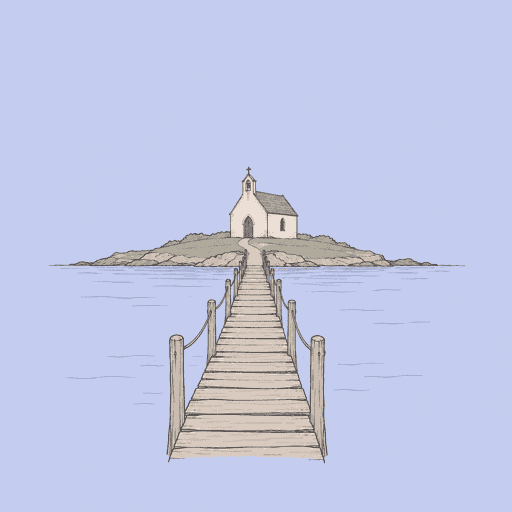
Marvelous feels foreboding as she notices a change in the weather and an unusually high tide. They remind her of the conditions that preceded a great storm years earlier. Drake awakens to find the boathouse flooded. Marvelous appears in a canoe, and they paddle onto the inundated creek. They steer the canoe into the flooded, roofless church on the island, its walls covered with small, handmade model boats. Marvelous explains that she made one for every child she delivered. She tells Drake the local legends about the hamlet’s founding saint and then confirms that a man named Jack, whom Drake had overheard her talking to one night, was her third and greatest love.
Part 3, Chapter 26 Summary
Inside the flooded church, Marvelous tells Drake about her first love. At 17, she traveled to the Eddystone lighthouse to help a dying sea captain and fell in love with his daughter. Trapped by a storm, the two began a passionate affair that lasted two weeks. During her stay, Marvelous helped the girl to catch fish using a huge kite. When Marvelous left, she never saw the girl again. Years later, Marvelous was caught in a dangerous storm at sea. She was rescued by a large canvas kite that carried her to a nearby shore. Marvelous concludes that love is “the only thing to have faith in” (144).
Part 3, Chapter 27 Summary
After the flood subsides, Drake and Marvelous return to her caravan. She tells him that she collects washed-up bottles from the shore and answers messages in them. Showing him an empty gin bottle she collected, Marvelous states that this was the “silent” message Drake dropped in the River Thames on November 2, 1947. This prompts Drake to finally tell her the full story of Missy’s suicide. As he is about to leave her caravan, Marvelous tells him that she has faith in him. The next morning, as the sun rises, Drake feels a deep sense of hope. He knows he will be all right and is finally ready to leave the creek.
Part 3, Chapter 28 Summary
The day he decides to leave, Drake changes into his old civilian clothes, which now feel foreign. He packs away the things Marvelous gave him, erasing his presence from the boathouse. He feels a deep sadness, realizing he cares for Marvelous and has never learned how to say a proper goodbye. He finds her digging for worms in the mudflats and tells her he is leaving and doesn’t expect to return. She wishes him well, urging him to “Live well. Love again” (149). They shake hands, and he walks away.
Part 3, Chapter 29 Summary
Drake travels to the city of Truro to deliver the letter to Dr. Arnold. After getting a haircut, he finds the doctor’s house. Dr. Arnold, a kind man, reads his son’s letter while Drake waits inside. When Drake pretends to have known his son, claiming he was “a good soldier” (153), Dr. Arnold gently corrects him, revealing his son hated the war. Drake then tells the truth: He was a stranger who made a promise to a dying soldier. As they talk, Drake mentions he has been staying with an old woman named Marvelous.
Stunned, Dr. Arnold reveals that he knew Marvelous approximately 25 years earlier, around 1922. As a young doctor, he treated her when she was living wild in the woods, overcome with grief for a dead lover. He diagnosed her with sorrow. On his last visit, she gave him a dowsing rod and promised it would find him love. Soon after, he met and married a widow with a young son, Douglas. Dr. Arnold then discloses that Marvelous delivered his stepson, Douglas—the very soldier who gave Drake the letter.
Part 3, Chapter 30 Summary
Dr. Arnold takes Drake to a local museum and shows him a painting titled Lady of the Sea, dated 1857. Dr. Arnold explains that he has researched the subject of the portrait, who was allegedly a mermaid. A man named William Ways fell in love with her in the American South, likely bought her freedom from enslavement, and brought her back to England. Drake notes that the picture frame’s size perfectly matches the soot-stained outline above the boathouse fireplace. He realizes it is a portrait of Marvelous’s mother, a beautiful woman of color.
Part 3, Chapter 31 Summary
Dr. Arnold drives Drake back to the creek that night and gives him the dowsing rod, insisting it is something to be borrowed, not owned. Drake returns to the caravan, where he finds Marvelous frail and in bed. She has little memory of Dr. Arnold. Drake tells her he has decided not to leave after all and kisses her.
Part 3, Chapter 32 Summary
A brief, undated chapter describes a scene from the past. A young, newly married Dr. Arnold visited Marvelous in a psychiatric hospital. She was sitting in a gray room, surrounded by her model boats and wearing only a yellow coat. She pulled a loose brick from the wall and pressed her face to the opening, inhaling the scent of the distant river, which she believed was calling her home. When the doctor spoke her name, she looked at him without recognition.
Part 3, Chapter 33 Summary
A few days before Christmas, Drake remembers a happy Christmas from his boyhood at the pub where his mother worked. He decides to decorate the boathouse, hanging the dowsing rod with holly over the door and placing his mother’s photo behind it. He takes out a collage of a man’s face he created as a child from magazine clippings, based on his mother’s descriptions of the father he never knew. He sticks the portrait on the wall, where it perfectly fits the smudged outline above the hearth. When Marvelous enters and asks who it is, Drake reveals that it is his father. Marvelous studies him and says he has his father’s eyes.
Part 3, Chapter 34 Summary
As a Christmas surprise, Drake takes Marvelous to Truro. In a tearoom, he grows protective as other customers stare at her. Afterward, he leads her to the museum and leaves her alone in the gallery with her mother’s portrait, and Marvelous finally sees her mother’s face. As they leave, snow begins to fall. The journey home feels magical to Marvelous. By the milestone at St. Ophere, Drake gives her an early Christmas gift: a tube of “pillar-box red” lipstick, the same bright color as UK postboxes.
Part 3, Chapter 35 Summary
In January, Drake’s old restlessness and tremors return, and Marvelous realizes she has begun to absorb his trauma. She is plagued by fear and experiences his nightmares, including one involving a card game. One night, she is mysteriously thrown to the ground outside her caravan. Drake finds her the next morning, frosted and weak, and nurses her back to health. A week later, she recovers and wordlessly hands him a playing card: the nine of diamonds. He collapses in tears, finally ready to tell her what happened.
Part 3, Chapter 36 Summary
Drake finally confesses the source of his trauma. During the war in France, his comrades brought a local woman accused of collaboration back to their camp. One of them, Scripps, had the men each draw a card, with the highest card going first. Scripps drew a king, and Drake held the lowest card, the nine of diamonds. His comrades then lined up to rape the French woman. When Drake protested, the five men aggressively instructed Drake to leave, and he did as he was told, a personal failure he knows he can never undo. He later saw the French woman publicly shamed and beaten by a mob. After that day, his unit ostracized him.
When his story ends, Marvelous quietly notes that the tide is turning. Drake wades into the freezing river and fully submerges himself, feeling an overwhelming peace wash away his fear. He surfaces by the wreck of Deliverance and feels as if he hears the old boat whispering that his ordeal is finally over.
Part 3 Analysis
Marvelous’s decision to wash a terrified Drake in the river establishes the central role of water in his recovery. This scene reinforces the symbol of water and the creek as a space of both terror and potential purification. The act of washing represents a ritualized cleansing of physical and spiritual sickness, but Drake’s initial refusal to go “further than his knees” (84) signals that he is not yet ready to accept this baptism. His eventual, willing immersion in the creek after confessing his wartime trauma marks the culmination of his healing arc, illustrating Nature as a Restorative Force. Marvelous, who lives by the tidal rhythms and swims at every high water, is a guide, understanding that the natural world provides a power beyond human intervention. Her quiet observation that the “Tide’s on the turn” (179) after Drake’s confession and subsequent submersion suggests his psychological release is synchronized with the creek’s cycles, which ultimately offer him “overwhelming peace” (179).
As Drake recovers, his relationship with Marvelous solidifies around the reciprocal acts of telling and listening. When Marvelous begins sharing her life story and then pauses, Drake insists she continue, stating, “You can’t leave a story in the middle” (109). Healing Through Storytelling becomes the primary mechanism for their connection. Marvelous’s personal history, involving a mermaid mother and a father who “stopped breathing” (96) yet continued to live, provides a mythic framework that allows Drake to approach his own trauma indirectly. Her narratives of loss (her mother’s death and her father’s grief) mirror Drake’s own losses (Missy, his absent father, and the innocence he lost during the war), creating parallels that foster empathy and, eventually, his own confession. By framing her life through the lens of Cornish folklore and family legend, Marvelous creates a non-judgmental space where Drake can unburden himself. This dynamic reflects author Sarah Winman’s focus on how unconventional relationships foster recovery, suggesting that healing comes not from objective truth, but from the emotional honesty and shared witness found in storytelling.
Drake’s confession about a horrifying incident in France gives a specific origin to The Lingering Trauma of War, grounding his tremors, nightmares, and existential despair in a concrete event. His trauma is rooted not only in combat but in the moral injury of his complicity in a war crime—his failure to intervene in the rape of a woman. The men drawing cards to decide the order of the sexual assault perverts soldierly camaraderie into a grotesque lottery of violence. Drake’s story marks this as the moment his identity fractured, leaving him feeling as if he has “no shadow” (178). His profound guilt and later ostracization highlight the complex psychological wounds carried by many veterans, beyond the trauma induced by lethal combat. In the historical context of post-WWII Britain, where stoicism was expected and trauma was often unacknowledged, Drake’s inability to speak about his experience until finding Marvelous emphasizes the silent, isolating suffering of his generation.
Throughout this section, a series of improbable coincidences suggests that the world is governed by a force beyond rational explanation. Drake’s arrival at the creek is predicated on his misreading of the milestone “ST OPHERE” as a command to “STOP HERE.” This initial accident leads him to Marvelous, who later declares she has been waiting for him. The narrative’s web of connections tightens when Drake delivers the letter to Douglas’s stepfather, Dr. Arnold, and learns he treated Marvelous for grief decades earlier. Marvelous’s gift of a dowsing rod that she promises will find love further imbues the story with a sense of fate. These narrative events blur the line between chance and destiny, creating a magical realist atmosphere where the universe conspires to bring characters together for necessary encounters. This worldview aligns with Marvelous’s philosophy when she tells Drake he must have faith in something, whether it be “The sun. The moon. Anything” (144), proposing a world where belief and connection are the guiding principles of existence.
In this section, the boathouse evolves into a space for confronting and reconstructing fragmented identities. When Dr. Arnold shows Drake Lady of the Sea, he encounters a tangible image of Marvelous’s mother that fills the absence indicated by the “smudged outline” (160) above the boathouse’s hearth. For Marvelous, the portrait crystallizes the mother she has only known through oral history and folklore. The revelation also anchors her magical origin story in a complex, unspoken history of racism and displacement. Shortly after, Drake similarly connects the symbolic space to ancestral memory by hanging his own collage of his imagined father in the portrait’s place. In telling Marvelous, “It’s my father” (168), he moves from a state of rootlessness to one of declared lineage, constructing an identity where there was once a void. The boathouse, initially a temporary shelter, becomes a repository for both family histories, cementing the bond between its two inhabitants.

Get in-depth, chapter-by-chapter summaries and analysis from our literary experts.
- Grasp challenging concepts with clear, comprehensive explanations
- Revisit key plot points and ideas without rereading the book
- Share impressive insights in classes and book clubs
Related Titles
By Sarah Winman