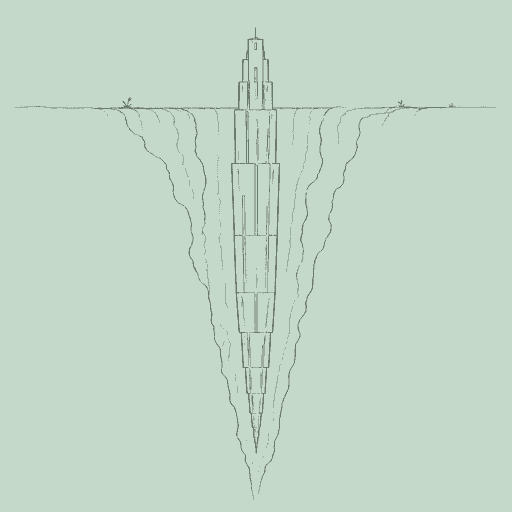
Absolution: A Southern Reach Novel
A modern alternative to SparkNotes and CliffsNotes, SuperSummary offers high-quality Study Guides with detailed chapter summaries and analysis of major themes, characters, and more.
Summaries & Analyses
Quizzes
NEWReading Tools
Book 3, Part 1Chapter Summaries & Analyses
Content Warning: This section of the guide includes discussion of graphic violence, substance use, cursing, and death.
Book 3: “The First and the Last”, Book 3, Part 1: “1=Fuck That Chicken”
Book 3, Part 1, Chapter 41 Summary: “Love and Glory Holes”
A day before his expedition, the first set to cross the Border into Active Area X, is to depart, Lowry feels a deep loathing for the mission, especially for the constricting suit he will have to wear. He is in a clandestine sexual relationship with the expedition leader, Sky, but finds her physical closeness after sex to be oppressive. Recently, Lowry gave her a bouquet of white lilies and a ring with a diamond splinter, a gesture that made their casual relationship feel more serious. As the mission departure nears, Lowry’s nervous tic of saying “fuck” constantly has grown more pronounced, as has his use of the drugs that the medic, Landry, supplies. He privately thinks of the corridor that leads into Area X not as a tunnel but as a massive intestine.
Book 3, Part 1, Chapter 42 Summary: “Fuckling Pickle Jars”
Lowry reflects on a specific room within Central’s Southern Reach complex that he favors. The room contains the tombstone of a man named Chaste Dickdred, the former owner of the doll factory on which the facility was built. It is filled with shelves of jars holding preserved deep-sea creatures, scientific specimens that Lowry considers to be old friends. This is the room where Lowry gave Sky the flowers and the ring; she recoiled at the preserved specimens, and Lowry was too inarticulate to explain his affinity for them. Whitby, an expedition alternate whom Lowry sees as a confidant, also likes the room.
Book 3, Part 1, Chapter 43 Summary: “Haunted Brass”
The expedition members attend a final briefing from the Director and other senior staff, whom Lowry privately calls the “unnerved brass.” They are told they might encounter surviving soldiers from an army base inside Area X, as well as navy seamen from a destroyer cut in half by the Border, who might have swum to shore. Lowry notices Jackie, Jack’s daughter, and recalls a rumor that she was in a car sliced in half by the Border when it first appeared, suddenly and without warning. At the briefing, Whitby cryptically warns Lowry to look for a tag reading “TOT,” telling him to run if he ever sees it and whispering, “trash or treasure” (145).
Book 3, Part 1, Chapter 44 Summary: “Scroll Call”
Lowry resents the expedition’s second-in-command, Jamal Winters, believing that he is more qualified for the position. He likes very few of his teammates, naming Landry and Hargraves, though he remains deeply ambivalent about Hargraves and keeps her at a distance. Scott Landry is a medic who supplies him with drugs. Lowry has secretly created a list of the 24 expedition members, ranking them in the order he predicts they will die; Landry is number one. The full roster is called, including the alternates Whitby Allen, David Read, and Jenny Spirling. To cope with his anxiety, Lowry continues to take the drugs Landry provides.
Book 3, Part 1, Chapter 45 Summary: “No Reason Titty”
At their last lunch in the cafeteria, the expedition members discuss their motivations for joining the mission, with some citing “Love” and “Death.” Lowry disrupts the serious conversation by randomly saying the word “Titty.” The group also discusses the Director’s theory of an “off switch” for Area X. Lowry privately scoffs at this notion, wondering if Area X might have an “on switch” they could accidentally trigger instead. Despite viewing him as an oddity, Lowry feels a strange reliance on Whitby for guidance and feels frustrated with himself for it.
Book 3, Part 1, Chapter 46 Summary: “The Off Switch”
Before departure, Lowry reflects on his secret assignment from Jack, who has tasked him with acting as a shadow leader on the mission. Lowry’s clandestine meetings with Jack, who has a perpetually sunburned-looking face and wears a silver cross, take place at a local pool hall. His secret objective is to find a man named “Old Jim,” who Jack believes may still be alive inside Area X. The instructions for this mission were delivered to Lowry inside a hollowed-out Bible.
Book 3, Part 1, Chapter 47 Summary: “Reverse Puffer Fish”
The expedition team gathers in a locker room to don their protective suits to go through the Border and enter Area X. Lowry despises his suit, which feels like wearing another person’s skin beneath several constricting layers. Once fully suited, the members are too bulky to move easily and are transported on dollies. They are loaded onto a truck and packed so tightly together that they are immobilized. Inside their helmets, the team members can only stare at one another as the truck begins its journey toward the Border.
Book 3, Part 1, Chapter 48 Summary: “Nekcihc Eht”
As the truck carries the team toward the Border, Lowry remembers a disturbing story Whitby told him about the first test of the corridor into Area X. According to Whitby, after a robotic carriage became stuck, they placed a rooster fitted with a small camera around its neck into the carriage and unspooled a long rope; the rooster left the carriage and went toward the light on its own, reaching the other end. They then pulled it back to retrieve the camera. However, when it returned, it was reportedly “unrecognizable.” The memory of this story deeply unsettles Lowry as he prepares to enter the same passage.
Book 3, Part 1, Chapter 49 Summary: “Kcuffuck”
While traveling through the corridor into Area X, Lowry has a verbal outburst, screaming a long stream of obscenities. Upon emerging, he feels completely sober and finds himself unable to say the word “fuck.” He then vomits inside his helmet. When they arrive inside Area X, the team discovers that expedition member Marianne Rodgers has vanished in the corridor. Shortly after, another member, Jon Erlickson, is found in a fetal position as his suit fuses to his body and turns into a milky white substance.
In a panic, Lowry screams that the suits are contaminated and convinces the team to remove them, defying direct orders from Sky. They strip and pile the suits into a large mound. Sky, after ordering Lowry to get dressed, is the last to remove her own suit. She then hisses that she hates him and tells him to “get it the fuck together” (348). Lowry muses absurdly that his missing fucks have somehow gone into her brain.
Book 3, Part 1 Analysis
Book 3 introduces another narrator, Lowry, establishing his unreliability through the portrayal of the final hours before the expedition, which are filtered through his drug-fueled, profanity-laced consciousness. His internal state is a mirror of the mission’s external chaos, and he qualifies his repetitive use of the word “fuck” as a linguistic defense mechanism against a world he feels is “in shackles.” This verbal armor, which he uses to cope with his mission-loathing and anxiety, proves as fragile as the mission’s other preparations. The moment Lowry emerges from the corridor into Area X, he is rendered sober and finds himself unable to say “fuck,” a sudden and deep alteration suggesting the environment has already breached his psychological defenses. This immediate transformation demonstrates the theme of How Survival Shapes Identity, as attempts to grapple with this new reality seems capable of reprogramming an individual’s most ingrained habits. Lowry’s earlier, frantic outburst in the corridor becomes a final, desperate assertion of his old self before it is irrevocably altered. Area X strips him of his linguistic crutch, forcing him into a new, more vulnerable state of being, a process ironically punctuated when Sky hisses at him to “get it the fuck together” (348), wielding the very profanity he can no longer access.
The expedition’s contamination suits become a symbol of institutional failure and misguided authority, one which Lowry mistrusts before the expedition begins and is revealed to be wholly inadequate to protect them from Area X. Lowry experiences his suit as a tomb, a hostile organism that threatens to “dissolve and cheese-grate him into nothing but feeble as fuck motes of dust and light” (306). His visceral claustrophobia foreshadows the suit’s actual danger, which is realized when Jon Erlickson’s suit fuses to his body, transforming him into a milky white mass. This event confirms that the equipment provided by the Southern Reach is not only useless but can be actively lethal, a physical manifestation of The Harmful Effects of Bureaucracy. Lowry’s panicked, insubordinate command to remove the suits is a rejection of the mission’s flawed protocols in favor of primal instinct. The resulting mound of discarded suits is a monument to the swift collapse of the Southern Reach’s authority. In stripping away the gear, the team sheds the last vestiges of their connection to the world they left behind, becoming fully exposed to Area X’s influence even as they escape an immediate, manufactured threat.
Lowry’s reactions to the influence and features of Area are intuitive, and affinity for the Southern Reach’s jar room reveals his alienation from the human world and his comfort with contained, dead things. He considers the preserved deep-sea creatures to be “old friends” and finds more solace in their grotesque, static company than in physical intimacy with Sky. This chamber, a mausoleum of bizarre specimens surrounding a tombstone, is a microcosm of the agency’s entire project. It is a place dedicated to the collection and display of strange life forms, yet Lowry notes that “none of it” is useful or helps them understand what happened (309). This detail emphasizes The Futility of Knowledge as Control, showing that the accumulation of data and specimens does not lead to genuine understanding. The room’s bizarre juxtaposition of a graveyard and a laboratory highlights the morbid nature of the Southern Reach’s mission. Lowry’s romantic gesture to Sky fails in this setting because he is unable to articulate that he feels more kinship with the dead things in jars than with the living people on his team, a preference that reflects his own sense of being estranged and preserved in a state of arrested development.
The narrative uses institutional folklore and rumor to build a sense of dread that official briefings cannot. Whitby’s story about the rooster sent through the corridor is a key example. The test, intended to provide data, instead produces a horror story: The creature returns “unrecognizable,” a detail that suggests a transformation far more terrifying than simple death. This anecdote, passed along as a rumor, is more impactful to Lowry than any of the Director’s formal warnings about surviving soldiers or navy seamen. Similarly, the gossip about Jackie’s car being sliced in half by the Border’s appearance mythologizes the phenomenon, turning it from a scientific anomaly into an event of almost supernatural violence. These stories, which circulate on the periphery of the official mission, reflect the New Weird genre’s focus on the inexplicable. They demonstrate how, in the absence of concrete facts, human systems generate narratives of dread that capture the emotional truth of confronting the unknown, a truth that the sterile, controlled language of the bureaucracy actively ignores.
The hallmarks of the New Weird genre are also illustrated through the team’s transition into Area X, which is depicted not as a simple crossing but as a violent and immediate dissolution of order, reality, and identity. The corridor, which Lowry presciently imagines as a “huge stretch of intestines” (306), acts as a digestive tract that consumes one member, Marianne Rodgers, entirely. The events that follow—Erlickson’s horrific death and Lowry’s own psychological reset—confirm that Area X is an agent of transformation, not a passive landscape. The expedition’s meticulously planned structure, with its roll calls and command hierarchy, collapses within minutes. Sky, the leader, loses control as her team defies her direct orders, a breakdown underscored by her being the last one to remove her suit. Lowry’s prediction that Jamal Winters’s “good leadership skills” might get them all killed becomes a plausible reality as formal training proves useless against an incomprehensible environment (318). The expedition, meant to be an act of “conquest” or at least exploration, immediately becomes a chaotic struggle for survival where the primary threat is the very fabric of their new reality.

Get in-depth, chapter-by-chapter summaries and analysis from our literary experts.
- Grasp challenging concepts with clear, comprehensive explanations
- Revisit key plot points and ideas without rereading the book
- Share impressive insights in classes and book clubs
Related Titles
By Jeff VanderMeer