Angel Down
A modern alternative to SparkNotes and CliffsNotes, SuperSummary offers high-quality Study Guides with detailed chapter summaries and analysis of major themes, characters, and more.
Summaries & Analyses
Author Insights
Quizzes
NEWReading Tools
Symbols & Motifs
Content Warning: This section of the guide includes discussion of death, graphic violence, animal death, and racism.
Red Bible
The red leather Bible that Bishop Bagger presses into his son’s hands before boarding the Lusitania functions as a symbol of paternal love persisting beyond death. By extension, it also represents the faith that Bagger cannot bring himself to accept on intellectual terms but cannot fully abandon on emotional ones. Bagger has no interest in the book’s theological content; he never reads scripture and dismisses religion as superstitious bunk. What compels him is the object’s sensory residue: “the damp protean smell of the book’s red leather and the woody scratch of its onionskin pages, each one half-mooned by his father’s finger-stains” (5). The Bible’s power, in other words, is material, rooted in the physical traces of the man who handled it. This distinction is central to the novel’s treatment of faith, since Bagger’s relationship to the Bible enacts a paradox in which the trappings of belief sustain him while the beliefs themselves do not.
The Bible’s symbolic weight intensifies when Bagger discovers it stopped three German bullets during his sprint across No Man’s Land, the holes punched through the back cover and into the Raphael reproduction of the Solly Madonna. In the novel’s visionary church sequence, Bagger realizes the image of Mary in her red dress and blue cape is the face he has been seeing in the angel all along. The Bible thus becomes a layered object of sacrifice: the father’s gift absorbed the violence meant for the son, and the Madonna within absorbed the violence meant for the book. The discovery reframes the Bible as evidence of a parent’s protection, collapsing the distance between human devotion and the divine.
The Son of Tarzan
Burroughs’s The Son of Tarzan operates as a motif throughout the novel, recurring as a shared text between Bagger and Arno that refracts the themes of surrogate fatherhood, inherited violence, and The Power of Narrative to Shape Reality and Survival. The pulp adventure provides the framework for both characters to interpret their relationship and their war. Bagger reads aloud to Arno, inserting fabricated obscenities into the text, yet finds himself “engaged by the plot” (16) despite his contempt for its boyish fantasies. The act of reading together forges the bond Bagger spends the novel denying, transforming a dime novel into a surrogate scripture as emotionally binding as the Bishop’s Bible.
The motif’s meaning shifts as the novel progresses. Early on, the book represents escapism and innocence, a child’s adventure consumed amid real carnage. But when Bagger reflects that Korak “killed because he felt like killing” (100), the parallel between fictional jungle violence and battlefield slaughter becomes explicit. The adventure tradition’s glorification of masculine aggression is exposed as being complicit in the ideology that sustains war. The motif reaches its crisis when Bagger fabricates an ending in which Tarzan kills Korak, a father-son duel to the death that foreshadows the novel’s own pattern of lethal surrogate bonds. Arno later rejects this invented conclusion, reasoning that Tarzan would rather sacrifice himself than harm his son. Arno’s revision corrects the narrative Bagger imposed on the narrative, asserting that selflessness, not dominance, defines the parent’s role. This offers Bagger a model he will ultimately follow in his relationship with Arno.
Horse Head
The severed horse head that Ben Veck hollows out and wears as a mask functions as a symbol of psychological refuge through self-erasure. Veck arrives at Company P already traumatized by combat and by the institutional racism that set the 368th Infantry Regiment up to fail. He experiences a persistent trembling that marks him as a man whose identity has been ground down by forces beyond his control. When he encounters the shrapnel-torn horse, he carefully extracts its contents and fits the head over his own, an act the other soldiers find unsettling. For Veck, however, the horse head visibly calms him: “… he’s acting almost normal if that’s a word you can apply to a guy wearing a severed horse head…” (131) The horse head soothes Veck because it offers him an identity unburdened by the expectations and humiliations heaped on a Black soldier in a predominantly white regiment.
The symbol also connects to the novel’s pervasive imagery of war’s dehumanizing machinery. Horses are among the conflict’s most numerous casualties, and by wearing one’s remains, Veck merges with the war’s animal victims, rather than the war’s human perpetrators. When he carries the angel while wearing the mask, the narrative describes the traveling party as “one man, one beast, one boy, one centaur, and one angel” (116), a mythic assemblage in which Veck occupies the hybrid position. The centaur is a creature of two natures, and so is Veck: soldier and victim, protector and threat. By the time Veck strips naked before his final act, the removal of the horse head signals that he has also shed any remaining buffer between himself and annihilation.
Body Parts
Disarticulated body parts constitute a motif that recurs with relentless frequency, illustrating how industrial warfare dismantles the concept of individual human identity. From the opening pages, Bagger catalogues corpses as inventories of anatomy: “… one dead doughboy nearly beheaded by a pelvic bone, another who bit it collecting his intestines in one of his boots, a third stomped so flat by a shell that his spinal column protrudes from his gaping mouth…” (4). The passage establishes the motif’s governing logic, in which a body becomes legible only as a collection of severed components. This fragmentation extends to the living: Popkin’s trench-mouth gums, Veck’s trembling jaw, and Bagger’s face coated in another man’s blood. All of these details present the living human body as a site already undergoing disassembly.
The motif intersects with the theme of The Brutal Reality of War Versus Idealized Masculinity by exposing the grotesque gap between the Army’s rhetoric of wholeness and valor and the physical reality it produces. Soldiers are supposed to be unified instruments of national will, yet the landscape they inhabit is marked with arms holding hands without bodies, tongues hiding in trenches like vipers, and a dismembered ear that Bagger peels from his own cheek. His impulse to pin that ear to his lapel “a medal more useful than the Croix de Guerre” (12) crystallizes the motif’s darkest irony: In a war that awards medals for destroying bodies, the body part itself becomes the truest decoration, an honest emblem of what combat actually achieves.
Shamefly
The shamefly, also called Uncle Sam, is a symbol of internalized guilt that Bagger carries inside his chest. Its origin is specific: At Camp Winn, a fly buzzed into Bagger’s open mouth while he stared at a recruitment poster whose Uncle Sam illustration resembled his dead father. In that instant, an insect lodged in his throat and, in Bagger’s imagination, never left. He names it Uncle Sam and identifies it as “all that’s left of Bagger’s father” (21), conflating the fly with both paternal judgment and nationalistic compulsion. The shamefly thus externalizes the two forces Bagger most resists: the obligation to be a better man, which his father embodied, and the obligation to fight, which the state demands.
Throughout the novel, Bagger registers the shamefly’s restless activity in moments when Bagger’s self-interest collides with his capacity for decency. It flutters when Reis humiliates him, swells when Arno is stabbed, and hatches a swarm when Frenchy Franchouillard accuses the Americans of arriving too late to the field of war to claim any moral authority. Bagger repeatedly tries to expel the fly through vomiting, drinking, or sheer willpower, yet it persists because the guilt it represents is constitutive rather than circumstantial.
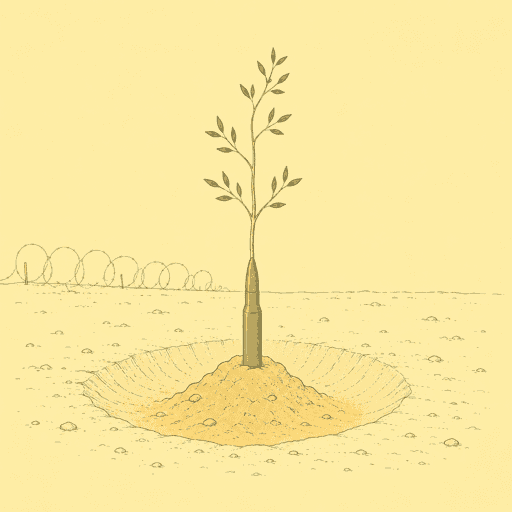
It is only in the novel’s closing vision, when Old Man Bagger whispers to the bullet tree that he regrets nothing, that “the shamefly, good old Uncle Sam” comes “buzzing out through the hole in his cheek” and flies “finally, finally away” (280). The expulsion marks the resolution of Bagger’s shame through the hope of a life fully lived, suggesting that guilt is overcome by the accumulation of acts worthy enough to answer it.

Unlock the meaning behind every key symbol & motif
See how recurring imagery, objects, and ideas shape the narrative.
- Explore how the author builds meaning through symbolism
- Understand what symbols & motifs represent in the text
- Connect recurring ideas to themes, characters, and events
Related Titles
By Daniel Kraus



Featured Collections
Challenging Authority
View Collection
Fathers
View Collection
Good & Evil
View Collection
Guilt
View Collection
Hispanic & Latinx American Literature
View Collection
Mortality & Death
View Collection
Nation & Nationalism
View Collection
Power
View Collection
Pulitzer Prize Fiction Awardees &...
View Collection
The Best of "Best Book" Lists
View Collection
The Past
View Collection
War
View Collection