Go Gentle
Go Gentle
A modern alternative to SparkNotes and CliffsNotes, SuperSummary offers high-quality Study Guides with detailed chapter summaries and analysis of major themes, characters, and more.
Summaries & Analyses
Author Insights
Quizzes
NEWReading Tools
Part 5Chapter Summaries & Analyses
Content Warning: This section of the guide includes discussion of mental illness, gender discrimination, sexual harassment, and sexual assault.
Part 5: “Released Parties”
Part 5, Chapter 35 Summary
Adora and her daughter, Viv, arrive at their fifth-floor walk-up apartment in Paris, located in a building from 1430. Adora carries both suitcases up the narrow, spiral staircase to appease Viv, who is annoyed by the climb. Inside, the flat has a view of Notre-Dame. Viv claims the larger bedroom and declares she is never leaving the apartment. The narrative flashes back to New York. The news, featuring footage of Adora’s arrest, was broadcast on Taxi TV, which Viv saw on her way to school. That night, a red-eyed Viv told Adora she never wanted to speak of the incident. Back in the present, Adora finds Viv asleep, wakes her, and gives her the Wi-Fi password. She tells Viv to decide what she wants to do in Paris, as Adora has a lecture in two days.
Part 5, Chapter 36 Summary
While walking along the Seine toward the Assemblée nationale, or the French parliament, Adora obsesses over Digby. She struggles to remember the man who wrote her NDA 30 years ago and wonders how he became involved with the Lockwoods. She muses on their recent night together, recalling their intimate conversations and intense connection. Distracted, she trips and falls.
Adora arrives at the Assemblée nationale just as an emergency meeting of the Art and Antiquities Recovery Council (AARC), led by Celine, is ending. Terrorist group QUANDO recently destroyed a Mesopotamian horse in Berlin, and Paris is believed to be their next target. Adora confronts Celine, apologizing for reporting her to the FBI for smuggling explosives. When Celine asks for an explanation, Adora recounts her faulty reasoning based on Digby’s note about an “arms deal” and a fearful voicemail from Ravi. Celine explains that the “arms deal” was a misunderstanding and that Ravi was trying to blackmail her over a clerical error on the customs forms for the Boy With Apple statue’s arms. Celine also reveals Digby’s client was her half-brother, who wanted a share of the statue’s sale proceeds. This new information brings Adora a sense of peace. She returns to the flat to find Viv eating a Subway sandwich.
Part 5, Chapter 37 Summary
The next morning, Adora and Viv have breakfast at a café, where Adora explains some Parisian customs. Afterward, they attempt to visit Adora’s choice, the Panthéon, a burial site for revered French figures like Voltaire and Rousseau. Adora explains Rousseau’s philosophy that man is born good but corrupted by civilization. However, they discover the Panthéon is closed due to a workers’ strike. Viv is delighted, and they head to the Luxembourg Gardens.
Part 5, Chapter 38 Summary
In the Luxembourg Gardens, Adora sits with Viv, who is annoyed by the romantic couples and packs of American teens. Adora finally tells Viv about her past as a comedy writer and reveals that she was sexually assaulted by an actor named TJ Steele. She explains that she signed an NDA, which prevented her from speaking about it, but has recently been released from the agreement. Viv, concerned about their finances, asks if Adora was raped. Adora reassures her that she was not and that she is genuinely okay. Having fulfilled her need to share, Adora asks Viv what she wants to do, and Viv requests to go to the Café de Flore.
Part 5, Chapter 39 Summary
At the Café de Flore, Adora and Viv sit in a glass atrium. Viv orders the hot chocolate, a favorite of the main character from the show Emily in Paris. Adora is disappointed, having assumed Viv chose the café for its historical significance as a haunt for intellectuals like Hemingway and Sartre. Adora tries to explain Sartre’s concept of the “bad faith waiter,” an automaton-like figure who inspired existentialist thought. Viv calls the observation mean and argues that the waiter may be happy and supporting a family.
The conversation escalates into a full-blown argument. Viv accuses Adora of being bitter and belittling her interests, such as Taylor Swift’s Eras tour and trendy sneakers. She passionately defends her generation’s fleeting joys and accuses Adora of shaming her. The other patrons, including a group of American teenagers, watch in sympathy with Viv. Realizing she has no cash or her phone to pay, Adora uses her credit card. Deeply hurt, Viv walks out, leaving Adora alone.
Part 5, Chapter 40 Summary
Distraught after her fight with Viv, Adora leaves the café and searches for her daughter but cannot find her. Panicked, she starts heading back toward their apartment, berating herself for her cruelty. She notices a man who seems to be following her. She ducks into a perfumery to hide, but the man waits outside. Adora decides to confront the situation, exits the shop, and tries to walk past him. The man, who has a strong French accent, addresses her as “Adora Hazzard.”
A small car pulls up, and its door opens. The man tries to guide her toward it, but Adora shoves him to the ground. A figure in black grabs her from behind and forces her into the car. Inside, Adora discovers her captors are Blanche and Dorris, Blanche’s Peruvian contractor. Blanche, the driver, calmly informs Adora that Viv is safe and on her way to Sephora.
Part 5, Chapter 41 Summary
Blanche drives them to a government building and explains that she works for Interpol. While on a landscaping job in Dubai, she uncovered a threat and was recruited. Interpol sent her to New York to track the terrorist group QUANDO, who were suspected of smuggling four crates into the country via a private plane to Sag Harbor. Because the crates were headed to the Lockwoods, Blanche used her history with the family to get hired for a landscaping project as a cover.
She became suspicious of Adora after observing her “coven” and seeing her hide a letter. To monitor Adora, Blanche and Dorris bugged her apartment and cloned Viv’s phone. The QUANDO threat then shifted to Berlin, where a Mesopotamian horse was destroyed, so Blanche was reassigned. She is now staking out Adora in Paris because Ravi Bhardwaj has vanished and is a potential QUANDO suspect. A trendspotter named Mathieu, whom Dorris hired for the day, has been following Adora and photographed a man breaking into her flat that morning. Blanche needs Adora to tell her everything she knows about Ravi to aid the investigation.
Part 5, Chapter 42 Summary
Adora recounts her interactions with Ravi, including seeing him with a mysterious machine and a woman in black. Blanche dismisses this, explaining that Dorris found a document revealing the machine was a standard spectrometer for marble analysis, as the Lockwood Library’s was broken. Adora is embarrassed by her wild speculation. She realizes Ravi’s video and voicemail have been deleted from her phone, which she left at the flat. Blanche concludes that the intruder found what they were looking for and that Adora is likely safe. Just then, a flower delivery arrives for Adora. The card, in Digby’s handwriting, contains only her name.
Part 5, Chapter 43 Summary
Viv returns from her shopping spree in a cheerful mood, and she and Adora watch High School Musical 2 in bed, the earlier fight forgotten. Later, Adora reads a long letter from Digby. In it, he explains his past as a successful lawyer who specialized in NDAs, including the one he wrote for Adora 30 years prior. He reveals he felt a connection to her even then and tried to telepathically warn her not to sign the initial contract.
Years later, after the #MeToo movement began, he was consumed by guilt over his complicity in silencing women. This crisis led him to quit his job and find a new purpose. He also reveals he became wealthy from a patent on a machine his brother invented. He currently makes amends for his actions by offering discreet counsel for free. He explains he came to New York on a sensitive diplomatic mission and recognized Adora at the ballet. He apologizes for his behavior after their night together, admitting his life exploded along with hers. He confesses his love and proposes they “go gentle” together.
Part 5, Chapter 44 Summary
The next morning, just before Adora’s lecture, Blanche and Dorris arrive with bad news about Ravi. He was accidentally locked in the soundproof “screaming room” at the Lockwood residence a week ago. He is in a coma at the hospital with kidney failure. Shaken, Adora proceeds to the lecture hall. As she is introduced, she thinks about Ravi’s suffering and begins to question the cold, rational tenets of Stoicism that have guided her life. She realizes she has been jealous of Layla’s passionate love for Lionel and that she craves love herself. A new idea about the central mystery begins to form. Overwhelmed by a sudden insight, Adora stops her lecture before it begins, telling the director she has to check something, and rushes out of the hall with Viv, Blanche, and Dorris in tow.
Part 5, Chapter 45 Summary
Adora leads her group on a frantic race across Paris to the Louvre. After a chaotic entry, blending in with a tour group, they navigate through the museum’s galleries. Adora heads directly for the Venus de Milo. Standing before the statue, she confirms her suspicion: its size is comparable to the Boy With Apple. Adora realizes the statue Celine sold to the Lockwoods was a composite, with its body being a boy but its arms being the authentic, long-lost arms of the Venus de Milo. She texts Digby that it was a literal arms deal, and he replies with a fire emoji. She explains to a stunned Blanche that Celine smuggled the arms out of France to sell to Layla, who feared that reattaching them to the Venus would trigger Lionel’s depression over losing his own arms, as the armless Venus bolstered his confidence. Suddenly, Adora sees Digby standing nearby. He reveals he was working for the Louvre, not Celine’s brother. As they passionately reunite, a man in a pink net poncho throws the garment over the Venus de Milo, and Adora screams, “Bomb!” An explosion rocks the gallery, and when the dust settles, the statue is gone.
Part 5, Chapter 46 Summary
In the aftermath of the explosion, authorities secure the scene. As with previous QUANDO attacks, there are no casualties. Digby introduces Adora and the others to Benjamin Montfort, Celine’s nephew. Benjamin explains that he worked as an intern at the Louvre, monitoring the museum’s tip line. A Greek fisherman had emailed about finding a pair of marble arms believed to belong to the Venus de Milo. Celine, after seeing the email on Benjamin’s phone during a drunken dinner, secretly flew to Greece and bought the arms herself.
This information led the Louvre to hire Digby to discreetly recover them. Adora realizes Celine sold the arms to Layla for only $1 million—a small sum for such a valuable artifact—because her primary motive was to protect her family’s reputation, not to make money. Adora deduces the truth and, with the marble analysis report from Ravi’s call as proof, leaves for the Chateau Montfort.
Part 5, Chapter 47 Summary
Adora arrives at the Chateau Montfort and confronts Celine. She lays out her theory that, during World War II, Celine’s father, Pierre Montfort, smuggled the real Venus de Milo to the chateau for safekeeping but returned a fake to the Louvre after the war. The family’s reputation would be destroyed if a marble analysis of the newly discovered arms revealed the famous statue was a forgery. Adora explains that Ravi uncovered this truth with the marble analysis of Boy With Apple, which proved the statue was a composite of marble from two different eras and locations. This was the proof he presented to Celine before she locked him in the soundproof room. Celine, cornered, throws the analysis into the fire, but Adora reveals they have copies. Digby and the authorities enter. Dorris, by knocking on walls, discovers a secret room behind a fabric. Inside, Adora finds the real Venus de Milo, along with a record player and empty wine bottles.
Part 5, Chapter 48 Summary
That night, France’s Minister of Culture offers to reward Viv for her role in the discovery, and she negotiates a stay for her family at the Ritz Paris. Adora and Digby spend the night together, as does Viv, who FaceTimes her friends from the suite where Princess Diana was proposed to.
Part 5, Chapter 49 Summary
A month later, Adora, Viv, and Digby return to Paris for the official unveiling of the restored Venus de Milo at the Louvre. The event is a star-studded red-carpet affair. Adora’s friends and family are all in attendance, including Dante and Ziggy, Dorris with Mathieu, and a reluctant Blanche, through whom Interpol tried to recruit Adora. Her ex-husband Hal and his new family are there, as are Lionel and Layla, whose role in the affair has been quietly overlooked after a large donation. Adora’s mother, Phyllis, is also present.
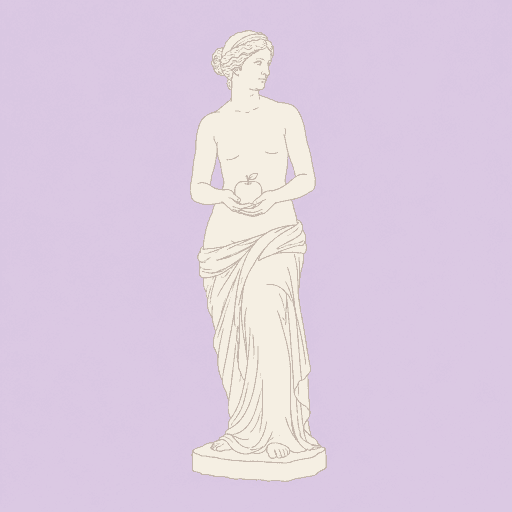
After speeches, the shroud is lifted to reveal the Venus de Milo with her arms reattached, one hand holding an apple. Lionel is unfazed, and Adora shares a moment of understanding with him. Viv, however, confesses she liked the statue better before. Ravi is recovering but could not travel; his and Scott’s surrogate is present with their newborn daughter.
The novel concludes with a flash-forward: Adora and Digby move into a larger apartment in the Ansonia, forming a thriving “coven” with Blanche and their architect. Adora continues her work, feeling whole, loved, and at peace.
Part 5 Analysis
The intense argument between Adora and Viv at the Café de Flore shifts the novel’s focus from an international art conspiracy to the intimate, generational conflict between mother and daughter. When Viv accuses Adora of being a “bitter, old woman” who shames her for liking popular culture (295), she articulates a powerful critique of her mother’s intellectual elitism. Viv’s passionate defense of her generation’s fleeting joys—her desire for trendy sneakers, her love for Taylor Swift, her investment in the popular show Emily in Paris—surpasses adolescent defiance to become a sophisticated argument against Adora’s Stoic-inflected worldview, which dismisses such “externals” as trivial. Viv’s plea, “Let me belong” (296), exposes the emotional cost of Adora’s relentless rationalism, recasting her intellectual superiority as a form of cruelty and isolation. The scene forces Adora to confront the limitations of a philosophy that prioritizes abstract wisdom over present-day emotional connection. Their quick reconciliation over a shared love for High School Musical 2 demonstrates the resilience of their bond, but the fight compels Adora to begin re-evaluating the human impact of her philosophical ideals.
Digby’s long, confessional letter in Chapter 43 reframes the narrative’s central trauma by giving voice to a complicit figure grappling with his past. His admission of being “the NDA guy” and his subsequent crisis of conscience directly engage with the cultural context of the #MeToo movement (315), exploring the personal cost of enabling systemic abuse. The symbol of the NDA, previously representing Adora’s silencing, is here depicted as the source of Digby’s moral decay and eventual rebirth. His journey from a powerful lawyer who felt like a “Hindu god” to a penitent, wealthy lawyer acting for free illustrates a search for atonement outside of conventional justice systems. This backstory provides a personal and intimate lens on How Institutional Power Enforces Complicity and Silence, focusing on an individual’s attempt to make “living amends” for his role in a corrupt system. His closing offer to Adora—to “go gentle” with her—presents a direct alternative to her Stoic self-sufficiency, suggesting that healing comes from mutual tenderness and vulnerability rather than emotional fortitude.
Just before her scheduled lecture, Adora receives the news that Ravi was trapped for a week in the soundproof screaming room. This dangerous yet absurd event serves as the catalyst for her rejection of Stoicism. Faced with Ravi’s deep and senseless suffering, the Stoic principle of dispassionately accepting fate appears inadequate. She considers Layla’s contrasting passion, thinking “Maybe that’s why Layla had gotten under my skin so. Because she had something I didn’t. Not money. Not status. Not a ridiculous wardrobe. Love” (326). This marks the climax of her philosophical transformation, revealing that her embrace of Stoicism was a defense mechanism against her own deep-seated craving for connection. This moment crystallizes the novel’s assertion that freedom alone is insufficient for a fulfilling life; prioritizing only freedom leads to alienation from the connections and communities that may provide happiness. Adora’s abrupt decision to abandon her lecture and race to the Louvre signifies her pivot from a life governed by abstract reason to one driven by intuition and feeling, embracing the idea of Love as a Radical Action.
The final section of the novel uses the Venus de Milo to resolve its complex thriller plot while exploring themes of authenticity, reputation, and historical truth. Adora’s climactic insight—that Celine smuggled the statue’s real arms inside the composite Boy With Apple—is a triumph of intuition over the flawed logic that previously led her astray. The subsequent revelation that the Louvre’s iconic statue is a post-WWII forgery exposes the fragility of institutional authority and the extreme measures taken to protect a family’s reputation, a preoccupation Celine shares with the Stoic philosopher-kings Adora once admired. The mystery’s solution hinges on the real-world science of stable isotope analysis, grounding the elaborate conspiracy in historical and art-world context. Yet, Viv’s final judgment humorously undercuts the grand restoration: “I liked it better before” (364). This remark subverts the notion of a triumphant return to wholeness, suggesting that the “mutilated” version, with its history of loss and mystery, held its own unique power and beauty.
The concluding scenes at the Louvre celebrate a new, blended community forged from the preceding chaos. The red-carpet event assembles all the key characters—Adora’s family, the Lockwoods and their sons, and Interpol agents—into a cohesive, if unconventional, community. Layla’s part in the criminal affair is conveniently erased by a large donation, a final comment on How Institutional Power Enforces Complicity and Silence. Lionel’s emotional indifference to the restored Venus de Milo, a statue Layla believed was central to his psychological well-being, demonstrates that her grand gestures were a manifestation of her own anxieties. This form of Love as a Radical Action ultimately missed its mark, making Layla both an antagonist and a sympathetic character. Adora’s quiet moment of connection with Lionel, where she shows him her tattoo, signals her own acceptance of a past she no longer needs to conceal or intellectualize. Her final state of feeling “whole” is achieved not through Stoic detachment; rather, it requires her integration into a loving, eclectic community, confirming her journey from isolated intellectual to an emotionally connected partner, mother, and friend.

Get in-depth, chapter-by-chapter summaries and analysis from our literary experts.
- Grasp challenging concepts with clear, comprehensive explanations
- Revisit key plot points and ideas without rereading the book
- Share impressive insights in classes and book clubs