Go Gentle
Go Gentle
A modern alternative to SparkNotes and CliffsNotes, SuperSummary offers high-quality Study Guides with detailed chapter summaries and analysis of major themes, characters, and more.
Summaries & Analyses
Author Insights
Quizzes
NEWReading Tools
Symbols & Motifs
Content Warning: This section of the guide includes discussion of mental illness, gender discrimination, sexual harassment, and sexual assault.
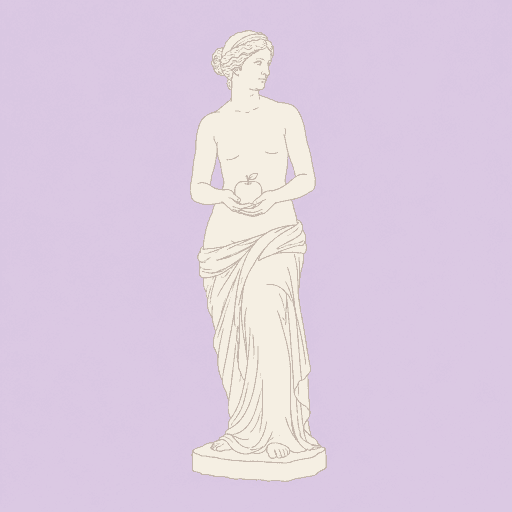
The Venus de Milo
As a complex symbol, the Venus de Milo represents beauty in imperfection, the healing power of art, and the manipulation of historical truth. Initially, her armless form provides a deep sense of healing for Lionel Lockwood, whose own amputation has left him struggling with suicidal ideation. In her perceived loss, he finds a validation that allows him to accept his new reality. This personal connection makes the statue the catalyst for the novel’s central conflict, as it inspires Layla’s misguided campaign to protect her husband’s feelings, a demonstration of Love as a Radical Action.
The statue’s significance, however, is built on a series of lies. The world believes her arms are lost to time, but they are secretly recovered; the public reveres a fake statue in the Louvre, while the authentic one is hidden in a private chateau. This deception emphasizes How Institutional Power Enforces Complicity and Silence, as Celine Montfort utilizes her immense privilege and implicates others in her crime solely to protect her family’s reputation. When the real statue is finally made whole and unveiled, Lionel isn’t upset by its appearance, demonstrating how Layla’s actions were unnecessary and how his sense of self-worth has become more bolstered by his inner strength rather than external symbols of validation. Meanwhile, Viv remarks, “I liked it better before” (364), emphasizing that—like the central characters—things can be loved not only in spite of their flaws, but because of them.
The Blue Contract
The non-disclosure agreement (NDA) Adora signs, with its distinctive sky-blue backing paper, is a symbol of How Institutional Power Enforces Complicity and Silence. It is the physical manifestation of how powerful systems—in this case, the Hollywood machine—commodify and legally erase trauma to protect abusers. The contract transforms a violent, personal violation into a sterile financial transaction, its legal jargon and corporate blue color representing the complete dehumanization of Adora’s experience.
A lawyer emphasizes the self-serving nature of the system, stating, “It’s in nobody’s interest to turn this into a docudrama” (138). This reveals the institutional imperative to manage and neutralize human suffering to protect themselves rather than address its cause. For decades, the document dictates Adora’s relationship with her own history, forcing her into a silent, isolated existence. Her inability to speak about the assault fundamentally shapes her personality, her approach to Stoicism, and her relationship with Viv, who can’t understand the source of Adora’s pain and alienation. Digby’s eventual return of the contract, along with the letter from TJ Steele’s daughter nullifying it, liberates Adora. More than just a legal release, this symbolically undermines the institutional power that held her captive, allowing Adora to reclaim agency over her narrative and finally achieve true freedom.
Stoic Quotations
Adora’s frequent citation of Stoic philosophers is a recurring motif that tracks her evolution from intellectual and detached to more emotionally vulnerability. Initially, Adora uses the wisdom of Seneca and Marcus Aurelius as a shield, creating a rational framework to manage the pain of her past trauma and the dissolution of her marriage. This practice allows her to survive, but it also renders her a “tranquility bully,” emotionally detached and at times condescending to those, like her daughter Viv, who are more in touch with their feelings and desires.
Her journey is defined by the slow recognition that a life governed purely by reason is incomplete. The motif culminates in a deep shift in her personal philosophy, which beings when she changes her daily mantra. Before the narrative present, she changes her most frequent mantra of “VIRTUE = HAPPINESS” to “VIRTUE = FREEDOM,” as she craves “Freedom from tension. Freedom from being misunderstood. Freedom from self-pity. Freedom from fear. Freedom from shame. Freedom from helplessness. Freedom from obsession” (176). This redefinition signals her intense avoidance of vulnerability and the potential to be hurt again.
However, when dwelling on this after meeting Digby, she realizes her desire for intimacy—emotional and physical—has been reignited. This initiates her character arc of recognizing how she used her philosophy as a defense mechanism against what might hurt her, isolating and alienating herself in the process. By the novel’s end, she no longer views philosophy as an escape from life’s painful extremes but as the tool that gives her the strength to engage with them. This development is the novel’s central illustration of The Interplay Between Freedom and Happiness.
Apples
The apple is a subtle but central motif that represents deception, hidden knowledge, and the manufacturing of benevolent legacies to conceal corrupt foundations. This pattern is first established through the Lockwood family, whose fortune comes from weapons manufacturing. They launder this dark history through philanthropy and the promotion of their famous Lockwood Red apple—the reason for which New York is supposedly called the “Big Apple”. This act of whitewashing or “apple washing” exemplifies the theme of How Institutional Power Enforces Complicity and Silence.
This public deception is mirrored by the private fraud at the heart of the plot. Celine Montfort’s creation of the fictional Boy With Apple statue. The statue is a Trojan horse, its innocent name designed to smuggle the real arms of the Venus de Milo into the United States. The motif’s meaning is emphasized when Adora deciphers the central clue that unravels the entire conspiracy. Her realization that “boys don’t hold apples. Aphrodite holds apples” connects the statue to its true, hidden identity (334). In this context, the apple—a classic symbol of both temptation and foundational knowledge, from Eden to Newton—functions as the key that exposes the truth buried beneath layers of personal and institutional deceit, ultimately leading to the recovery of a priceless cultural artifact.

Unlock the meaning behind every key symbol & motif
See how recurring imagery, objects, and ideas shape the narrative.
- Explore how the author builds meaning through symbolism
- Understand what symbols & motifs represent in the text
- Connect recurring ideas to themes, characters, and events