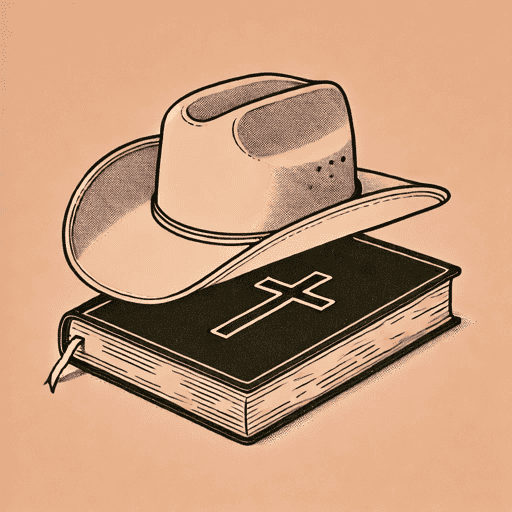
Jesus and John Wayne: How White Evangelicals Corrupted a Faith and Fractured a Nation
Jesus and John Wayne: How White Evangelicals Corrupted a Faith and Fractured a Nation
A modern alternative to SparkNotes and CliffsNotes, SuperSummary offers high-quality Study Guides with detailed chapter summaries and analysis of major themes, characters, and more.
Summaries & Analyses
Quizzes
NEWReading Tools
Chapters 1-4Chapter Summaries & Analyses
Chapter 1 Summary: “Saddling Up”
In the 19th-century US, masculinity was defined by hard physical work and “gentlemanly self-restraint” (15). However, by the 1890s, a cultural crisis of masculinity occurred since an increasing number of men were working in offices instead of with their hands. This led to the popularity of figures like Theodore Roosevelt, who promoted a “rougher, tougher masculinity” (16) to white Protestant men. This was reflected in Roosevelt’s persona and his more aggressive, expansionist foreign policy in the Spanish-American War. For Roosevelt and others, personal and national masculinity were one and the same.
By the 1910s, the trend led to an effort to “‘re-masculinize’” Christianity by drawing on Christian concepts in the US South, where rigidly hierarchical, slave-based society had shaped Christianity. By drawing on Southern Christianity, “rugged American masculinity united northern and southern white men and transformed American Christianity” (17).
Pastor Billy Sunday, who promoted the new, “muscular Christianity,” supported American intervention in World War I and denounced pacifism. Sunday’s brand of Christianity was promoted through evangelical revivals, which rivaled the traditional Protestant Christianity that was structured around institutional churches. Unlike those churches, revivals tapped into consumer culture and modern marketing and preferred fundamentalist interpretations of the Bible.
These fundamentalist Christians rivaled modernist Christians, who likewise sought to modernize Christianity but to do so through academic readings of the Bible. However, both modernists and fundamentalists agreed on the importance of muscular Christianity. The two sides still fought over involvement in World War I, however, modernists argued that fundamentalists were more loyal to their religion than to the nation, while fundamentalists countered that modernists depended on scholarship from the enemies of the US, the Germans.
After the bloodshed of World War I led to “disillusionment” among Christians, a new kind of muscular Christianity appeared in Bruce Barton’s 1925 book, The Man Nobody Knows. It depicted an image of Jesus that was strong and masculine in the sense of being like an efficient, charismatic businessman. Fundamentalists clung to their version of muscular Christianity, but the majority of Americans viewed them with “cultural disdain.”
Preacher Billy Graham helped popularize evangelism through his revivals and masculine persona. Graham “sought to prove that Christianity was wholly compatible with red-blooded masculinity” (23). World War II, with its clear enemies, revitalized the popular desire for the fundamentalist brand of masculinity and Christianity. Graham and his organization, Youth for Christ, “preached a gospel of heroic Christian nationalism with unparalleled passion” (25). After the beginning of the Cold War and increased American paranoia over communism, Graham went along with conservative Cold War values by emphasizing sexual morality and female submission to the authority of husbands. This was a change from earlier evangelical activism, which supported women’s rights and “egalitarian gender roles” (27).
Graham’s popularity dramatically increased when he converted famous country music singer Stuart Hamblen. Because of the fundamentalist valorization of masculinity and individualism, a cowboy image like that of Stuart Hamblen appealed to evangelicals in the Western US because of their nostalgia for the days of the American frontier. With the support of Hamblen and musician Pat Boone, Graham began to form a “vibrant media empire” (29) through television, magazines, books, and student organizations. Despite not living up to evangelical family values, actor John Wayne, the star of numerous Westerns, also became popular among evangelicals because of a “shared masculine ideal” (27).
Chapter 2 Summary: “John Wayne Will Save Your Ass”
Like many white Southerners in the 1940s, Billy Graham was originally a member of the Democratic Party. However, he became critical of Democratic President Harry S. Truman for not taking a more aggressive stance in the Korean War against communist North Korea. After the election of Republican Dwight Eisenhower to the presidency, Graham turned to the Republican Party. Both Grahan and Eisenhower believed that conservative sexual morality and gender roles were important in the Cold War fight against atheistic communism and “that Christianity could help America wage the Cold War” (35). In the 1950s, conservative evangelical Christians went from the margins to “the political and cultural mainstream” (36).
Some evangelicals, including Graham, supported the civil rights movement, especially the end of segregation between white and Black Americans. However, after the Civil Rights Act of 1964 passed and civil rights protests spread, Graham and many other evangelicals began to turn against the civil rights movement. In particular, they opposed government intervention to protect civil rights and found the idea that racism had dominated the history of the US incompatible with their own concept of the US as a Christian nation. Du Mez argues that evangelical belief in family values led them to oppose legal desegregation, which they saw as a threat to the authority of parents over their children’s education. Also, evangelical Christianity was being influenced by the South through the idea of “the heroic Christian man” as a “white man […] who defended against the threat of nonwhite men and foreigners” (39).
By 1961, evangelicals came to oppose President Jack Kennedy on the basis that he was Catholic and seen as weak on the issue of the Cold War. They instead supported Republican presidential candidate Barry Goldwater. While Goldwater was not religious, evangelicals liked his militant anti-communism, his cowboy image, and his “hard-edged, bombastic style” (40). Nevertheless, Goldwater lost the 1964 election by massive margins. Furthermore, he was not endorsed by Graham and was only supported by evangelicals in the South and the Sunbelt (southwestern states). He was seen as too extremist elsewhere. However, “Goldwater’s defeat […] masked a political realignment already under way” (44).
This realignment led to a national evangelical voting bloc that supported family values, “law and order,” and a militant stance against communism (44). This evangelical bloc was courted by Republican politician Richard Nixon. His religious background was as a Quaker, a Christian sect that held views against violence. However, Graham “coached” Nixon on how to appeal to white evangelical voters. When Nixon became president, Graham and other evangelical leaders like the Southern Baptist Convention explicitly backed Nixon’s controversial foreign policy, including the Vietnam War. While some evangelicals supported Nixon’s Democratic opponent in the 1972 presidential election, George McGovern, many influential evangelicals were firmly in Nixon’s camp. A pro-Nixon event held by the youth organization Campus Crusade for Christ, Expo ‘72, likewise represented the emergence of “a Christian version of popular music” and would “pave the way for what would become a thriving contemporary Christian music industry” (48).
Many Christians led the anti-Vietnam War movement. Conservative white evangelicals were instead “among the most enthusiastic supporters of the war” (49), seeing it as a righteous crusade against communism. Accounts of American war atrocities in Vietnam were dismissed as being less severe than communist atrocities or such violence was seen as inevitable because of the “sin lurking in every human heart” (49). As Americans became more skeptical about the global role of the US because of the Vietnam War, conservative white evangelicals became more outspoken in support of the US military. The split between the Christian left and right widened as conservative white evangelicals aligned more closely with right-wing Catholics, Mormons, and even the conservative non-religious. At the same time, because conservative white evangelicals were historically poor, even though they were increasingly becoming middle-class they were still “drawn to the values of the white working class” (52).
The US defeat in the Vietnam War and the common appearance of long-haired men through hippie youth culture provoked another crisis in masculinity. Evangelicals responded with works like preacher Jack Hyles’s 1972 book How to Raise Children, which encouraged parents to raise boys to be traditionally masculine, willing to use violence to protect themselves and their loved ones, and promoted the idea that wives and children must be completely subordinate to men. This trend led evangelicals to embrace even nonreligious idols of militant masculinity, such as actor John Wayne, who was not an evangelical but was known to be a right-wing and pro-Vietnam War activist. Wayne’s roles in war films reaffirmed conservative evangelicals’ pro-war stances and their “sense of embattlement” (55), despite the “disillusionment” that Vietnam veterans themselves often felt despite having been inspired to enlist by role models like John Wayne. Still, for certain evangelicals and conservatives, “Wayne modeled masculine strength, aggression, and redemptive violence” (59).
Chapter 3 Summary: “God’s Gift to Man”
In 1974, Christian conservative Marabel Morgan published the book The Total Woman, which argued that unhappiness among women was not a result of women’s inequality but a result of modern women’s not being submissive to their husbands. Morgan’s arguments had “a religious foundation” (61). Morgan argued for women not only to be subordinate but also to be sexually available and complimentary to their husbands. Another book that strove to provide a conservative evangelical counter to the feminist movement was the 1976 book, Let Me Be a Woman by Jane Elliot. It argued that women and men were “complimentary opposites” but that women were still made to be subordinate to men.
Influential right-wing activist Phyllis Schlafly appealed to conservative evangelical women with her opposition to the Equal Rights Amendment (ERA), which would have created legal rights for women as part of the US Constitution. She argued that women’s true rights were achieved through marriage and the family, which feminism undermined. Du Mez argues that Schlafly’s opposition to the ERA was intertwined with other conservative evangelical causes such as anti-communism and Christian nationalism. Schlafly’s campaign succeeded in preventing the ratification of the ERA.
Chapter 4 Summary: “Discipline and Command”
In the 1960s, evangelicals Rousas John Rushdoony and Bill Gothard argued for fathers as the “ultimate authority” in the family, replacing dating with courtship overseen by fathers, discouraging girls from higher education, and institutionalizing rebellious children. Gothard also argued for the absolute power of governments over citizens, churches over members, and employers over employees. Rushdoony and Gothard influenced the perception among conservative white evangelicals that public education was a threat to parents’ authority over their children and the movement toward Christian homeschooling.
Another prominent figure was James Dobson, an evangelical child psychologist who published a book, Dare to Discipline, in 1970. He viewed “children as naturally sinful creatures, inclined toward defiance and rebellion” (79). Blaming the social movements of the 1960s on a breakdown in family values across society, Dobson supported the “reassertion of an authoritarian family structure” (80). In later books, Dobson also argued for a return to traditional gender roles and against feminism. Dobson’s anti-feminism message was reacting against several victories and near-victories for women’s rights in the 1970s, such as the push for the ERA, the Supreme Court decision in Roe v. Wade, which gave women the right to access abortion nationwide, and a law that would have established government-funded daycares, which nearly passed but was vetoed by President Nixon. At the same time, the decline of American manufacturing and more women being hired for full-time jobs was seen as a “‘crisis’ of the family” (82).
Dobson was enormously successful and developed an audience of millions through his books, lectures, and radio programs. He explicitly linked families having authoritative fathers and obedient wives to the success of the nation. While Dobson at first tried to be “apolitical,” he and the nonprofit organization he established, Focus on the Family, became more overtly political by the early 1980s.
Chapters 1-4 Analysis
In these chapters, Du Mez provides a historical survey of the development of the culture and ideas that formed the Religious Right. For Du Mez, the historical context of the rise of the Religious Right is important to understand to show that this development was “a historical and a cultural movement, forged over time by individuals and organizations with varied motivations,” demonstrating that the Religious Right was not “inevitable” and that therefore current situations may be changed. In addition, the development of conservative evangelical Christianity and The Intersection of Faith, Politics, and National Identity was clearly shaped by external factors such as the American South’s legacy of white patriarchy, the Cold War, and the Vietnam War and the emergent civil rights and anti-Vietnam War movements of the 1960s. These forces either formed fundamental ideas behind the Religious Right or provided it with enemies and threats that conservative white evangelicals defined themselves against and that increased their “sense of embattlement” (55).
The Cold War was especially important for understanding how the Religious Right became not just a religious and moral movement but also a movement for Christian nationalism. Du Mez argues that Billy Graham, in conjunction with the presidency of Dwight Eisenhower in the 1950s, consciously weaponized Christianity against the threat of communism. Still, this process was historically a gradual one. For example, the anti-feminist advocacy of Phyllis Schlafly and the rigid views of James Dobson on family values and gender roles began as social campaigns with a religious grounding, but they became “intimately connected to a larger set of political issues” (70), mixing issues of gender and sexual morality with politics, specifically the modern platform of the Republican Party. Du Mez argues, “A common evangelical heritage and shared theological commitments diminished in significance as Christian nationalism, militarism, and gender ‘traditionalism’ came to define conservative evangelical identity and dictate ideological allies” (51).
The history Du Mez lays out also follows The Emergence of Militant Masculinity. Anxieties over masculinity and proper gender roles have a long history, even before the 19th century. Nevertheless, aspects of modern society and life or modernity often pose a disruption to traditional understandings of masculinity, given the expansion of women’s presence in higher education, work, and politics and the reduced role of many men in physical labor and war. Du Mez observes such a process as a vital early stage in the history of the Religious Right as the “model of manly restraint” began “to falter” at the end of the 19th century. While Du Mez focuses on gender as a category of analysis, gender also overlaps with race, class, religion, and nationalism here. Specifically, the crisis of masculinity Du Mez describes especially affected middle-class, white, Protestant Christian men in a way that formed a nexus between patriotic nationalism, masculinity, and the working and middle classes that eventually came to define the Religious Right. Du Mez views these developments as resulting from both the actions and personas of prominent political and cultural individuals as well as broader historical changes. For example, Du Mez argues that President Theodore Roosevelt merged masculinity with a militant foreign policy when he “offered ordinary men the sense that they were participating in a larger cause” (16).
Finally, Du Mez views the early history of masculine, white Protestant evangelism as overlapping with the history of mass media and marketing. Even long before the term “Religious Right” was coined, Du Mez suggests that the history of The Development of an Evangelical Consumerist Culture could be traced back to the early 20th century. Evangelism in this period already used “modern advertising techniques,” “religious merchandising,” and “celebrity pitchmen” to market itself to the public in a way that “replaced traditional denominational authorities with the authority of the market and the power of consumer change” (18). This is an important step in a development Du Mez discusses throughout Jesus and John Wayne. It is how a specific type of conservative, white Protestant evangelism became a movement that was more political, cultural, and social than theological, to the point that it detached from certain traditional understandings of Christianity and Christian ethics, as Billy Graham’s presentation of Jesus as “the most physically powerful man who ever lived” (23) exemplified.

Get in-depth, chapter-by-chapter summaries and analysis from our literary experts.
- Grasp challenging concepts with clear, comprehensive explanations
- Revisit key plot points and ideas without rereading the book
- Share impressive insights in classes and book clubs