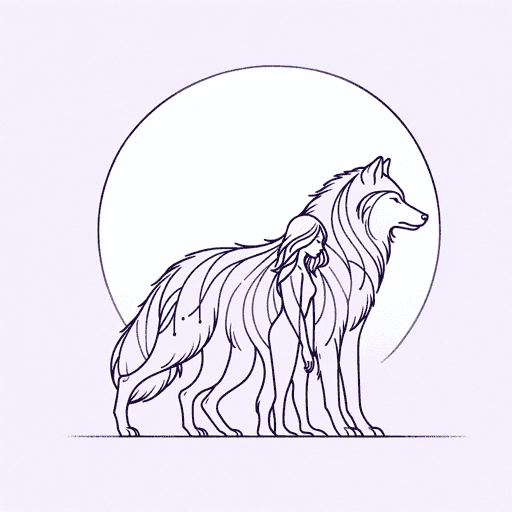
Julie Of The Wolves
Julie Of The Wolves
A modern alternative to SparkNotes and CliffsNotes, SuperSummary offers high-quality Study Guides with detailed chapter summaries and analysis of major themes, characters, and more. For select classroom titles, we also provide Teaching Guides with discussion and quiz questions to prompt student engagement.
Summaries & Analyses
Quizzes
NEWReading Tools
Background
Content Warning: This section of the guide includes discussion of racism and animal death.
Cultural Context: Inuit Culture and Its Relationship to Western Society
The Inuit are a group of Indigenous peoples hailing from the Arctic and subarctic and united by similarities in language and culture. The term is most closely associated with the Indigenous peoples of Greenland and far northern North America, as these are the regions where the Inuit languages are most spoken. The Inupiat people, the community to which Miyax belongs, are a group of Inuit people with traditional territories in northern and western Alaska.
Historically, colonizers used the term “Eskimo” to refer to both the Inuit and the Yupik, a group of related peoples residing in Russia and parts of what is now Alaska. However, the term did not originate in any Inuit or Yupik language; rather, it likely came from an Algonquian language by way of French (“Eskimo — Pamana’rmiuq, eskimuq, Pamanirmiu’aq, Yup’ik.” Alutiiq Museum). This term is used frequently in Julie of the Wolves. Because of both this and the word’s long history in colonialist discourse, it is now widely considered offensive.
Traditional Inuit cultures reflect the harsh environment in which it developed. Resources in the Arctic are scarce and mostly derived from animals; thus, the historical Inuit lifestyle centered heavily on hunting and fishing and was nomadic, often following the movements of reindeer and other game. Hunting also provided the Inuit with shelter (tents made from animal skins, though winter homes were usually made of snow or stone) and fuel (seal oil). Miyax’s resourcefulness when lost in Alaska reflects this cultural legacy.
Julie of the Wolves takes place in the 20th century, by which point Inuit traditions were under threat. Even prior to this, contact with Westerners was having ripple effects in Inuit society; for instance, trading relationships built around fox fur sometimes forced Inuit peoples to relocate to areas with less game available, resulting in greater dependence on purchased provisions (“Colonialism.” Indigenous Peoples Atlas of Canada). In the 20th century, however, such changes greatly accelerated, and the Canadian government forcibly relocated some Inuit communities (“No Events to Mark Inuit Relocation Program.” CBC, 8 Sep. 2004). The introduction of Christianity and environmental changes also destabilized Inuit ways of life.
George’s novel sees its protagonist grappling with whether to assimilate into modern Western society or to embrace her connection to her heritage. However, Inuit readers have noted that the details of the novel’s portrayal of Inuit life are not always correct, often incorporating Yupik words (“gussak”) and traditions (the bladder festival) and otherwise reflecting a lack of familiarity with Inupiat culture; for instance, the “x” that ends Miyax’s name has no Inupiaq correlate (Stackhouse, Martha. “Book Review on Julie of the Wolves.” Alaska Native Knowledge Network). Indeed, Julie’s ethnicity is not entirely clear in the novel; she is described as speaking “Upick,” but other elements suggest that she was intended to be Inupiaq. The novel is therefore best understood as a Western writer’s use of a generalized Indigenous character to explore the drawbacks of modernization, a stereotype sometimes known as the “noble savage.”

Get in-depth, chapter-by-chapter summaries and analysis from our literary experts.
- Grasp challenging concepts with clear, comprehensive explanations
- Revisit key plot points and ideas without rereading the book
- Share impressive insights in classes and book clubs