Robinson Crusoe
Robinson Crusoe
A modern alternative to SparkNotes and CliffsNotes, SuperSummary offers high-quality Study Guides with detailed chapter summaries and analysis of major themes, characters, and more.
Summaries & Analyses
Quizzes
NEWReading Tools
Games
Pages 76-144Chapter Summaries & Analyses
Content Warning: This section of the guide includes discussion of racism and animal death.
Pages 76-99 Summary
This section begins with Crusoe’s second-year, including an account of his getting lost after continued exploration of the western fruitful side of the island, where sweet savanna fields run free. He finds his way back to his home due to a post he drove into the ground after hiking some miles east from the verdant, fruitful fields and comments that he was never so happy to be back at his humble home.
In his third year, Crusoe experiences a major shift, becoming religious to the point that he undertakes Scripture studies every day. Crusoe believes only God’s providence led him to this island where Crusoe has more than all he needs for happiness. His new experiences show the errors of his past life:
It was now that I began sensibly to feel how much more happy this life I now led was, with all its miserable circumstances, than the wicked, cursed, abominable life I led all the past part of my days; and now I chang’d both my sorrows and my joys; my very desires alter’d, my affections changed their gusts, and my delights were perfectly new (82).
Crusoe learns to plant barley and rice stalks seeds before the start of rainy season and, in doing so, learns the start and end of each rainy season, according to the 12-month calendar. Though at first fowl, and other wild creatures, prey on his corn harvest, after killing a few fowl, Crusoe learns to use scarecrows to protect his crops, of which he plants only enough to last one year—40 bushels of barley and rice. He also eats tortoise eggs and flesh. Once he learns to farm, Crusoe longs for an oven and cooking utensils, which he succeeds in making after much trial and error. By mistake, he learns to make fireproof earthen pots by leaving the clay in a fire to burn, like in a kiln. He eventually weaves baskets and builds a grindstone and then pestle and mortar for his corn. He uses skins of wild creatures to create raincoats and makes a shirt from leftover lines salvaged from the wreck. Crusoe spends many years constructing a boat. On his first attempts, he makes a boat too large and too far from the sea to launch it and sail.
The next five years pass in much the same manner. Crusoe decides he must be closest to the Caribbean coast, which he has heard is populated by people who practice cannibalism. His religious devotion grows serious. “By a constant study, and serious application of the Word of God, and by the assistance of his grace, I gain’d different knowledge from what I had before […] I look’d now upon the world as a thing remote, which I had nothing to do with” (94).
Pages 100-124 Summary
Crusoe at last manages to construct a boat and describes his getting caught in a powerful rip current during a boat-journey six years into his stay. Crusoe almost meets ruin. After incredible efforts, Crusoe navigates free of the current. He returns to his bower, again praising the wealth of the island and deciding not to venture off it again.
As this section progresses, Crusoe further details his life on the island, describing his clothes, made of goat skin, which make him resemble a medieval knight because he carries two pistols and a broad sword across his waist.
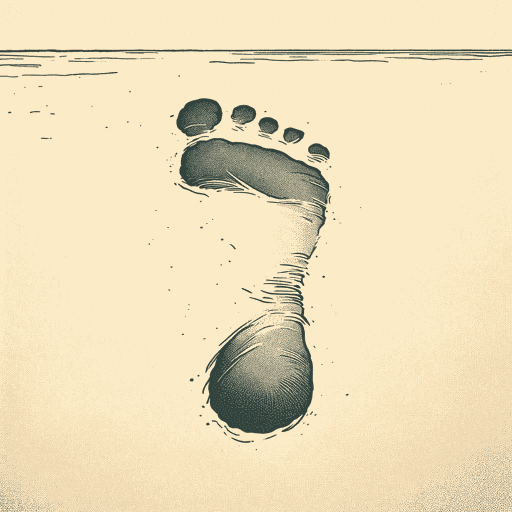
His routine remains similar for 18 years. As Crusoe thinks about new needs—like wanting beer and not having a large enough oven—he expands his cave into various apartments so that it occupies the inside of the hill and exits through a door on the side of the hill opposite his tent. He also continues fortifying his wall, ultimately building another semi-circle wall outside his second wall, which includes holes for muskets. This is because Crusoe sees a footprint one day in his 11th year. It is near the shore and breeds intense fear that his island might be inhabited or visited by “cannibals” sailing from a nearby island. At first Crusoe, “fancy’d it must be the Devil” (113). “O what ridiculous resolutions men take, when possess’d with fear!” Crusoe writes. “It deprives them of the use of those means which reason offers for their relief. The first thing I propos’d to my self, was, to thrown down my enclosures, and turn all my tame cattle into wild woods, that the enemy might not find them” (116).
For months, Crusoe becomes bent on destroying the people this one footprint must belong to. Every day Crusoe camouflages himself on top of a hill, observing the shore where he spotted the print for any approaching ships. Crusoe’s fear leads him to create an enclosure for the goats, in a barely-seen wooded meadow near the western fruitful fields. He plans to grow surplus barley and rice. Toward the end of this section, Crusoe spots a beach littered with human skulls and bones.
Pages 125-144 Summary
Crusoe spends the first part of this section in moral exploration, deciding that it would be sinful to hunt and kill the people who may live on the island. It is God’s providence that has allowed them to continue in their traditions for ages: “What authority or call I had, to pretend to be judge as executioner upon these men as criminals” he writes, “whom Heaven had thought fit for so many ages to suffer unpunish’d, to go on, and to be, as it were, the executioners of his judgments” (125). Crusoe condemns Spain for its enslaving millions of Indigenous peoples in Brazil and abroad.
Crusoe changes his daily routine to reduce smoke from his fires. He spends more time in the wooded meadow and one day, moving bushel and firewood, discovers a cave that inside is quite large. Crusoe begins using this cave as a place of security, believing no one else would venture inside. One day, he sees two eyes and hears moaning, stirring his greatest fears, but finds it is a dying goat. In the cave, or grotto, Crusoe finds “the walls reflected a hundred thousand lights” but “whether diamonds, or any precious stones or gold” (130), he is unsure. Into this cave, Crusoe brings his magazine of ammunition and other provisions.
Crusoe discusses his parrot, which often calls out Poor Robin Crusoe, and describes other animals he keeps: “several tame sea-fowls, whose names I know not, who I caught upon the shore, and cut their wings” (132). Crusoe journals how he could stay inside his enclave and never leave, for fear of other people: “How frequently, in the course of our lives, the evil which in itself we seek most to shun […] is oftentimes the very means or door of our deliverance, by which alone we can be rais’d again from the affliction we are fallen into” (132).
During Crusoe’s 23rd year, in the month of May, Crusoe sees humans on the island for the first time: “no less than nine naked savages, sitting round a small fire, they had made, not to warm them […] but as I suppos’d, to dress some of their barbarous diet, of human flesh, which they had brought with them, whether alive or dead I could not know” (133). Seeing them, Crusoe runs to a hill where he can better observe. There, he watches the people canoe out to a larger group, with many more canoes, and sail off toward a main island. In the years that follow, Crusoe learns they come every 18 months or so, which alleviates some of his fears, allowing Crusoe to again sink into routine. Toward the end of this section, Crusoe hears gunfire that he judges comes from men in distress. Crusoe then lights bushels on fire on the side of the hill as a means of communication, which inspires more gunfire. However, when the storm subsides the following day, Crusoe finds the men’s ship wrecked, and he resolves to approach it and scour for provisions.
Pages 75-144 Analysis
These pages chronicle Crusoe’s attempts to make the uninhabited island home. Descriptions of physical hardship are frequently followed by philosophical inquiry, developing themes of God’s Providence Through Hardship and Physical Versus Spiritual Deliverance. As before, Crusoe’s mind moves back and forth between doubt and belief in God’s providence. Major changes occur in Crusoe’s thinking, as Crusoe comes to rationalize all events and behavior in the name of God’s providence.
Crusoe’s fears and inner explorations often foreshadow what happens to him next on the island. Crusoe’s fear of “savages” grows, and then Crusoe sees humans for the first time in 23 years: nine naked men who correspond to his ideas about the likely nature of the people on the island. This portrayal of Indigenous Caribbeans reflects early colonialist narratives about the area—e.g., Christopher Colombus’s accounts of cannibalism. By contrast, Defoe depicts Crusoe in an idealized fashion. Crusoe domesticates his homestead, covering basic needs and then developing tools to work on those needs. As each need is satisfied, another want or need surfaces. In this way, Defoe uses Crusoe as a means of exploring how humankind might have first evolved from the “state of nature” (a key topic at the time of the novel’s publication, when philosophers like John Locke wrote extensive treatises on human society’s origins) but also implicitly justifies Western imperialist ambitions. Crusoe quite literally brings “civilization” to an island populated by Indigenous peoples depicted as violent and ignorant.
Defoe moves the chronological timeline of Crusoe’s experience forward using the dates in the journal, while within the journal, Crusoe jumps forward and backward many years in time. These pages take one up to the book’s halfway point and at the same time detail 26 years of Crusoe’s experience being a castaway. This is an early technique in the Realist novel for expanding a novel’s breadth. It allows Defoe to provide more details and creates space for Crusoe’s inner explorations, which are as important to Robinson Crusoe as the time Crusoe spends on the island. The sea journey accounts for the least amount of narrative real estate. This suggests that while the sea stands as a symbol of humanity’s helplessness without God, Robinson Crusoe is more a novel about how a man thinks when he becomes cast away.

Unlock all 38 pages of this Study Guide
Get in-depth, chapter-by-chapter summaries and analysis from our literary experts.
- Grasp challenging concepts with clear, comprehensive explanations
- Revisit key plot points and ideas without rereading the book
- Share impressive insights in classes and book clubs