Roses of May
Roses of May
A modern alternative to SparkNotes and CliffsNotes, SuperSummary offers high-quality Study Guides with detailed chapter summaries and analysis of major themes, characters, and more.
Summaries & Analyses
Quizzes
NEWReading Tools
Symbols & Motifs
The Flowers
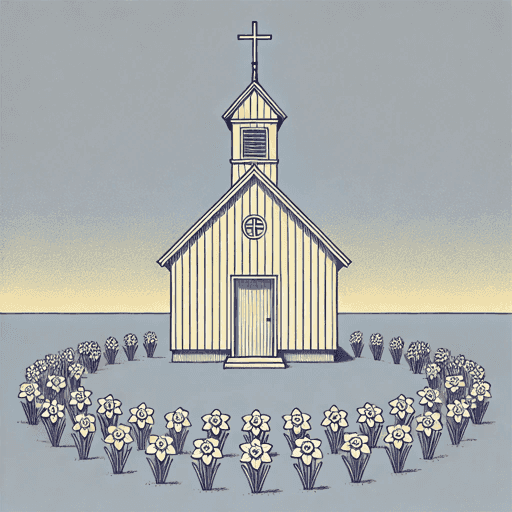
The flowers left with each victim function as the novel’s central and most chilling motif, representing the killer’s perverse moral system and his ritualistic enactment of judgment. Jameson Carmichael transforms these symbols of beauty and nature into markers of his violent ideology, revealing how ideas of feminine “innocence” are constructed and enforced through violence. Each flower is a signature that communicates his self-defined judgment of the victim’s “purity.” For girls he labels as “good” and wants to “preserve,” like Zoraida Bourret, he creates a carefully arranged display of purple-throated white lilies. For those he believes have been “tarnished” (3) and must be punished, like Darla Jean Carmichael, the jonquils scattered around her savaged body become symbols of his imposed judgment, shaped by his distorted moral framework. The beauty of the flowers, juxtaposed with the brutality of the murders, highlights the grotesque logic of a killer who conflates violence with salvation. The meaning of this motif intensifies as the narrative progresses when the killer begins delivering flowers to Priya Sravasti. What was once a post-mortem signature becomes a direct, personal threat, a methodical countdown to her own murder. The arrival of each new bouquet, following the exact sequence of the original crimes, transforms the motif from a static element of the killer’s pattern into a dynamic instrument of psychological terror. The flowers are no longer just a message about the dead; they are a deliberate threat directed at the living. This evolution demonstrates how a recurring element can gain greater significance over time, escalating the narrative’s tension and shifting Priya’s role from a grieving survivor to the killer’s intended target within his established pattern.
Journals
The journals are motif that represent sisterhood, grief, continuing identity, and, ultimately, investigation. Chavi began the practice before Priya was born, filling composition books with letters meant to "prepare her baby sister for life" (41). Priya wrote back once she learned how, and the two would sit side by side on the bed writing after their father sent them to sleep. This origin establishes the journals as a shared language between sisters, even as they respected each other’s privacy while Chavi was alive and didn’t read each other’s journals.
After Chavi's death, Priya continues addressing entries to her sister, maintaining the conversation as an active element of daily life rather than a sealed archive. The motif gains additional weight when Priya begins reading Chavi's notebooks for the first time. Where Priya's journals contain photographs tucked between pages, Chavi's are "full of sketches, many on the pages themselves, as she either lost track of what she wanted to say or couldn't make the words she had say it" (205). In these drawings and private reflections, Priya encounters a version of her sister she never fully knew: Chavi's fears about college, about their father's reaction to Josephine, about leaving Priya behind. The journals reveal that the relationship was marked by mutual vulnerability. This discovery reshapes how the motif connects to grief as identity, showing that mourning involves not only preserving what was known but encountering what was hidden.
The journals also acquire investigative significance when the FBI requests them as evidence of the San Diego flower deliveries. Their disordered state, repacked "very haphazardly" because the sisters constantly revisited them together (83), registers as both evidentiary challenge and proof that the notebooks belonged to a living relationship, not a static memorial. Sorting through them requires Priya to use a private ordering system only she understands: a small blue lizard hidden somewhere on each notebook, carrying roman numerals that mark sequence. This personal indexing method means the journals cannot simply be handed over and decoded by outsiders. The FBI needs Priya to read through them herself, and in doing so, she is drawn back into the emotional texture of periods she had tried to move past.
Reading the San Diego journals adds new context to the flower deliveries Priya dismissed at the time as the gestures of a shy boy she was tutoring. Without context, the jonquils and calla lilies and baby's breath were simply flowers. Revisiting those entries with the knowledge of the murders reframes them entirely, transforming what seemed like innocent gifts into a serial killer's courtship. The journals do not change, but Priya's understanding of what she recorded does, and this retroactive reinterpretation connects the motif to the novel's treatment of justice. By researching the other victims and matching the flowers to each girl's death, Priya builds her own understanding of the case independently of what the FBI chooses to share with her, positioning herself as someone capable of reading patterns the authorities have missed.
Chavi's journals serve a parallel investigative function near the novel's climax. Reading through them, Priya finds Chavi's account of a man who followed the sisters from a diner to a cinema. Chavi confronted him, and he thanked her for being a good sister before leaving. Priya cannot remember the encounter herself, but Chavi's written record preserves what her own memory does not. Priya later sees a family photo of the Carmichaels and recognizes the face of Darla Jean's brother as Joshua from the café; thus, it is the combination of Chavi's journal entry and Priya’s own photographs that allows the identification. In this way, the sisters' separate notebooks converge across time: Chavi's words from five years earlier and Priya's camera work from the present work together supply the evidence that the legal system has failed to produce. The motif thus connects to the theme of justice's failure, as the journals accomplish through private, emotional labor what institutional investigation could not achieve on its own.
Priya’s Camera
Priya’s camera is a central symbol of her method for processing grief and navigating a world rendered unsafe by trauma. It serves as both a protective barrier and a means of maintaining connection, making it central to how she continues to live with grief as part of her identity. Priya uses photography to create a necessary barrier between herself and her surroundings, imposing order on a chaotic world by selecting what to focus on. She observes, “The world seems a little less frightening, somehow, if I can keep the camera lens between me and everything else” (13). This act of framing her reality grants her a measure of control in a life defined by a profound loss of it. The lens creates distance, allowing her to observe and document life while limiting direct engagement with it. The camera also functions as the primary means by which Priya maintains an active relationship with her deceased sister. She explicitly states that she takes pictures “for Chavi, so she can see the things I see” (13). This transforms the act of photography from a solitary coping mechanism into a form of ongoing dialogue, illustrating that her grief is a continuing presence in her life. By capturing moments for Chavi, Priya integrates her loss into her present identity, ensuring her sister remains a present and active part of her lived experience. The camera symbolizes her way of living with loss through memory and continuity, expressed through ongoing connection that remains part of her daily life.
Chess
The recurring motif of chess represents the search for order, community, and strategy in the face of overwhelming chaos and grief. For Priya, whose life was shattered by the senseless violence of her sister’s murder, the logical, rule-bound world of the chessboard offers a structured form of comfort. The game’s structure stands in contrast to the randomness of her trauma. The chess pavilion in the park becomes a consistent place of return, and the veteran players who gather there become a found family, offering Priya a sense of safety and belonging that has been missing since her family disintegrated. Her connection to the game is also a way of preserving a piece of her identity tied to her late father, with whom she used to play, linking the motif to her ongoing experience of loss. The motif’s significance deepens as it comes to mirror the psychological battle between Priya and her sister’s killer, reflecting her movement toward personal action when institutional justice proves uncertain. Priya’s decision to confront Jameson emerges through planning and anticipation, shaped by the same strategic thinking the game requires. As she notes, in both chess and her plan, one must “think three, five, eight moves ahead” (80) to control the outcome. This parallel highlights her shift toward deliberate, strategic action in response to her circumstances. The motif traces her movement toward reclaiming a sense of control, as she carries out a planned confrontation that mirrors the structure and anticipation of a chess endgame.

Unlock the meaning behind every key symbol & motif
See how recurring imagery, objects, and ideas shape the narrative.
- Explore how the author builds meaning through symbolism
- Understand what symbols & motifs represent in the text
- Connect recurring ideas to themes, characters, and events