The Bomb
The Bomb
A modern alternative to SparkNotes and CliffsNotes, SuperSummary offers high-quality Study Guides with detailed chapter summaries and analysis of major themes, characters, and more.
Summaries & Analyses
Quizzes
NEWReading Tools
Part 1, Chapters 6-12Chapter Summaries & Analyses
Part 1: “Book I: Bikini”
Part 1, Chapter 6 Summary
On the morning before the full moon, the second since the Japanese soldiers killed themselves, Sorry travels alone by sailing canoe to Nantil, an uninhabited island five miles northwest of Bikini, to celebrate his coming of age—a tradition his father, Badina, also observed, allowing him time alone away from the close-knit life of the island. He brings sleeping matting, fishing gear, and his prized Japanese magazine, which Lokileni has protected in a woven pandanus pouch.
As he sails, he thinks about the navigation skills his father and grandfather Jonjen taught him. He plans to spend the day beachcombing, reading, gathering coconuts, and hunting lobsters at night. He also reflects on a tragedy from the previous year: an Ijjirik boy named August found a washed-up Japanese mine and, despite his cousin Jasua’s warning, struck its triggering horn and was killed in the explosion. Since then, people have largely avoided visiting Nantil.
Sorry swims, collects debris from American ships, and gathers shells for Lokileni. He thinks about a conversation with Tara, who advised him to wait until he turns eighteen, travel to Kwajalein or Majuro, and eventually continue his education in Hawaii. Looking through his magazine, he is puzzled by images of Japanese people at leisure alongside images of war. He falls asleep thinking about August and the black crater left by the mine.
Part 1, Chapter 7 Summary
Sorry awakens at sunset and walks toward the barrier reef with a spear. After backing away from a large hak guarding its nest, he spears a blacktail snapper and eats some of it raw. At twilight, he studies his magazine again, wondering why people with advanced machinery cannot live peacefully.
After dark, he waits for the near-full moon to rise so he can hunt lobsters on the shallow inner reef shelf. He spears 11—one for each family on Bikini—and secures them in a tide pool for the morning, satisfied to have completed the coming-of-age tradition as his father had.
He senses August’s presence nearby and, recalling his grandmother Yolo’s stories about Micronesian demons and spirits, believes August remains present on the island and reflects that the war caused his death. Overcome with grief, he weeps for August and then for his father until he falls asleep.
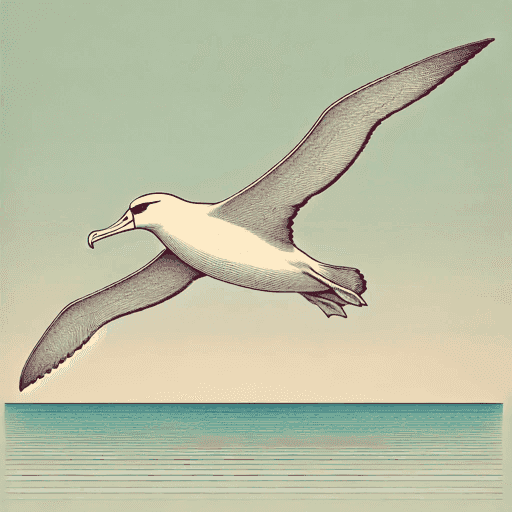
At dawn, he sees a lone Laysan albatross fly past and moan. Remembering Jonjen’s story that such a sound preceded a devastating typhoon long ago, he interprets it as a warning that something terrible is going to happen to the atoll.
Part 1, Chapter 8 Summary
When Sorry returns to Bikini, he tells Jonjen about the moaning albatross. Jonjen says it is not a good omen, and links it to a past typhoon that flooded the island and forced everyone up into the palms, describing it as a warning from God, while Sorry’s mother offers a different explanation. Other families gather to see what Sorry brought back from Nantil; Chief Juda will divide the items, except for a wooden chair Sorry’s family will keep.
A month later the rainy season arrives, bringing needed rain after a period of limited water, followed by a large storm with unusual thunder and lightning and strong winds that shake the dwellings and fill the cisterns. The rainy season ends in November without a typhoon, and no storm like the earlier one occurs that year.
Part 1, Chapter 9 Summary
Two months after the albatross sighting, Sorry’s uncle Abram Makaoliej unexpectedly sails into the lagoon, having traveled alone from Eniwetok, 170 miles away. He had deserted an American merchant ship there and taken a canoe. Jonjen summons the village with his conch to welcome him, as he had long been presumed dead. When Abram learns that Badina, Sorry’s father, died years earlier while spearing along the reef, he embraces Sorry’s mother and says that Badina was a good man. When he hears that seven Japanese soldiers had been on the island, he regrets not being there to kill them himself. Sorry’s mother says she is glad he was not—none of them would be alive.
Abram insists on wearing a loincloth instead of Western clothing. That night the village holds a feast; he plays guitar and flirts, and everyone dances. Sorry notices a large scar on Abram’s side and resolves to ask about it. Tara watches Abram with clear interest. Abram also speaks English.
Part 1, Chapter 10 Summary
The next morning, Abram dives naked into the lagoon, forgetting the missionary-imposed rule that men must bathe on the ocean side. After proposing that he and Sorry hunt for a shark the next day, he walks the island alone to revisit his memories.
Sorry’s mother then reveals that fifteen years earlier, Abram speared a tiger shark off the Rojkora barrier reef, became entangled in the harpoon line, and was dragged underwater. He cut the line with his knife, but the shark attacked him and left the scar on his side. Abram has been waiting ever since to settle the score. Sorry wonders if the same tiger shark might still be there.
Despite his mother’s warning, Sorry insists on going with Abram, and she reluctantly agrees, with Tara also expressing cautious agreement. Sorry teases Tara about her interest in Abram, and she laughs and admits he is handsome.
Part 1, Chapter 11 Summary
Sorry and Abram sail south to the Rojkora barrier reef to hunt the tiger shark. As they travel, Abram sharpens the steel head of Badina’s favorite harpoon and tells Sorry about surviving a torpedo attack that killed most of his crew. Disillusioned with the outside world, he has come home to live out his life on the island. He warns Sorry that the Americans may give gifts but could also take away the land.
At Rojkora, Sorry rattles coconut shells against the canoe to draw sharks. An enormous tiger shark—at least fourteen or fifteen feet long—rises beside them. Abram recognizes it as the same one and can see his old spearhead still embedded in its back. He stands poised to strike but, after a long moment, lowers the harpoon. The shark has carried the spearhead with honor all these years, he explains; they are now even. Sorry does not understand the decision.
On the sail home, Abram asks about Tara, and Sorry tells him everything he knows. Back on Bikini, Sorry’s mother confides her fear that Abram has come home to die—she has seen him carrying a large bottle of pills from London and says he carries a smaller bottle in his pocket—and asks Sorry to say nothing.
Part 1, Chapter 12 Summary
Over a year after his return, Abram has repaired the Japanese radio in the barracks and translates the daily English-language news from Kwajalein for the village each evening.
One evening in August, Abram is visibly shaken by a broadcast reporting that the Americans have dropped an atom bomb on Hiroshima, destroying the entire city and killing thousands almost instantly. He struggles to comprehend how a single bomb could cause such devastation. At the council place, he relays the news to the assembled villagers. Later, Sorry asks Tara if the Americans are happy about so many deaths; she explains that war is personal. Abram notes that Marshallese people also died when Americans attacked various atolls, and Jonjen laments that old hand-to-hand combat was better than bomb warfare. That night, Sorry has nightmares about the explosion and wakes up screaming.
Three days later, Abram reports that a second atom bomb has been dropped on Nagasaki, killing an estimated 140,000 people. On August 14, he announces Japan’s surrender, and the villager’s cheer. The world war is over.
Part 1, Chapters 6-12 Analysis
Sorry’s coming-of-age journey to Nantil establishes his spiritual connection to his environment, deepening the representation of the lagoon and reef as central to Bikinian identity and survival. According to local tradition, the eldest male assumes family leadership by spending time alone on an uninhabited island to reflect and prepare for adulthood. While on Nantil, Sorry relies on traditional navigation skills passed down by his grandfather and spears lobsters for the village, demonstrating his seamless integration into the island’s ecosystem and communal structures. However, this natural sanctuary is already marked by presence of global conflict, represented by the black crater where a Japanese mine killed his friend August. Sorry’s mourning for August and his subsequent vision of a moaning Laysan albatross—a bird his grandfather Jonjen identifies as a divine warning—illustrate the villagers’ reliance on nature to communicate impending danger, with the albatross functioning as a recurring motif that signals disruption before it is fully understood. The lagoon is understood as a living environment that carries meaning for its inhabitants. This spiritual attunement exists alongside forms of violence that originate beyond the island, indicating a growing tension between local ways of interpreting danger and external forces that operate through unfamiliar forms of power.
The unexpected return of Sorry’s uncle Abram introduces a critical counter-perspective to the alluring images of the outside world that Sorry studies in his prized Japanese magazine. Having jumped an American merchant ship to sail a stolen outrigger across 170 miles of open ocean, Abram immediately rejects the garments of the foreign world in favor of a traditional loincloth, signaling his desire to reintegrate into his culture. His position toward external influences becomes clearer during a shark hunt at the Rojkora barrier reef. Encountering the massive tiger shark that scarred him fifteen years earlier, Abram recognizes his old spearhead still embedded in the creature’s back. Instead of taking revenge, he lowers his weapon and declares that they are even because the shark carried the wound “with honor” (72). This act of restraint reflects an understanding of balance shaped by his experiences, without presenting it as a direct opposition to other forms of conflict in the narrative. His decision draws attention to a way of responding to harm that does not rely on escalation, while still remaining grounded in his personal history. Furthermore, Sorry’s mother’s private revelation that Abram carries a bottle of pills from London and has likely come home to die frames his return as a final, deliberate reconnection with his ancestral land before the end of his life.
The introduction of the atom bomb through Abram’s repaired Japanese radio marks a sudden expansion in the narrative’s scope, highlighting the theme of The Devastating Human Cost of Scientific Militarism. When Abram translates the news of the Hiroshima bombing for the village, he describes the event in terms that emphasize its scale, noting a fireball with heat exceeding “three hundred thousand degrees” (77-78). The villagers struggle to comprehend how a single weapon could turn thousands of people to ash in a split second. This incomprehension reflects a difference between the Bikinians’ familiarity with direct forms of conflict and the large-scale destruction described in the broadcast. As Tara explains, the Bikinians view war as personal encounters and immediate consequences, which makes the mass killing of civilians difficult for them to interpret within their existing framework. The atom bomb emerges as a form of destruction that is described in technical terms but experienced through its human consequences, without being fully grasped by those hearing about it. Its introduction to the village via radio waves extends the impact of distant events into local awareness, allowing information about the war to circulate even when its effects are not directly visible, transforming a distant geopolitical tragedy into a developing concern within the community.
The conclusion of World War II brings a sense of security that reflects the villagers’ interpretation of recent events, masking the broader changes in control that remain outside their awareness. When Abram announces Japan’s surrender, the villagers rejoice, believing the era of foreign occupation and violence has come to an end. However, the American victory in the Pacific results in a shift in authority over the Marshall Islands, placing the atoll under the influence of a larger external power whose decisions extend beyond the island itself. This transition is subtly prefaced by the unresolved omen of the moaning albatross. Although the typhoon season passes without incident, leading Sorry to doubt the bird’s warning, sense of unease associated with it continues to shape how events are interpreted. The emerging threat is not immediately visible or easily interpreted within existing frameworks, and the islanders’ traditional methods of interpreting threats—whether reading wave patterns or listening to birds—do not fully account for the forms of power described through the war, leaving them with limited ways of interpreting what lies ahead.

Get in-depth, chapter-by-chapter summaries and analysis from our literary experts.
- Grasp challenging concepts with clear, comprehensive explanations
- Revisit key plot points and ideas without rereading the book
- Share impressive insights in classes and book clubs