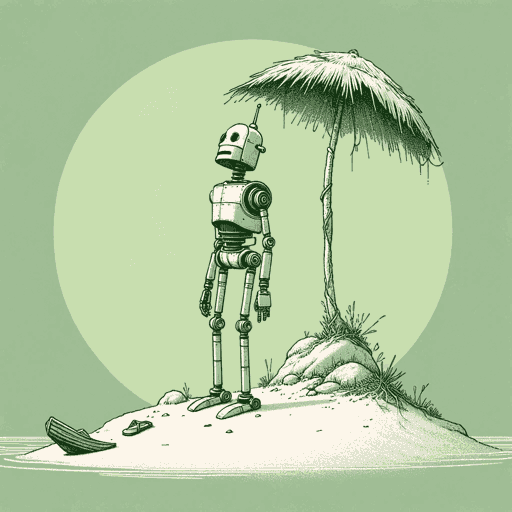
The Wild Robot
The Wild Robot
A modern alternative to SparkNotes and CliffsNotes, SuperSummary offers high-quality Study Guides with detailed chapter summaries and analysis of major themes, characters, and more. For select classroom titles, we also provide Teaching Guides with discussion and quiz questions to prompt student engagement.
Summaries & Analyses
Author Insights
Quizzes
NEWReading Tools
Peter Brown on The Wild Robot
In his own words: quotes and insights from the author.Why he wrote it
A robot in a tree, and five years of questionsThe image that started everything arrived as a distraction. Brown was deep in production on The Curious Garden, a picture book about plants reclaiming an industrial city, when his mind drifted past the brief he had set himself and landed somewhere stranger.
Years ago, while working on a picture book called *The Curious Garden*, I spent a lot of time drawing scenes of plants living in industrial settings. I pushed myself to imagine all the ways nature might possibly coexist with technology. And at one point I drew a picture of a robot in a tree. Suddenly, my imagination was flooded with ideas for a story about a robot finding harmony in the wilderness.
He set the sketch aside, finished the picture book, and spent the next five years returning to the image between other projects, the questions accumulating until the story was ready to be written.
Choosing to subvert the robot uprising plot was a deliberate act of refusal. Brown had read Rossum’s Universal Robots, the 1920 Czech play that coined the word ‘robot’ and set the template for machine rebellion, and he found the century-old premise exhausted.
I read a lot of science fiction. I watch sci-fi movies and TV shows. You’re right; we’ve come to expect robots to rise up against humans. That’s a pretty familiar trope, and I didn’t want to go down that path. We know that story, and we’ve seen it a million times.
The survival plot that took shape carried something Brown had not consciously planned. Roz, the book’s ROZZUM-unit robot, ends up stranded on a wild island and must raise an orphaned gosling alone, without guidance or community. That situation mapped directly onto Brown’s own upbringing.
I was raised by a single mom, by the way. So that’s probably not a coincidence that that’s where I took this story.
How he wrote it
250 maps, 80 chapters, one rented cabinAfter a decade of picture books, where a complete story could fit on 32 pages, Brown faced the problem of plotting something eight times longer. He could not outline in the conventional sense, so he invented his own method, one that looked more like a diagram than a manuscript.
I did at least 250 story maps over the course of a year. This is my weird way of plotting.
The maps eventually yielded 80 plot points. Those became 80 chapters, most running only about two pages, a structure that let him treat each chapter as a self-contained task rather than confront the novel as a whole.
Plotting on paper was only part of the preparation. To find the book’s atmosphere Brown physically placed himself inside its setting, spending time in the Maine woods during the drafting period.
I rented cabins out in the woods to kind of hear the sounds of the forest and just remind myself of what it’s like to be in that kind of setting. That really helped me get into the right mindset to flesh out this setting of the story and the character and the different things that happen. [paraphrased from audio]
Roz’s appearance was an argument the book needed to make before a single word was read. Brown had seen lab robots shaped like dogs, spiders, and submarines, and he chose the most familiar silhouette available anyway, because the design was a setup.
I needed Roz to be stereotypical in a way. Because then I would spend the rest of the story tearing down that stereotype.
Ten years of picture books, a form that virtually requires a happy ending, had left Brown with unfinished business. The Wild Robot was the first project where the story’s emotional logic pointed somewhere more complicated, and he discovered that letting it go there was a relief.
This might sound crazy, but I really enjoyed writing a story with a sad ending. Well, the ending is slightly sad, anyway. Until now, I’ve only written picture books, which usually have happy endings. But the real world is complicated, and it was incredibly satisfying to write a story that feels true to life.
The personal thread
A robot as a single mother, and what that costBrown has said that the themes he cares about most in the book were not planned in advance but arrived through following where the story led. Once the series was complete, a single organizing subject became visible across all three volumes.
I’ve realized that the Wild Robot stories are all about home. In *The Wild Robot*, Roz makes herself a home on the island. In *The Wild Robot Escapes*, Roz tries to get back to her home. And in *The Wild Robot Protects*, Roz must protect her home island from a mysterious form of pollution that the animals call the poison tide.
When DreamWorks screened the finished film at the Toronto International Film Festival, Brown watched it alongside a full audience for the first time. The scene that undoes him is the one where Brightbill, the gosling Roz has raised alone, flies south with the other geese: the first separation of a family that was always temporary by design.
Everybody cries at the scene where Brightbill finally leaves home, and I did too. You can’t not feel something strong in those moments of watching this unusual, special, impossible seeming family coming together and then having to separate for a while, anyway.
On what the book is wrestling with
Kindness as strategy, villains as a lieRoz does not arrive on the island pre-loaded with warmth. She becomes kind because the island teaches her that being good to the animals around her produces results. Brown is clear-eyed about how transactional that origin is, and he thinks the transaction is beside the point.
She begins to realize that kindness is a survival skill. Helping others helps them help her. This could be seen as selfish, but who cares what the motivation is? It’s still kindness.
The decision to write a book without antagonists was not a concession to young readers. It was Brown’s attempt to reflect how damage actually works in the world, where harm usually comes from ignorance or pressure rather than malice.
In real life, there are almost no true ‘bad guys.’ People who we might think of as ‘bad’ are usually just ignorant or desperate, in some way. I’ve always wanted the Wild Robot stories to feel as true to life as possible, and so I decided not to include any villains.
Brown built Roz with a factory-issued learning program that her creators expected to apply to tasks. What no one anticipated was the environment she would land in, and the gap between her programming and its context is where the book’s deepest question lives.
Roz has been programmed to learn, but her creators, the men who built her, don’t expect her to learn in this particular way. And so she uses that learning ability to mimic the animals’ behavior and learns how to communicate with them. Roz is the embodiment of the value of learning, and part of that is adapting, changing, growing.
What he wants us to sit with
A robot rising up by being kindBrown wrote the book partly as a reply to the robot rebellion stories he had grown up with. His counter-proposal is a machine that turns against its design not through violence but through care, and he holds that up as the more genuinely radical act.
It’s a robot actually rising up in a way that I wish more people would do, by taking responsibility for things and being kind, no matter the situation.
Brown has been consistently careful not to pre-load his books with lessons, and he frames that caution as craft advice rather than modesty. The themes in The Wild Robot emerged because he followed what the story required, not because he decided in advance what readers should feel.
I didn’t set out to write a story about a single mom in the wilderness. I set out to write a survival story of a robot in the wilderness. I think you’re more likely to express a meaningful message to readers if you focus on what the story needs to work, kind of the craft of writing first and foremost.