Woven by Gold
A modern alternative to SparkNotes and CliffsNotes, SuperSummary offers high-quality Study Guides with detailed chapter summaries and analysis of major themes, characters, and more.
Summaries & Analyses
Quizzes
NEWReading Tools
Important Quotes
Content Warning: This section of the guide references sexual content, graphic violence, physical abuse, emotional abuse, cursing, substance use, and animal death.
“It’s been four months, and the rosebush is still frozen. Winter has turned to spring, warm rain has washed away the snow, pastel flowers sprout up from the hard earth, and the rosebush is still frozen.”
(Part 1, Chapter 1, Page 3)
The opening lines immediately establish the central conflict and mood of the novel. The repetition of “the rosebush is still frozen” acts like a drumbeat, hammering home Rosalina’s emotional stagnation after her banishment. The contrast between the thawing world around her and the single frozen bush emphasizes her severed connection to the fae realm and the cold rejection from her mate, Keldarion.
“Gray and void on the outside but exploding within. Like there’s something in me clawing to get out.”
(Part 1, Chapter 2, Page 6)
This quote uses a simile (“Like there’s something in me clawing”) to capture Rosalina’s internal state. The word “clawing” gives her hidden power an animal quality, hinting at the beast-like magic she doesn’t yet know she carries. The contrast between “gray and void” outside and “exploding” inside builds tension between her dull life in Orca Cove and the force building beneath the surface.
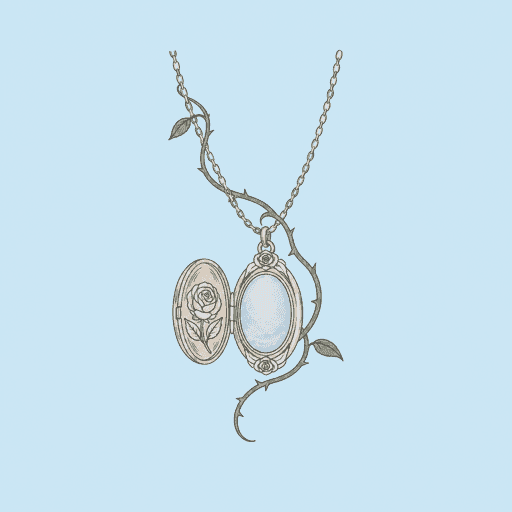
“An ethereal hum flows through me. It’s a moonstone necklace in the shape of a rose. I’ve seen this symbol before. On the door of Castletree.”
(Part 1, Chapter 3, Page 16)
The discovery of the necklace acts as a significant turning point in the plot. The object introduces the Moonstone Rose Locket as a symbol of Rosalina’s hidden heritage and her deep-seated connection to the fae world.
“‘It is true,’ he says, his deep voice dripping with ferocity, ‘and I could not have asked for a crueler fate in all the stars. The Enchantress’s curse is nothing compared to the utter torment of being mated to you.’”
(Part 2, Chapter 13, Page 71)
Keldarion’s rejection of their mate bond establishes the central conflict in his romantic relationship with Rosalina. He uses hyperbole, claiming their bond is worse than a magical curse, emphasizing how far his self-loathing goes. His ferocious tone underscores his determination to keep her at a distance.
“But I would lay waste to every realm, cover every field and mountain in an eternal winter, and keep you and Dayton and Farron and every being in Castletree cursed if it meant saving her.”
(Part 2, Chapter 16, Page 86)
This paradoxical statement frames Keldarion’s cruel actions as acts of deep, though twisted, love. The scale of his threat—entire realms, eternal winter—turns his devotion into something cosmic and frightening. His willingness to sacrifice everyone, including himself, characterizes his love as a force with the power to destroy.
“A beat of silence passes between us, full and aching. ‘Damn the stars,’ he growls. Then his left arm flings out, smashing the lantern. I jump at the sound, the pantry now pitch-black.”
(Part 2, Chapter 17, Page 93)
This sequence uses sensory details—the growled curse, the sound of smashing glass, the sudden pitch-blackness—to dramatize Ezryn’s intense internal conflict. By deliberately plunging them into darkness, he creates an anonymous space where he can act on his repressed desires without having to visually face Rosalina or the consequences.
“Because we already know that heroes are the best monsters, aren’t they? The other high princes have shown us that. You’re not like them. You can still be saved.”
(Part 2, Chapter 25, Page 157)
Caspian’s rhetorical question complicates the narrative’s portrayal of heroism and villainy, suggesting that heroes are defined by their capacity for monstrous acts. The paradox of “heroes are the best monsters” is meant to unsettle Farron, blurring the line between good and evil. By asserting that the other princes have already proven this, Caspian isolates Farron and positions himself as the only one who can help him embrace his monster to become a true hero, underscoring the novel’s thematic engagement with Building an Identity Through a Shadow Self.
“‘Sworn Protector of the Realms.’ Ezryn’s voice rumbles with a foreboding intensity, evoking the sound of a gathering storm. ‘I stand with you.’”
(Part 2, Chapter 28, Page 183)
Ezryn’s formal declaration of allegiance, addressing Keldarion by his official title, signals a key shift in their dynamic. The simile comparing his voice to “a gathering storm” gives his pledge weight and warning, suggesting both loyalty and the threat that will fall on anyone who opposes them. His pledge, followed by identical ones from Dayton and Farron, transforms their fractured relationships into a unified front.
“‘Where were you to explain,’ she says, ‘when our villages fell to the frost? Where were you to explain when the refugees showed up at Coppershire and we had no food to give them because our crops have failed?’ Her body shakes, voice growing raspy. ‘Where were you to explain when I traveled to the border with a host and watched them fall one by one to the frost and I could do nothing because I’d passed along Autumn’s blessing to someone who took the power and hid?’”
(Part 3, Chapter 32, Page 211)
Niamh’s anaphora, repeating “Where were you to explain,” creates a rhythmic, building accusation against Farron. Each repetition stacks another failure on top of the last, so the reader feels the weight of what his absence has cost. Her speech links his personal retreat into fear with the realm’s suffering and her own powerlessness.
“‘In Spring, we’re taught rebirth is all around us,’ he continues. ‘The seed becomes a sprout becomes a flower. The egg becomes the bird, which dies and becomes the dirt that houses the worm that feeds the bird. The deer feeds the cougar, which then lies to rest upon the grass, which, in turn, feeds the deer. And the stumps that I would sit on…There were rings and rings and rings, more than I could count. Ages upon ages of growing. It may all begin somewhere, but it changes, dies, renews.’”
(Part 3, Chapter 34, Page 226)
Ezryn uses an extended metaphor of natural life cycles—seed to flower, predator to prey—to explain a philosophy of constant renewal. The chain-like structure of his sentences, where each thing feeds into the next, mirrors the endless cycle he’s describing. This imagery of rebirth speaks directly to Rosalina’s trauma, suggesting that personal history is part of a larger, ever-changing process, not a fixed state.
“There’s a well within me, a reserve of power in the deep darkness of my spirit. A well that needs only a spark to ignite. My friends, my family, Rosalina…They are that spark. I focus all my energy on the abomination. Heat spreads through my chest, growing outward, lacing through my veins and swelling at the tips of my fingers. Flames erupt from my hands.”
(Part 3, Chapter 37, Page 259)
The internal monologue uses the metaphor of a “well” of power needing a “spark” to ignite, symbolizing Farron’s dormant potential. The imagery then shifts into literal sensation—heat, veins, flames—so the metaphor becomes physical reality on the page. This moment illustrates the theme of Courage Found Through Chosen Family, as his protective love acts as the explicit catalyst that unlocks his magic for the first time.
“One myth says that if you catch a will-o’-wisp, it will temporarily light up your mate bond, and you can see a path to the other half of your soul.”
(Part 3, Chapter 40, Page 280)
Helen uses the folklore surrounding will-o’-wisps to explore the fated connections and destinies of the Castletree princes. Describing the bond as a visible “path” turns an invisible feeling into something concrete a person can follow, reinforcing the idea of a predetermined journey to one’s mate. The introduction of this legend sets the stage for the magical revelation of the princes’ and Rosalina’s interconnected fates.
“‘The hoot of the owl,’ I say. ‘The breaking of boughs. Sometimes, I can hear the melody of the moon, whispering that tonight, I am free.’”
(Part 3, Chapter 43, Page 309)
Keldarion’s dialogue personifies nature, giving the moon a “melody” and a “whispering” voice, which reveals an intimate connection to his environment. The soft “wh” and “m” sounds throughout the line give it a quiet, almost musical quality that matches the peace he’s describing. This moment of poetic vulnerability shows that the full moon, for him, represents not a loss of control but a rare night of freedom from his curse.
“‘It’s my fault,’ I say. ‘I let the library burn to the ground.’”
(Part 3, Chapter 47, Page 339)
Farron’s unadorned confession reveals the traumatic origin of his self-doubt and his inability to see himself as a worthy leader. The plainness of the sentences—short, blunt, without excuse—mirrors how heavy the guilt is; he states it as simple fact. This backstory establishes the core failure he must confront before he can embrace his role and power as high prince.
“‘Listen, Rosalina.’ His voice carries an air of dominance. ‘In this room, there is just you and me. There’s no one else. So right now, you are mine.’”
(Part 3, Chapter 52, Page 371)
Farron’s love and desire for Rosalina gives him a new kind of confidence, foreshadowing the reveal of their mate bond. His tone of “dominance” directly contrasts his established persona the gentlest of the princes. The short, declarative sentences and the possessive “you are mine” demonstrates his ability to access dormant parts of himself when he’s with Rosalina. The dialogue explores themes of possession and desire, representing his attempt to act on his feelings and integrate a more assertive part of his identity.
“My mate may dress however she sees fit. So if you value any of your minions’ lives, you will tell them not to touch her. Anyone who does will answer to me.”
(Part 4, Chapter 55, Page 297)
In a hostile environment, Keldarion’s declaration is a political act of ownership and protection that establishes Rosalina’s status and warns others against harming her. His possessive language emphasizes the primal nature of the mate bond that frames their connection as a source of power and authority within the fae hierarchy, highlighting the novel’s thematic focus on Love as a Political Act.
“It’s like there’s music and a TV playing at the same time, two different sounds, two different emotions cluttering my mind, and neither of them feel like my own.”
(Part 4, Chapter 56, Page 403)
This quote uses a contemporary simile to articulate the psychic intrusion Rosalina experiences from her bond with Caspian. Comparing the sensation to overlapping “music and a TV” makes something magical feel familiar and easy to picture, and the clashing sounds capture her internal disarray as she struggles to separate her feelings from his.
“And if he ever tricks you into believing you’re the shore his star washed up on, remember he’s nothing but a selfish liar.”
(Part 4, Chapter 58, Page 416)
Caspian employs a romantic metaphor—the star and the shore—only to twist it, recasting Keldarion as a manipulator incapable of genuine love. By using such a beautiful image right before calling Keldarion a “selfish liar,” Caspian makes the accusation land harder through the sudden shift in tone. This introduces an important element of doubt regarding Keldarion’s character and backstory.
“A sorrow I cannot let Farron carry for the rest of his life.”
(Part 5, Chapter 67, Page 487)
This moment encapsulates Ezryn’s protective nature. He prioritizes Farron’s emotional well-being over a promise, illustrating a loyalty that transcends duty. This act of breaking one vow to uphold a deeper, unspoken one defines the strength and complexity of his love for his chosen family.
“I will show him that the fire burns within us. I will show myself.”
(Part 5, Chapter 69, Page 503)
Rosalina’s declaration signifies an important turning point in her arc, exemplifying the theme of Building an Identity Through the Shadow Self. The repetition of “I will show” gives the line the force of a vow, and the image of “fire” burning within stands in direct contrast to the frozen rosebush from the opening—showing how far she has come. She stops running from the beast and instead confronts it by revealing her own inner fire.
“But I’m not the beast. And I’m no longer only Farron. I am Rosalina’s mate. A receiver of the Enchantress’s gift. A scholar, a brother, a son. I am High Prince of the Autumn Realm. It’s time for me to act like it.”
(Part 5, Chapter 73, Page 523)
This internal monologue marks Farron’s integration of his multiple identities—beast, man, mate, and prince. The repeated “I am” phrases build like a list of claims, each one adding another layer to who he is, illustrating his acceptance all parts of himself to finally claim his political and personal power.
“Fuck, Rosie. I’m this close to falling in love with you. I’m teetering on the edge of the cliff, and one wrong step, and I’m going to drop and impale myself on your heart. There will be nothing for anyone else.”
(Part 5, Chapter 78, Page 559)
Dayton’s confession uses the metaphor of teetering on a cliff to articulate his emotional vulnerability and the perceived danger of his love for Rosalina. The violent image of being “impale[d]” on her heart turns the usual sweetness of “falling in love” into something painful and final, showing how high the stakes feel to him. His conflict highlights the tension between personal desire and his duty to find his own mate.
“Not all battles are won with the strike of a sword. Sometimes all it takes is an inspiring word, a little spark. You, Rosalina, are that spark.”
(Part 5, Chapter 79, Page 563)
Padraig’s words redefine strength, moving it beyond physical combat to include emotional influence and inspiration. The metaphor of Rosalina as a “spark” echoes Farron’s earlier “well and spark” imagery, tying her directly to the moment his magic ignited and framing her presence as the catalyst for his transformation into a leader.
“I made a bargain to kiss you, but I didn’t promise it would be now. It was you who failed to say where or when. It pays to be specific with bargains, you know.”
(Part 5, Chapter 82, Page 583)
By exploiting a loophole in their magical contract, Rosalina demonstrates her mastery of the fae world’s rules. This act signifies her character development from a passive victim to a clever strategist who can outmaneuver a famously manipulative prince. It shows her integrating into her new world not just by gaining power, but by learning its complex social and magical laws.
“Yes, Autumn is death. And I shall become death to save the living.”
(Part 5, Chapter 85, Page 597)
This line marks Farron’s complete acceptance of his shadow self. The paradox of “becom[ing] death to save the living” turns something usually feared into a form of protection, reframing Autumn’s association with death as a necessary part of the natural cycle.

Unlock every key quote and its meaning
Get 25 quotes with page numbers and clear analysis to help you reference, write, and discuss with confidence.
- Cite quotes accurately with exact page numbers
- Understand what each quote really means
- Strengthen your analysis in essays or discussions
Related Titles
By Elizabeth Helen



Featured Collections
Books that Feature the Theme of...
View Collection
BookTok Books
View Collection
Canadian Literature
View Collection
Earth Day
View Collection
Family
View Collection
Fear
View Collection
Guilt
View Collection
Pride & Shame
View Collection
Romance
View Collection
Teams & Gangs
View Collection
Valentine's Day Reads: The Theme of Love
View Collection