Woven by Gold
A modern alternative to SparkNotes and CliffsNotes, SuperSummary offers high-quality Study Guides with detailed chapter summaries and analysis of major themes, characters, and more.
Summaries & Analyses
Quizzes
NEWReading Tools
Symbols & Motifs
Content Warning: This section of the guide references graphic violence, sexual content, death, physical abuse, and emotional abuse.
The Frozen Rosebush
The frozen rosebush, which literally separates Rosalina from her chosen family in Castletree, represents the fear, shame, loneliness, and uncertainty the characters feel before they learn to integrate all the disparate parts of themselves into an authentic whole. Once the magical portal to her chosen home, Keldarion’s rejection and banishment of Rosalina transform the rosebush into an impassable barrier of ice. Its unnatural state is emphasized in the narrative: “Winter has turned to spring, warm rain has washed away the snow, pastel flowers sprout up from the hard earth, and the rosebush is still frozen” (3). Its magical resistance to the changing seasons positions it as a direct manifestation of the High Prince of Winter’s will.
The rosebush’s crystallized petals suggest a love that has been suspended in a state of cold denial, while the impenetrable thorns represent the pain of being shut out. The rosebush symbolizes a state of hopeless stasis—despite Rosalina’s pleas for Keldarion to give into their mate bond, Keldarion’s refusal leaves them both miserable and unfulfilled. Rosalina notes “Not just [their] mutual pleasure but the desire that sparked through [their] bond” when they are together—“Not only desire. Love. There was love there” (321). Yet, Keldarion repeatedly rejects her and attempts to create distance between them. The presence of the frozen rosebush emphasizes Rosalina’s severed connection to the world where she discovered her true self and the family she now desperately longs to rejoin.
The Moonstone Rose Locket
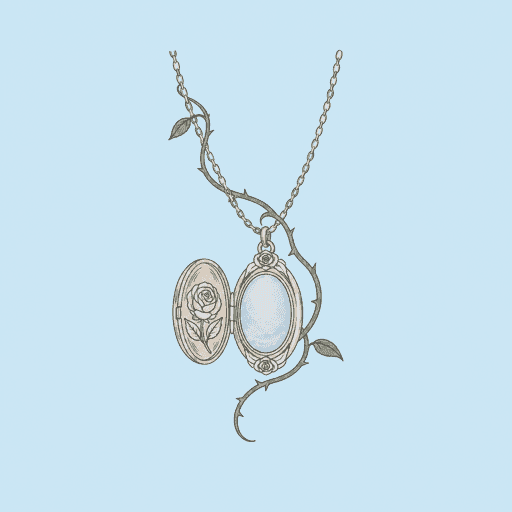
The moonstone rose locket symbolizes Rosalina’s hidden fae heritage and the reclamation of her personal power, highlighting the novel’s thematic engagement with Building an Identity Through a Shadow Self. Initially worn by her father as a keepsake of his lost wife, the locket is a tangible link to Rosalina’s matrilineal past. When she discovers it bears the same rose sigil as the door to Castletree and opens to reveal a mirror, its true purpose as a magical artifact is revealed.
The locket matches the necklaces worn by the high princes, hinting that Rosalina possesses a similar inherent connection to fae magic. After the locket is shattered by Lucas and painstakingly glued back together, its imperfect repair mirrors Rosalina’s own journey of healing from a broken past to forge a new, resilient identity. The successful activation of the damaged locket to contact Ezryn signals the moment Rosalina stops relying on the magic of the princes and begins to trust in her own innate abilities.
The Thorn Collar and Briar Bracelets
Thorns appear throughout the novel as a recurring motif representing the duality of power as both a form of constraint and a source of empowerment. This duality is most clearly embodied in the bargains associated with Caspian. For Farron, the bargain manifests as a thorn collar, a physical and magical restraint designed to control his beastly transformations. Caspian tells him, “I will conjure a spell on you, one of thorns and shackles, that will confine your beast” (158), explicitly framing the thorns as a form of imprisonment, even if it is for Farron’s own safety.
In contrast, Rosalina’s bargain with Caspian grants her briar bracelets that give her the ability to summon and control thorns, transforming them into a weapon for defense and a tool for action. Farron’s journey involves learning to live with his inner beast constrained by thorns, while Rosalina’s involves embracing a thorny, dangerous power to achieve her full potential. The thorns are never wholly good or evil; they are a neutral force whose meaning is defined by intent, symbolizing that power itself is defined by how it is wielded.

Unlock the meaning behind every key symbol & motif
See how recurring imagery, objects, and ideas shape the narrative.
- Explore how the author builds meaning through symbolism
- Understand what symbols & motifs represent in the text
- Connect recurring ideas to themes, characters, and events
Related Titles
By Elizabeth Helen


Featured Collections
Books that Feature the Theme of...
View Collection
BookTok Books
View Collection
Canadian Literature
View Collection
Earth Day
View Collection
Family
View Collection
Fear
View Collection
Guilt
View Collection
Pride & Shame
View Collection
Romance
View Collection
Teams & Gangs
View Collection
Valentine's Day Reads: The Theme of Love
View Collection