Away
A modern alternative to SparkNotes and CliffsNotes, SuperSummary offers high-quality Study Guides with detailed chapter summaries and analysis of major themes, characters, and more.
Summaries & Analyses
Quizzes
NEWReading Tools
Parts 4-6Chapter Summaries & Analyses
Content Warning: This section of the guide contains discussion of illness.
Part 4: “Acclimation” - Part 6: “Enterprise”
Part 4, Chapter 58 Summary: “DAC Bulletin Board”
An official media advisory from Incident Command urges evacuees who own property in contamination zones to register those properties so Incident Command can communicate status updates efficiently.
Part 4, Chapter 59 Summary: “Harmony”
Nearly seven weeks into the evacuation, Harmony Addams-Paul writes another letter to her Aunt Beckie from the shelter. She reflects on the surreal experience of being quarantined while the rest of the world carries on normally. She has encountered few familiar faces from home, and her mother believes the evacuation was mishandled, scattering people from the same communities into different camps. No one appears ill from the contamination, though obsessive hand-washing has become routine. Harmony has been writing articles in her journal but cannot mail her letters due to a lack of stamps.
Part 4, Chapter 60 Summary: “Harmony”
Two months into the evacuation, Harmony writes a journalistic article about how young people at Camp Rogers are carving out private spaces in communal housing. Edison “Teddy” Brenkert takes advantage of his elderly roommates’ early bedtimes for solitude. Ashanti Johnson has converted a corner of a medical storeroom near her mother’s infirmary into a reading nook. Harmony herself hangs a bedsheet from the top bunk to create privacy in the room she shares with her mother and younger sister.
Part 4, Chapter 61 Summary: “Ashanti”
Ashanti describes waiting for her mother to finish closing the infirmary for the evening. Once her mother is settled, Ashanti secretly puts on the white coat and stethoscope and sits across from an imaginary patient, practicing the role of a doctor.
Part 4, Chapter 62 Summary: “Teddy”
In his Film Production Diary, Teddy writes that he has been shooting extensive footage but cannot edit without his computer. He finds that interview subjects open up quickly, often sharing conspiracy theories. He notes that Gram has calmed down since speaking with Dr. Johnson and is beginning to show enthusiasm for organizing a theatrical production, believing that making art relieves stress.
Part 4, Chapter 63 Summary: “Grandin”
Grandin describes Camp Rogers as a fully enclosed facility with fenced perimeters, guarded gates, and the nearest town more than 80 miles away. He compares his restlessness to that of a trapped animal and quietly wonders whether there might be a way to slip out of camp.
Part 4, Chapter 64 Summary: “DAC Bulletin Board”
A new official advisory from Incident Command reports that some evacuation camps are seeing unusual health cases with symptoms including nausea, vertigo, and sensory disturbances. The cause is not yet known, and all evacuees will remain in quarantine while the situation is investigated.
Part 4, Chapter 65 Summary: “Ashanti”
Ashanti wrestles with anxiety after the health-incident report, despite her mother’s reassurances. She wonders whether they could be contaminated without showing symptoms, comparing their helpless waiting to that of Odysseus’s men in Homer’s Odyssey, who were poisoned by Circe’s magic and left to rely on outside intervention for survival.
Part 4, Chapter 66 Summary: “Teddy”
On the quad, Teddy and Harmony review interview footage while Pax plays nearby. Harmony voices concern about the reports of illness in other camps; Teddy relays that their camp has not been affected. When Teddy decides the documentary needs B-roll footage from around the base, Pax threatens to report them to their mother unless she is included. Teddy solves the standoff by giving Pax the role of “producer” in exchange for her Goldfish crackers. The three follow a painted yellow line deeper into camp until the buildings become increasingly dilapidated, pressing on despite Teddy’s unease about being out of bounds.
Part 4, Chapter 67 Summary: “Grandin”
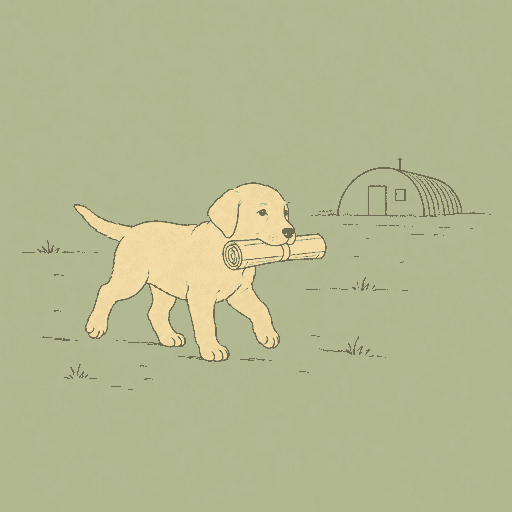
Grandin describes exploring the camp’s forgotten edges, where he discovers a Labrador nursing a litter of seven puppies in a makeshift nest of rags behind an old hut.
Part 4, Chapter 68 Summary: “Teddy”
Teddy, Harmony, and Pax come across a long, arched green hut with boarded windows and padlocked doors that Pax dubs the Emerald City. While Harmony and Teddy debate whether journalists Bob Woodward and Carl Bernstein—famous for breaking the Watergate scandal during the Richard Nixon administration—qualify as muckrakers, they realize Pax has wandered off. A squeal from behind the hut brings them running, where they find Pax sitting with Grandin and a lapful of puppies. Harmony, having feared Pax was in danger, confronts Grandin sharply before catching herself and apologizing. Grandin, whose uncle breeds Labradors, explains that he followed the sound of squeaking pups and estimates the litter is about two weeks old. Harmony offers to help smuggle food for the dogs. Teddy then notices that one puppy is unusually limp; Grandin identifies the condition as fading puppy syndrome and explains that the smallest pup is likely being pushed away from its mother. Teddy suggests consulting Ashanti’s mother, and Pax immediately bolts toward the DAC to get help.
Part 4, Chapter 69 Summary: “Ashanti”
In a verse poem, Ashanti describes Dr. Johnson examining the sick puppy right in the hallway after the children arrive with it. The doctor diagnoses the puppy with failure to thrive, administers fluids, and prescribes warmth and continuous care, cautioning them not to expect too much. Grandin holds the puppy close and quietly promises that it will survive.
Part 4, Chapter 70 Summary: “Teddy”
Grandin sits on the DAC steps with the puppy nestled in a shoebox while Ashanti reviews care instructions with him—dropper feedings every two to three hours, sterilized between uses, no missed feedings. As the puppy falls asleep in Grandin’s hand, Harmony asks Grandin’s name, and he introduces himself. Pax promptly introduces the rest of the group and asks Grandin whether he ever plays Wizard of Oz.
Part 4, Chapter 71 Summary: “Grandin”
Grandin reflects on the daily routine of bringing solid food to the nearly weaned puppies. He notes that the puppies are almost independent but still reliant, just as the evacuees line up every day in the mess hall, dependent on others and never quite weaned from the camp.
Part 4, Chapter 72 Summary: “Harmony”
Harmony writes to Aunt Beckie that the mother dog has wandered off now that her puppies no longer need her, and the runt is growing stronger. The children have found homes for the rest of the litter throughout camp, even placing one with a guardsman. Harmony connects the mother dog’s departure to her own father’s absence, wondering bitterly whether he too decided his children were old enough to be on their own.
Part 4, Chapter 73 Summary: “Teddy”
The group watches Grandin play with the rescued puppy on the quad. In an unusual burst of words, the typically laconic Grandin announces that he is keeping the dog and plans to hunt and camp with him on his family’s ranch once the quarantine ends. When Pax demands that the puppy be named Toto, Grandin declines and names the dog Popcorn—then demonstrates why by having Pax smell the puppy’s paw pads, which carry the scent of buttered popcorn.
Part 4, Chapter 74 Summary: “Grandin”
Grandin recalls the purposeful, hands-on life he shared with his father on the ranch, where there were always animals to tend and tasks to complete. In camp, his hands feel empty and purposeless. Popcorn nipping at his jeans and then falling asleep on his boot offers a small but meaningful sense of connection.
Part 5, Chapter 75 Summary: “DAC Bulletin Board”
Five months after statewide evacuations, the Colorado governor’s office has established the Council for Displaced Coloradans to advise on issues affecting evacuees quarantined in relocation shelters. The council’s immediate priorities include providing adequate housing, supplies, and temporary schools for displaced children. However, the council cannot comment on individual properties or the status of contamination zones, referring all such inquiries to Incident Command.
Part 5, Chapter 76 Summary: “Harmony”
Harmony writes to Aunt Beckie about the launch of “Temp School.” Teddy dismisses traditional schooling as suffocating to creative thinking. Harmony is genuinely enthusiastic: School will occupy Pax, provide tablets for writing, and may include a journalism class. She wishes Mr. Sedillo could teach the class and wonders where he is.
Part 5, Chapter 77 Summary: “Grandin”
Grandin interprets the decision to open schools as a signal from authorities that the evacuation will last a very long time.
Part 5, Chapter 78 Summary: “Ashanti”
In a verse poem, Ashanti relays her mother’s view that school will provide healthy structure to the endless, shapeless days in camp. For her own part, Ashanti is relieved not to fall behind academically, as she is fully committed to medical school and demands the most rigorous education available.
Part 5, Chapter 79 Summary: “Teddy”
On the first day of Temp School, the children and teens crowd into a large auditorium. Teddy immediately objects to being sorted by grade level. Harmony is focused on the tablets, which she plans to use to launch a self-published zine, and tries with limited success to get Teddy excited about editing his documentary. The chaotic, overcrowded auditorium overwhelms Teddy, who mutters that he would rather take his chances in the contamination zones.
Part 5, Chapter 80 Summary: “Teddy”
In his Film Production Diary, Teddy writes that he cannot function in conventional school and plans to have Gram write him an exemption note. This frustration leads him to brainstorm how film can depict claustrophobia, listing visual metaphors such as trapped animals, packed elevators, and crowded shelters. The entry includes a hand-drawn storyboard.
Part 5, Chapter 81 Summary: “Ashanti”
Ashanti misses her swim team with a physical intensity that goes beyond nostalgia—she feels the absence in her muscles. She notes the irony that the dry prairie surrounding the camp stretches out like an ocean, yet the nearest swimming pool is over a hundred miles away.
Part 5, Chapter 82 Summary: “Grandin”
After school, Grandin picks up keys dropped by an elderly man whose low, deep voice reminds him of his father and brings him to unexpected tears. The man—Ramón, a driver for Incident Command officials—keeps talking to give Grandin time to recover, and Grandin finds himself opening up about his fears, his father, and the puppy. Ramón’s advice is to choose hope over worry.
Part 5, Chapter 83 Summary: “Harmony”
Harmony writes to her aunt that the promised tablets failed to work and have been replaced by stapled worksheets, which are so remedial that the students learn nothing. Via Grandin, Harmony has learned from Ramón that the school’s principal has already quit. Ashanti, whose academic ambitions far exceed what the camp’s teachers can offer, is nearing her limit of patience.
Part 5, Chapter 84 Summary: “Ashanti”
Ashanti complains that her biology teacher is a former school counselor with no biology background—someone who confused anaerobic respiration with a type of physical exercise and could not identify basic cell structures. The teacher has said that facts matter less than feelings, leading Ashanti to remark privately that she feels like punching the teacher.
Part 5, Chapter 85 Summary: “Harmony”
At the six-month mark, Harmony publishes a community article reporting on new activities at Camp Rogers as winter sets in. Her mother, Pastor Addams, and Rabbi Lerner have formed an interdenominational committee to coordinate holiday planning. Gram is holding auditions for a community theater production. Dr. Johnson is offering wellness classes for all ages. Harmony also reflects that she never expected to turn 13 in donated clothing while living in quarantine.
Part 5, Chapter 86 Summary: “Teddy”
In his diary, Teddy reports that Gram’s holiday musical was hampered by a failing sound system and a heating outage at intermission, but still provided useful footage and seemed to lift people’s spirits. He ends on a note of relief that school is suspended until after New Year’s.
Part 5, Chapter 87 Summary: “Grandin”
In a verse poem, Grandin describes New Year’s Eve at camp, where even his mother briefly joins in the celebration with a midnight toast. Almost immediately afterward, both are overcome with guilt at having momentarily forgotten their worries. Grandin resolves to start the new year by keeping his father’s memory actively present in his mind.
Part 5, Chapter 88 Summary: “Harmony”
Writing to Aunt Beckie on St. Patrick’s Day, Harmony reflects on how quarantine has compressed their world, with people now measuring time in months rather than days. The formation of a garden committee unsettles her—who will harvest the produce if they go home? Her mother responds with a story about a run-down farm where a pot of vibrant geraniums showed that someone still found a reason to tend something beautiful. Harmony hears the lesson but worries that focusing too much on camp means losing sight of home.
Part 6, Chapter 89 Summary: “DAC Bulletin Board”
Eleven months into the evacuation, an official advisory announces that the toxic contamination has spread, enlarging the uninhabitable zones. General Giles is activating additional troops to secure the perimeters, all remaining mountain routes have been closed, and the condition is now being called Contamination Syndrome.
Part 6, Chapter 90 Summary: “Ashanti”
In a verse poem, Ashanti observes that every official press update drives a new wave of patients to the infirmary with stress-related symptoms: stomachaches, sleeplessness, and hives. She echoes her mother’s belief that mental distress often manifests physically, and that sometimes the most effective treatment is simply a kind word and the reassurance that what they’re feeling is a normal response to an abnormal situation.
Part 6, Chapter 91 Summary: “Teddy”
While doing schoolwork on the quad with Popcorn sleeping at Grandin’s feet, Harmony asks the group whether everyone seems to be growing too comfortable with the status quo. Ashanti compares the situation to the Lotus Eaters in The Odyssey—people lulled into passivity who forgot their homes and their purpose. Pax connects this to the scene in The Wizard of Oz where Dorothy and her companions fall asleep in a poppy field. Harmony stares off into the distance, visibly forming an idea.
Part 6, Chapter 92 Summary: “Harmony”
Harmony writes to her aunt that a small idea took shape after the Lotus Eaters conversation. Pax suggested using the old green hut—which she still calls the Emerald City—as their base. Unable to bring himself to damage military property, Grandin declined to force the lock, so the group removed a board from a back window and crawled inside. They found a disused office filled with usable resources: maps, encyclopedias, wooden desks, stationery, manual typewriters, and a copy machine.
Part 6, Chapter 93 Summary: “Teddy”
Gathered in the Emerald City, Harmony makes Pax swear to keep the location secret, then announces the group’s new mission: to be muckrakers—investigative journalists who expose wrongdoing and corruption. Her goal is to report truthfully on the contamination in the hope that uncovering its cause might accelerate the cleanup and get them home. When everyone agrees they want to return, Harmony declares that the truth will set them free. Ashanti quips that clicking their heels together would be simpler.
Part 6, Chapter 94 Summary: “Harmony”
Harmony writes to her aunt that she is reviewing and revising her stockpiled articles for the first issue, drawing on official press releases and photos that Ramón has provided. She plans to start with accessible content and build a readership before pursuing bigger investigative stories. Learning to use the typewriter is slow and frustrating, and she admits her fear of making an error.
Part 6, Chapter 95 Summary: “Harmony”
At the 12-month mark, the inaugural edition of the Camp Rogers Gazette appears, bearing the motto “As Powerful as the People Who Read It.” Harmony’s lead article covers Governor Clark’s declaration of Evacuee Appreciation Day to mark the one-year anniversary of Operation Relocate Freedom, quoting the governor’s acknowledgment of evacuees’ patience and promising celebrations including food, music, and activities for children.
Part 6, Chapter 96 Summary: “Teddy”
The kids celebrate the Gazette’s first issue with a party in the Emerald City. Harmony toasts to the paper and expresses hope that this will be the last anniversary they spend in evacuation. Pax then launches a game she calls “Glinda’s Crystal Ball,” using an old glass coffeepot: Each player must stare into the pot for 15 seconds and share a personal truth. Pax goes first, delivering a theatrical prophecy about their intertwined fates and the need to face their fears—drawn from The Wizard of Oz, which she has apparently read many times.
Part 6, Chapter 97 Summary: “Ashanti”
For her turn in the crystal ball game, Ashanti shares in verse that her ambitions are unchanging: to become a doctor who heals people and cures disease, and to become an authority on the workings of the human body.
Part 6, Chapter 98 Summary: “Teddy”
When it is Teddy’s turn, he reveals that his parents died in a car accident when he was an infant and that Gram raised him. He then admits that he feels an urgency to make a feature film before he turns 30. The group is puzzled by the specific age until Grandin quietly asks whether Teddy’s parents were thirty when they died. Teddy neither confirms nor denies it and changes the subject.
Part 6, Chapter 99 Summary: “Harmony”
Harmony writes to her aunt that she did not need 15 seconds to know her truth: She wants to become the greatest journalist of the 21st century. Beneath that ambition is a more personal hope that her success might make both parents proud and perhaps even bring them back together.
Part 6, Chapter 100 Summary: “Teddy”
When Harmony’s words about her father’s departure surface in conversation, Pax becomes upset and insists their father is only taking a break and will return, suggesting he may simply be unable to find them because of the evacuation. Harmony holds Pax firmly and confronts her with the facts: Their father packed his belongings, loaded his truck, and drove away nearly two years ago. Pax rejects this, pulls free, and abruptly shifts the game to Grandin’s turn.
Part 6, Chapter 101 Summary: “Grandin”
In a verse poem, Grandin takes his turn with quiet honesty: the ambitions he once held—to serve his country, heal the world, and ranch alongside his father—feel distant. His only wish now is for the ordeal of evacuation to end.
Parts 4-6 Analysis
Amid the isolation of the relocation camp, the children discover the value of Community as a Source of Resilience, as their emotional wellbeing relies on forging an interdependent, proactive found family. The foundation of this resistance forms when the children discover a litter of abandoned Labrador puppies behind a derelict building. Their shared responsibility in smuggling food, consulting Ashanti’s mother for medical advice, and providing round-the-clock care for the fading runt, Popcorn, creates a unified front. Grandin, who feels purposeless without his family’s ranch, finds that the puppy offers a vital sense of stewardship and connection. When the children successfully nurse Popcorn back to health, they establish a micro-community built on mutual support, compassion, and tangible action. This localized success counters the overwhelming helplessness imposed by the military evacuation. The narrative posits that human connection and shared purpose are essential tools for combating despair.
To further conceptualize their exile, the children rely on the recurring motif of The Wizard of Oz, which provides a familiar narrative framework for understanding their fractured reality. The group begins meeting in an abandoned green hut, which Pax dubs “the Emerald City” (155), a name that marks the location as a site of truth-seeking. Inside this space, the group plays “Glinda’s Crystal Ball” (215), a game in which each character articulates their deepest truths and vulnerabilities. Teddy confesses his anxiety over his parents’ early deaths, driving his urgency to make a film before age 30, while Harmony admits her underlying hope that her journalistic success will reunite her divorced parents. By adopting the iconography of a classic quest narrative, the children impose meaning onto their chaotic circumstances. The motif elevates their situation from a senseless government quarantine to a deliberate journey toward home.
The generational divide between the children and the adult evacuees drives the theme of Coming of Age as Learning to Question Authority. As the months pass, the camp’s adult population increasingly accepts their confinement, organizing holiday committees, theater productions, and gardening clubs. Ashanti compares this complacency to the Lotus Eaters from The Odyssey, who “were lulled into passivity” and forgot they were trying to get home (207). The adults’ embrace of these routines acts as a coping mechanism but fundamentally masks their subjugation, rendering them compliant to Incident Command’s shifting, unverified narratives about a vaguely defined “Contamination Syndrome” (203) purportedly spreading through other camps. In contrast, the children refuse to normalize their detention. Harmony observes that planting gardens implies a long-term stay, directly contradicting the official promise of a temporary evacuation. This refusal to accept a fabricated normalcy forces the protagonists to rely on their own critical faculties.
Rejecting this camp-wide passivity, the protagonists launch the Camp Rogers Gazette, a vital source of community and agency. Though the paper mostly disseminates innocuous information about the weather and approved camp activities, Harmony makes clear to her young colleagues that its real purpose is The Power of a Free Press in Combating Disinformation. Discovering an old copy machine and typewriters in the Emerald City, Harmony declares her intention to become a muckraker, inspired by historical journalists who exposed systemic corruption. She recognizes that creating an independent publication is a liberatory act, stating, “[…] The truth will set us free” (211). Initially, the zine serves to document daily camp events, countering the vague, top-down Incident Command bulletins with verified local reporting. By building a readership and establishing a platform, the children prepare to challenge the state-sponsored narrative that keeps the evacuees docile. Harmony’s first issue bears the motto “As Powerful as the People Who Read It” (213), explicitly positioning the publication as a tool for collective empowerment. The physical zine embodies their defiance, transforming their private suspicions into a public mechanism for accountability. Ultimately, the publication proves that citizen journalism and the meticulous dissemination of facts are weapons against institutional deception.

Get in-depth, chapter-by-chapter summaries and analysis from our literary experts.
- Grasp challenging concepts with clear, comprehensive explanations
- Revisit key plot points and ideas without rereading the book
- Share impressive insights in classes and book clubs

Featured Collections
Books on Justice & Injustice
View Collection
Challenging Authority
View Collection
Coming-of-Age Journeys
View Collection
Community
View Collection
Juvenile Literature
View Collection
Power
View Collection
School Book List Titles
View Collection
Teams & Gangs
View Collection
Truth & Lies
View Collection