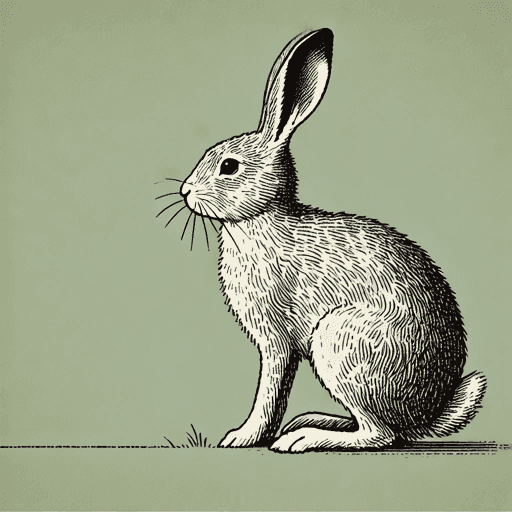
Raising Hare
A modern alternative to SparkNotes and CliffsNotes, SuperSummary offers high-quality Study Guides with detailed chapter summaries and analysis of major themes, characters, and more.
Summaries & Analyses
Author Insights
Quizzes
NEWReading Tools
Chloe Dalton on Raising Hare
In her own words: quotes and insights from the author.Why she wrote it
A door held open at the last momentDalton spent more than a decade writing in other people’s voices, for politicians and diplomats, and had made a quiet peace with that arrangement. The hare arrived before any ambition to write a book did.
I always felt I would achieve more in the context of the people I was writing for and with rather than in my own life. I didn’t aspire to be an author.
The book nearly didn’t happen at all. At the moment literary agent Caroline Michel asked her to sit back down, Dalton was still fully employed advising on one of the most consequential foreign policy crises of recent years.
If it wasn’t for Caroline I wouldn’t have written the book. I had a full-time job and was preoccupied by pressing issues including the return to power of the Taliban in Afghanistan. But then I did something that I would normally consider completely unprofessional. I finished a meeting with Caroline on behalf of someone else and then as I was heading out of the door I said: ‘one day I must tell you about a book I’d like to write’. And she said — ‘sit down and tell me about it now’.
Two years of notebooks and behavioral diagrams already existed by then. The decision to treat them as a book was made in that doorway.
Even with an agent’s encouragement, the project needed a moment that made its scale undeniable. It came when the hare, who moved freely in and out of the house as a fully wild animal, chose to give birth inside it.
It was two years into the experience when the hare gave birth to leverets of her own inside my house, that I realized that I was witnessing something extraordinary. And she was doing this, as I say, as a fully free wild animal, and she chose to give birth in my house. [paraphrased from audio]
Watching the hare one afternoon, Dalton recognized a habit she had cultivated throughout her career, one that had kept her effective and invisible in equal measure.
I watched the hare perfectly camouflaged in the landscape, and realized that maybe I in my line of work, or my life, maybe I was acting a little bit too much like the hare, that I was very camouflaged in the background of other people’s lives, working for big prominent politicians. [paraphrased from audio]
How she wrote it
What a sleeping hare teaches a political speechwriterBefore she could write about the hare, Dalton had to figure out how to keep her alive. Google returned rabbit care guides. The useful answer turned out to be buried in eighteenth-century poetry: William Cowper, who kept hares while suffering from depression, left detailed feeding records. Dalton worked through every item on his list.
Don’t discount poetry. [paraphrased from audio]
For the broader cultural and historical context, she turned to the London Library, drawing on sources that had little obvious connection to each other.
The range of what she pulled from the stacks reflects how far the book reaches beyond a simple wildlife memoir.
In the London Library I found books on witchcraft, hunting and poaching; studies of hawks, foxes, grasses, herbal medicine; and accounts of rural myths and legends, all of which I relied on for an understanding of the cultural context and history of human-hare relations. I borrowed books on hedgerows and mushrooms, and the mathematics of rainbows.
Her entire professional formation had been in the 800-word political argument, where compression was the measure of skill. Writing at the length and pace a memoir required meant unlearning what her career had rewarded.
In politics, a single word can make all of the difference. I was always expected to write about other people in their voices. It was different when I did it for myself.
The book’s rhythm was set not by editorial instinct but by the animal herself. Hares are crepuscular, most active at dawn and dusk, and spend their daylight hours in long stretches of stillness. Dalton let that biology determine the tempo on the page.
The way I wrote the story was really determined by the hare herself. Their daily life of a hare is actually very calm, very quiet, very steady. [paraphrased from audio]
The physical fact of writing beside a living wild animal produced moments that collapsed the distance between subject and writer. This one arrived on an ordinary stormy afternoon, roughly halfway through the first draft.
I remember an intense summer storm, a day when there was no going outside. I was working on the book, listening to the rain cascading off the roof. I looked up to see that I was surrounded by sleeping hares: the mother hare, stretched out in the sitting room, one of her wild leverets lounging on the sofa, and the other leveret outside, crouched on the windowsill flanking my desk. In that moment we were all just animals sheltering from the rain, lulled into sleepiness by the downpour, coexisting. My feelings in that instant and the sentiment I wanted to capture on the page were one and the same.
The personal thread
Camouflage, and the cost of itThe book’s most unexpected reversal is that the creature who prompted Dalton to write under her own name never speaks, never performs, and never steps forward. She found her voice by watching an animal whose survival depended on remaining unseen.
There’s this beautiful and unexpected irony that a creature who is totally silent and totally wild helped me to find my own voice. To write a story under my own name is a huge step for me and a joyful experience.
The change in what she paid attention to was also a change in where she located consequence. She had spent years with her gaze fixed on war zones and international crises, walking past English fields without registering them.
Before, I’d always thought that drama and interest was in forces of war and history and conflict. There is so much drama to be found in a small garden, if you know where to look.
What she wants us to sit with
Still time, if we look nowOne of the book’s quiet arguments is that attentiveness is a skill most people in modern life have let atrophy, and that the cost of that loss is harder to measure than a species count. Dalton arrived at this through her own belated discovery of what had been there all along.
It was thrilling to me to realise that, even in our very heavily domesticated landscape, there are still pockets of wildness, of things and creatures that we don’t understand as much as we think we do and that can shed new light on what it is to be human, in a way, and to interact with the wild.
The book documents an 80-85% decline in British hare numbers over the past century, and notes that hares are the only game animal in England and Wales that can legally be shot throughout the year, including during breeding season. But Dalton’s larger claim is about what that loss says about the people doing the losing.
We are now so alienated from nature that we have forgotten that we are animals ourselves. We all benefit from access to nature — and I know how fortunate I am in that regard. The hare has enriched my understanding of what gives us peace.
The phrase ‘mad as a March hare’ encodes a centuries-old misreading that Dalton spent years watching the evidence contradict. The hare she knew was not erratic or cowardly but consistent, faithful, and precise in her habits.
If I could, I would change the phrase ‘mad as a March hare’ in our language with ‘as faithful as a hare’ and ‘as constant’. [paraphrased from audio]
The hope she wants readers to leave with is proportional to that correction: not optimism as a stance, but the specific conviction that paying closer attention to what remains is itself a form of action.