The Ballad of Falling Dragons
A modern alternative to SparkNotes and CliffsNotes, SuperSummary offers high-quality Study Guides with detailed chapter summaries and analysis of major themes, characters, and more.
Summaries & Analyses
Author Insights
Quizzes
NEWReading Tools
Background
Content Warning: This section of the guide includes discussion of death.
Series Context: The World of Moonfall
The Ballad of Falling Dragons is the second installment in Sarah A. Parker’s Moonfall series, following the debut novel that established the world, its mythology, and its central characters. The first book introduced readers to a sprawling fantasy realm shaped by an ancient divine conflict, where gods, fae, and dragons coexist in a precarious balance of power. The extensive front-matter glossary, retained and expanded in this volume, signals the depth of worldbuilding carried forward from book one, including the kingdoms’ political geography, the taxonomy of dragon species, and the unique time-keeping systems that govern daily life in Parker’s universe.
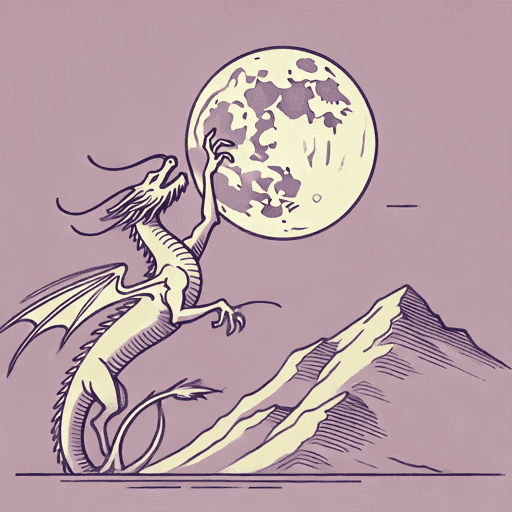
Central to the series’ foundation is the fraught relationship between the mortal kingdoms and the divine beings whose conflicts shaped the world’s history. The series’s fictional world was created by five gods, each associated with one of five elements—Caelis of the aeither, Bulder of the earth, Rayne of the water, Close of the air, and Ignos of fire. The gods peopled the world with humans, fae, and many other creatures, including various breeds of dragons such as the Sabersythes of the Burn, the Moltenmaws of the Fade, and the Moonplumes of the Shade. When dragons die, they rise into the sky to become moons. Occasionally, one of these moons falls to the earth—a rare, cataclysmic event that no one can explain or predict.
In the first book, When the Moon Hatched, Elluin Neván is a human princess of the Shade who develops a close relationship with a female dragon named Slátra. Betrothed to the cruel Tyroth Vaegor, she falls in love with his kind brother, Kaan Vaegor, and becomes pregnant with Kaan’s child. Shortly after the forced marriage, Elluin is rumored to have died and been carried into the sky by Slátra, who becomes a moon. When this moon falls from the sky years later, Elluin emerges alive but unable to remember who she is. She remembers only her middle name, Raeve. Under this name, she becomes a cage fighter and later joins a rebel group called the Fíur du Ath. She soon meets Kaan and begins to fall in love with him all over again, though she doesn’t remember having known him before. As she wrestles with her fragmented memory and sense of identity, the novel reveals that the child Raeve had with Kaan in her former life as Elluin is now a princess of the Shade named Kyzari, and that she has been captured by the Scavenger King, half-brother of the Vaegors.
In The Ballad of Falling Dragons, the political intrigue between kingdoms intensifies, the consequences of the first book’s revelations unfold, and the romantic relationship between Raeve and Kaan moves into more complex emotional and physical territory.
Genre Context: The Surge of Romantasy
The Ballad of Falling Dragons belongs to the “romantasy” subgenre, a portmanteau of romance and fantasy that has seen a meteoric rise in the publishing world. Coined as early as 2008 but popularized by online communities in the 2020s, romantasy designates stories that take place in high-fantasy settings—worlds separate from that of the reader and governed by different rules, often including complex systems of magic—and in which romantic relationships are central to the plot, often with the fates of worlds and empires hinging on the romance between the two central characters. This formula has proven highly popular with audiences, giving rise to a thriving subgenre dominated by powerhouse authors like Sarah J. Maas, whose A Court of Thorns and Roses series has sold over 13 million copies, and Rebecca Yarros, whose 2023 debut Fourth Wing became a viral sensation.
Parker’s Moonfall series fits squarely within this framework. The book features a sprawling, immersive world with fae, gods, and multiple dragon species, detailed in an extensive front-matter glossary. The plot is driven by political intrigue between kingdoms and a history of divine conflict, fulfilling the high-stakes fantasy component of the genre. Crucially, the narrative is anchored by an intense romance that drives both the protagonists’ personal development and the fate of the world. As Raeve, with support from her beloved Kaan Vaegor, gradually pieces together her forgotten past, she rebuilds a cohesive identity and gains the perspective needed to emerge as an effective actor on the world stage, thwarting the tyrannical ambitions of the Scavenger King and changing the course of history. Understanding the genre’s blend of epic fantasy and central, explicit romance helps contextualize the book’s structure and appeal, placing it in conversation with some of the most commercially successful fiction of the decade.

Get in-depth, chapter-by-chapter summaries and analysis from our literary experts.
- Grasp challenging concepts with clear, comprehensive explanations
- Revisit key plot points and ideas without rereading the book
- Share impressive insights in classes and book clubs
Related Titles
By Sarah A. Parker