The Ballad of Falling Dragons
A modern alternative to SparkNotes and CliffsNotes, SuperSummary offers high-quality Study Guides with detailed chapter summaries and analysis of major themes, characters, and more.
Summaries & Analyses
Author Insights
Quizzes
NEWReading Tools
Symbols & Motifs
Content Warning: This section of the guide contains discussion of graphic violence, death, physical abuse, emotional abuse, and child abuse.
Fallen Moons and Moonshards
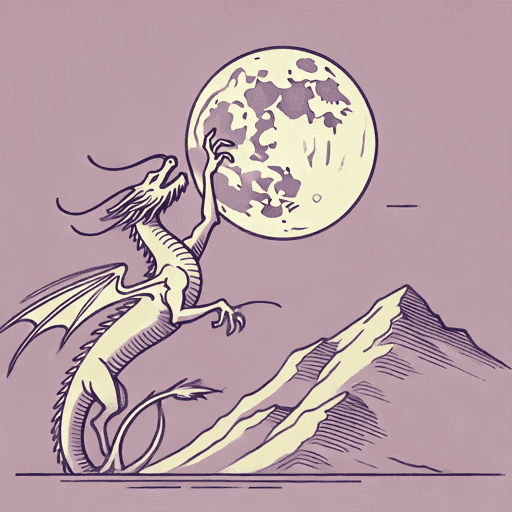
The fallen moons and their scattered moonshards serve as a recurring motif representing the shattering nature of loss, the fragmentation of memory, and the arduous path toward restoration. In this world’s mythology, the moons are the solidified bodies of deceased dragons, embodying a legacy of grief and reverence. Slátra’s fall, the event that returns Elluin to the world as Raeve, is a cataclysm that mirrors the violent destruction of her family and identity. Her shattered moon becomes a physical manifestation of a broken past. Kaan’s obsessive quest to reassemble the scattered moonshards is a ritual of healing. He promises the dormant dragon, “You will be whole again […] I will not rest until I’ve found every last piece and brought them back to you” (3). This vow reflects his own desperate need to mend the wound of Elluin’s loss and restore the past he feels was stolen from him.
This motif supports the theme of Navigating Trauma and Repressed Memories, as the physical act of piecing together a broken celestial body parallels the psychological struggle to reintegrate a fractured self. The impending mass moonfall at the novel’s climax elevates this motif to an apocalyptic scale, suggesting that the world itself is on the verge of irreparable fragmentation, its history and foundations threatened by the unresolved traumas of its gods and rulers.
The Book of Voyd
The Book of Voyd is a symbol of Power as a Morally Corrosive Force. Believed to have been written by the god Caelis, the book shows a source of ultimate power, containing runes capable of protecting against apocalyptic events. The Tri-Council’s hoarding of this artifact and their decision to share only a “condensed version” of its contents with the world illustrates the degree to which the institution’s pursuit of power has corrupted its original purpose. By restricting access to knowledge that could save lives, they maintain their political dominance and expose the populace to dangers they themselves are shielded from. The book itself defies simple definition, behaving almost as a sentient entity. Roan insists that when he tried to open it, the book simply vanished, leaving behind “a cloud of silver particles that seemed to…well […] prowl right out the door” (57). This mysterious quality suggests a power that transcends mortal ownership and control, one that chooses its own keepers.
When Raeve successfully steals the book, bypassing lethal runes that have killed all previous intruders, the act symbolizes a reclamation of this divine power from a corrupt institution. The book’s transfer into the hands of those who intend to use its knowledge for protection rather than political leverage shows a shift toward a more just and responsible form of governance, one based on shared salvation rather than hoarded secrets.
Málmr and Uhloo
The málmr and the uhloo are culturally specific symbols from the Boltanic Plains that represent chosen love, mutual honor, and lasting commitment. The málmr, a hand-carved pendant, is an offering of courtship, while the uhloo, a braid of hair given in return, signifies the acceptance of that offer and a declaration of intent. Kaan’s málmr, which depicts two dragons coiled together, is a tangible representation of his and Elluin’s souls being intertwined. Raeve’s unconscious decision to keep the málmr even after losing her memories signifies the deep, unbreakable nature of their bond, which persists beyond conscious thought and trauma. It acts as an anchor to her true self and her deepest affections, a physical relic of a love she has forgotten but not truly lost. When Kaan explains the uhloo, he notes that “the tightness of the braid declares much about your intentions” (222). This detail emphasizes that the bond is an active, conscious choice.
This symbolism becomes especially moving in the context of The Burden of Duty and Sacrifice. While Elluin was forced into a political binding with Tyroth, the exchange of the uhloo between Raeve and Kaan shows a reclamation of agency. It is a free and public declaration of love, standing in stark opposition to the coercive and transactional relationships that define the world’s corrupt power structures. It symbolizes a love that is chosen, not commanded.
Blood Binds
The blood bind is a motif representing servitude, the loss of agency, and the physical manifestation of psychological control. This magical tether, which links Raeve to her ruthless handler Sereme, is a magical instrument of torture that embodies power as a morally corrosive force. Sereme can inflict terrible pain on Raeve from afar, ensuring her obedience and reinforcing a power dynamic in which Raeve’s body is not her own. The bind is more than a physical restraint; it is a constant, invasive presence that prevents Raeve from achieving true freedom. The Elding Squire’s threat that “should you not complete the mission, The Flourish will fall. A weight you’ll take to your grave” highlights how the bind is also used for emotional blackmail (251), tying Raeve’s actions to the fate of innocent people she sought to protect. This manipulation forces her to act against her own conscience, making her a pawn in the Elding’s corrupt schemes.
The journey to sever this bond is central to Raeve’s character arc. The process requires her to return to the physical location of her greatest trauma—the abandoned mineshaft where she nearly died—linking the act of breaking free from servitude to the necessity of navigating trauma and repressed memories. In severing the bind, Raeve reclaims not just her body but also her will, completing her transformation from a controlled asset into a self-determined individual.

Unlock the meaning behind every key symbol & motif
See how recurring imagery, objects, and ideas shape the narrative.
- Explore how the author builds meaning through symbolism
- Understand what symbols & motifs represent in the text
- Connect recurring ideas to themes, characters, and events
Related Titles
By Sarah A. Parker