The Ending Writes Itself
The Ending Writes Itself
A modern alternative to SparkNotes and CliffsNotes, SuperSummary offers high-quality Study Guides with detailed chapter summaries and analysis of major themes, characters, and more.
Summaries & Analyses
Quizzes
NEWReading Tools
Part 2, Chapter 32-EpilogueChapter Summaries & Analyses
Content Warning: This section of the guide includes discussion of death, graphic violence, and child abuse.
Part 2: “Main Character Energy”
Part 2, Chapter 32 Summary: “Jaxon: Chapter One”
While out for a run, Jaxon sees Malcolm standing precariously at a cliff’s edge. Fearing that he’s attempting to die by suicide, Jaxon sprints to intervene. Malcolm turns, drops the papers he was clutching, and steps backward off the cliff, falling to the rocks below. Immediately after, Millie appears and asks, “What did you do?” (245).
Jaxon insists that he was trying to save Malcolm, and after he swears he didn’t push him, Millie says she believes him. As they talk, Jaxon notices a person-shaped shadow in the top window of the house. Suddenly, Millie bolts toward the house. Jaxon chases her, catching her in the foyer just as she’s about to sound the gong. He grabs her arm, and she screams, which summons the other writers: Priscilla, Cate, and Kenzo, who’s holding an antique ax.
Millie tearfully tells the group that Jaxon pushed Malcolm off the cliff. Jaxon denies the accusation, claiming that one of them was in the attic room and witnessed the truth. The group finds that the door to the room is locked. Concluding that Jaxon is a threat, they decide to lock him in his bedroom for their safety. Kenzo and Priscilla escort him to his room. Before locking the door, Kenzo compliments Jaxon’s past work and tells him to write.
Part 2, Chapter 33 Summary: “Jaxon: Chapter Two”
Jaxon’s flashback reveals a childhood memory from 20 years earlier. A young Jaxon, then named Oswald Jackson Jr., is locked in his tiny bedroom by his abusive father. To cope with his claustrophobia, he crawls under his bed, a space that feels safe and chosen. While lying there, he gazes at glow-in-the-dark stars he has stuck on the underside of the bed—his mother found them in the dollar bin, but his father forbade putting them on the ceiling—and escapes into a fantasy world where he’s a starship captain. As his parents fight loudly outside his room, Oswald finds refuge in his imagination.
Part 2, Chapter 34 Summary: “Jaxon: Chapter Three”
Back in the present, Jaxon is locked in his room, and the small space triggers his anxiety. He channels his nervous energy into an exhaustive workout with a resistance band. Afterward, feeling calmer, he confronts the typewriter. He reflects on his once-promising career as a sci-fi author, which has devolved into writer’s block and desperation following the cancellation of his trilogy. He recalls a failed attempt to generate publicity by faking a viral photo of a celebrity reading his book.
With no other distractions, Jaxon sits down and finds an unexpected connection between Fletch’s crime novel and his own work. Inspiration strikes, and he begins to write with a fluency he hasn’t experienced in months. Deeply focused, he dimly hears his door open but assumes that it’s Priscilla bringing food. He finishes his sentence and turns to find that the door is closed. A shadow moves behind him, and someone loops his resistance band around his neck, strangling him to death in his chair.
Part 2, Chapter 35 Summary: “Millie: Chapter One”
In a flashback from two years earlier, Millie attends her parents’ funeral, unable to perform the grief expected of her. She reflects on her strict religious upbringing and how she has since built a life full of color and creativity, which includes a daily ritual of writing 3,000 words—a compulsion that she feels she can’t safely skip. She recalls lying to her publisher years ago by saying that her parents were dead, a falsehood that has now come true.
Her younger sister, Freya, confronts her for attempting to leave the wake early. Their conversation reveals a deep rift caused by their different upbringings; after Millie left for college, their parents became significantly more lenient, granting Freya a much happier adolescence. Freya criticizes Millie’s YA fantasy novels and her curated online author persona, urging her to mature. Millie coldly retorts that her “dragon porn” is what will now pay for Freya’s life, leaving her sister hurt and stunned.
Part 2, Chapter 36 Summary: “Millie: Chapter Two”
In the present, Millie is in her room, writing a scene that mirrors the recent events with Jaxon and Malcolm. She internally justifies her accusation against Jaxon, admitting to herself that while she didn’t see him physically push Malcolm, she’s confident in her version of the truth. She remembers having to rewrite her entire ending for Fletch’s novel after realizing that she had written it in the wrong point of view.
A flashback reveals that late the previous night, while intending to deliver her rewritten pages to Rufus’s cottage, she saw Priscilla leaving it instead. Millie confronted Priscilla, accusing her of trying to seduce Rufus to win the competition.
Back in the present, Millie goes to the library for inspiration for a character name. She passes Jaxon’s locked room and calls out to him but gets no answer. On the main staircase, she’s startled by the bloodstain where Sienna died. Kenzo appears with his typewriter and an ax, explaining that he’s moving to the kitchen to feel less isolated. They share a tense exchange.
Part 2, Chapter 37 Summary: “Millie: Chapter Three”
Millie finds Cate in the library, where they discover how to open the dollhouse. While examining the miniature rooms, Millie notices a network of secret passageways connecting the bedrooms. Later, she joins Priscilla and Kenzo in the kitchen. They decide to bring food to Jaxon, and though Kenzo volunteers to go alone, Millie casually offers to come along.
As they cross the foyer, a gust of wind causes Kenzo to trip and nearly fumble the tray into the antler sculpture; Millie steadies him before any harm is done. They proceed to Jaxon’s room, but he doesn’t answer their knocks. Kenzo uses a key to unlock the door, and they enter. They find Jaxon slumped over his desk, dead, strangled with a resistance band. In shock, Millie drops the tray of food.
Part 2, Chapter 38 Summary: “Millie: Chapter Four”
Millie is consumed with guilt, believing that her accusation led to Jaxon being murdered. Cate and Priscilla arrive, drawn by the noise. Cate notices that Jaxon’s manuscript pages aren’t on his desk. Kenzo announces that he intends to use the ax to open the safe and retrieve their phones, and leaves despite Millie’s warning about splitting up. While they wait, Cate leans against the wall and accidentally opens a hidden panel, revealing a secret passage that leads directly into Millie’s room.
This discovery immediately casts suspicion on Millie. She denies any involvement, but Priscilla points to a new stack of pages on her desk—her rewritten ending. To prove her innocence, Millie challenges Priscilla to search her suitcase and then runs to Priscilla’s room to search it. There, she finds Jaxon’s stolen pages on the dresser and her own original submitted manuscript hidden under the pillows.
Convinced that Priscilla is the killer, Millie grabs a decorative mace from the wall. She accuses Priscilla of murdering everyone, including Rufus. Priscilla suddenly yells a warning, looking at something behind Millie. Before Millie can react, she’s struck from behind and loses consciousness.
Part 2, Chapter 39 Summary: “Priscilla: Chapter One”
The narrative shifts to Ava Paulson, Fletch’s editor, who has been undercover as the romance writer Priscilla. She watches in horror as Cate strikes the unconscious Millie a second time with a heavy, solid gold book; Millie doesn’t get back up. Ava realizes that Cate is the murderer, a belief bolstered by the fact that she hit Millie twice instead of just once. Trying to save herself, Ava reveals her true identity and her role in organizing the competition, but Cate is unmoved.
Cate reveals that she found the golden book hidden in the foyer floor. She also confesses that her manuscript was generated by an AI program fed with Fletch’s entire body of work; her goal is money, not a writing career. Cate then admits to killing Jaxon; she also admits that she spiked the tea that Sienna drank, although her intent was to put the writers to sleep. She didn’t think Sienna would drink the whole pot, but when she was teetering on the stairs, Cate only had to give her a little push. She also admits to writing the threatening note for Millie and to staying silent while Jaxon was blamed for Malcolm’s accidental fall. Ava is terrified, but she attempts to placate Cate by telling her that they can open the safe and get her devices back. On the way to the safe, Ava finds Kenzo’s body impaled on the antler sculpture downstairs, and Cate confesses that she may have caused his “accident.”
Ava decides to make a run for the small jetty on the other side of the island. Cate pursues her with a crossbow, and she catches up when Ava’s ankle is caught in a snare. Cate comes closer and aims the crossbow. Ava stabs her hand with a pen, causing her to miss. Ava frees herself and escapes in a rowboat, but Cate leaps in after her. Ava hits Cate with an oar, knocking her into the sea. Weighed down by the satchel containing the golden book, Cate refuses to let it go and drowns.
Back at the house, the 72-hour timer on Fletch’s safe reaches 00:00:00. The lock clicks open, revealing the writers’ devices on the shelf—a tablet, a sticker-covered laptop, a smartwatch, two computers with matching screensavers, and an iPhone. The room is empty, and no one is present to retrieve them. Two days later, Eleanor enters the silent house. She calmly collects all the electronic devices from the open safe, places them in her weekender bag, and departs.
Part 2, Chapter 40 Summary: “Ava: Two Weeks Later”
Two weeks after the events on Skelbrae, Ava is back in New York, recovering from an ankle injury. She meets with Eleanor, who has adopted Sienna and Malcolm’s dog. Eleanor reveals that she deliberately selected writers with few personal connections, making their disappearances easier to manage, and notes that it shouldn’t be too hard to keep the matter out of the press. Unfazed by the deaths, Eleanor offers Ava a million-dollar deal to ghostwrite the final Fletch novel herself.
Jaded by the publishing industry but tempted by the money, Ava accepts. That night in her apartment, she sits down at her computer to begin writing but finds herself stuck, staring at the cursor blinking after Fletch’s final line: “I should have known” (320).
The narrative summarizes the final outcomes. Ava quit publishing, moved to upstate New York, and found happiness. In a successful marketing move suggested by Holden (formerly Rufus), Merriweather Press released Fletch’s last book unfinished, allowing readers to imagine their own endings. T-shirts bearing the phrase “I SHOULD HAVE KNOWN” became a fashion item among the literati (322), and the book spent 24 weeks on the New York Times Best Sellers list. Holden was promoted to senior editor. Skelbrae is now a tourist destination for his fans.
Epilogue Summary: “Kenzo”
Kenzo survived his injuries and is at a packed bookstore for the launch of his new horror novel, a fictionalized retelling of the events at Fletch’s house. The book is a major success, and Eleanor is now his agent.
A flashback explains his survival: Cate pushed him down the stairs, and he was impaled on the antler sculpture. He managed to pull himself free and stagger outside. He was found by Angus, whose family originally owned the island and who had stayed on as groundskeeper after selling to Fletch, with Fletch’s promise that the island would revert to him. Angus stitched Kenzo’s wound with fishing line and called for help.
At the book reading, Kenzo gives carefully rehearsed answers during the question-and-answer session, framing his novel as a “what if” scenario inspired by Fletch’s death. He reflects privately on the other writers and the brutal realities of the industry. The event concludes, and he begins signing books for a line of fans so long that he can’t see the end.
Part 2, Chapter 32-Epilogue Analysis
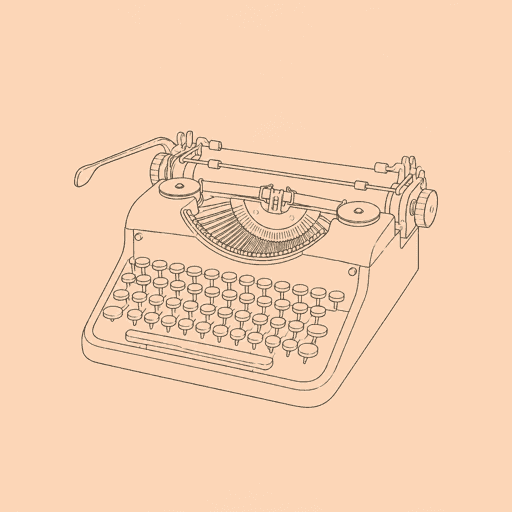
The motif of typewriters reaches its darkest point with Jaxon’s death in these final chapters. Throughout the novel, the typewriter has functioned as an instrument of analog, effortful creativity, the antithesis of the digital shortcuts that the competition implicitly condemns. That Jaxon’s murder is committed at the typewriter, at the exact moment when he has recovered his voice as a writer, is not incidental. Cate, later revealed to be the killer, snuffs out an act of genuine creation in order to protect her manuscript, which contains none. His childhood flashback in Chapter 33—the young Oswald Jackson Jr. locked in a bedroom, finding escape through an imagined universe—runs in direct structural parallel to his current confinement, and the repetition makes his murder feel like a commentary: The imagination that saved him as a child can’t protect him from the larger forces that determine whose writing survives.
Cate’s confession to Ava in Chapter 39 supplies the ideological center of these closing chapters. Her manuscript, she reveals, was generated by feeding Fletch’s entire bibliography into an AI program; her only stated goal is money, but her method also serves as revenge on an industry that she believes destroyed her mother’s life. This admission drives the theme of How Generative AI Destroys Authentic Creativity as it moves from background concern to explicit plot engine. In the broader publishing landscape, the question of whether AI training on copyrighted works constitutes infringement has already produced major litigation, and Cate’s method—appropriating one author’s complete body of work to produce a commercially viable imitation—enacts that violation in miniature. Her contempt for the artistic dimension of the competition is total; she describes her entry as product design optimized for familiarity, an attitude that draws some parallels to the industry’s own view.
The symbol of the golden book undergoes its definitive transformation across Chapters 38 and 39. Introduced earlier in the novel as the emblem of the ultimate prize—the escape from midlist precarity into financial security—the solid gold tome becomes, in Cate’s hands, a weapon and betrayal of the writers. She strikes Millie twice with it, and the abstraction of “cutthroat ambition” turns literal: The object that represents literary success is the murder weapon. Cate’s fate extends the symbol’s logic further. When Ava knocks her into the sea during their struggle in the rowboat, Cate refuses to release the satchel containing the golden book and drowns under its weight. The prize that she killed for becomes the instrument of her own destruction. Her drowning refuses the idea that the book’s value justifies any cost; it literalizes, instead, the self-defeating calculus of pursuing monetary reward at the expense of artistic integrity. The symbol’s final state—sinking with its pursuer—leaves no ambiguity about the novel’s position on the industry’s ultimate trophies.
Ava’s reveal of her true identity as an editor to Cate extends the theme of Masking Artistic Insecurity With Performative Personas from individual authors to institutional figures. Her undercover role means that the competition’s only authority—the editor nominally arbitrating the contest—was herself performing a fiction throughout. She wasn’t discovering talent; she was observing it under controlled, false conditions. When she reveals her identity to Cate in a bid for her own survival, the disclosure carries no moral weight: It’s simply another tactical move in a sequence of tactical moves. The revelation that Eleanor deliberately selected authors with few personal connections—ensuring that any crisis that occurred would be manageable—extends this institutional cynicism upward. Eleanor isn’t shocked by the deaths; she’s inconvenienced by them. Her arrival at the empty castle two days after the safe opens, her calm retrieval of all the devices, and her subsequent offer to Ava of a million-dollar ghostwriting deal depict an industry apparatus that treats human beings as variables in a production schedule. The facade of stewardship conceals, in Eleanor’s case, a logistical operation in which the writers were always expendable.
Kenzo’s survival and subsequent success in the Epilogue provide the novel’s most pointed satirical coda. He transforms the Skelbrae massacre into a best-selling horror novel—carefully framed in a question-and-answer session as speculative fiction—and signs books for a line so long he can’t see the end. His commercial triumph is inseparable from his willingness to repackage colleagues’ deaths as entertainment, and that willingness is precisely what the industry rewards. The Destructive Demands of the Publishing World finds its clearest illustration not in the losers of the competition but in its survivor: To thrive, Kenzo must excise the true account of what happened and sell a sanitized, marketable version instead. Fletch’s unfinished manuscript becoming a 24-week bestseller and his island becoming a tourist destination reinforce this pattern at scale. The industry profits from the myth of the author—regardless of whether any actual writing was involved.

Get in-depth, chapter-by-chapter summaries and analysis from our literary experts.
- Grasp challenging concepts with clear, comprehensive explanations
- Revisit key plot points and ideas without rereading the book
- Share impressive insights in classes and book clubs