The Ending Writes Itself
The Ending Writes Itself
A modern alternative to SparkNotes and CliffsNotes, SuperSummary offers high-quality Study Guides with detailed chapter summaries and analysis of major themes, characters, and more.
Summaries & Analyses
Quizzes
NEWReading Tools
Symbols & Motifs
Content Warning: This section of the guide includes discussion of death and graphic violence.
The Golden Book
The golden book is a symbol representing the mythical, ultimate prize of commercial literary success. Initially introduced into the narrative as a rumor culled from an interview with Arthur Fletch, this tome made of solid gold and encrusted with jewels embodies the near-unbelievable wealth, fame, and legacy that authors like those invited to Skelbrae desperately covet. For these writers, who have yet to “break out,” it’s a legendary treasure that fuels their fantasies of success. Jaxon considers abandoning the competition and going on a treasure hunt, while Cate is captivated by the idea of such an outlandish display of success. The book’s ambiguous reality—whether it’s a real object or just another piece of Fletch’s self-mythologizing—mirrors the often-illusory nature of the promises that the publishing industry dangles before aspiring authors.
The golden book’s meaning undergoes a full transformation when Cate unearths it. What was once a mythical representation of artistic and commercial glory is stripped of its mystique and reduced to its physical properties: weight and hardness. Cate’s pragmatic assessment highlights this shift as she notes, “It’s actually pretty gaudy. Honestly, the things rich people spend money on” (300). The narrative’s revelation of the golden book as a crude artifact culminates in her decision to use it to bludgeon Millie. With this violent act, the golden book’s symbolic value is destroyed as the narrative connects destruction to the brutal reality beneath the publishing industry’s glamorous facade. It literalizes the idea that the ruthless pursuit of publishing’s greatest prize can obliterate both art and humanity, illustrating The Destructive Demands of the Publishing World.
Typewriters
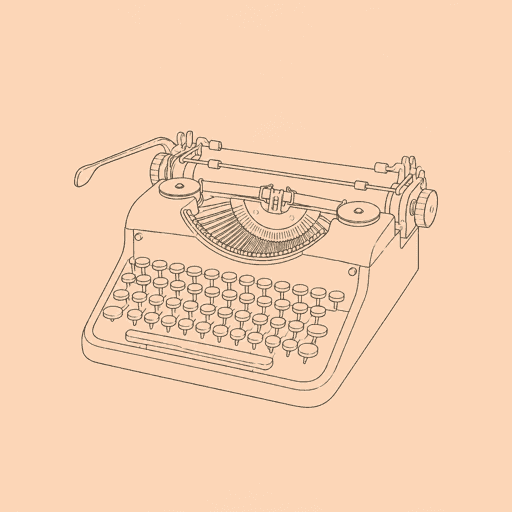
The typewriters are a recurring motif that represents an authentic, analog form of literary creation, offering a contrast to the methods of the digital age. By forcing the authors to use these old-fashioned machines, the competition aestheticizes a specific vision of authorship rooted in physical effort and tactile experience. Millie finds the clacking keys satisfying, but they also make the typically private act of writing a public and competitive performance; Sienna, for instance, is filled with anxiety when she hears another author already at work. This intrusion transforms the creative process into a source of psychological pressure, reflecting how the publishing industry often pits authors against one another in a race for productivity and recognition. The typewriters embody the tangible labor of writing, a concept that the novel ultimately contrasts with How Generative AI Destroys Authentic Creativity.
This motif gains a forensic dimension that contributes to the plot when a flaw in one machine—a misaligned “G”—becomes a key piece of evidence, first in Millie’s prank and later in Malcolm’s investigation into Sienna’s death. This flaw reinforces Malcolm’s belief that “humans lie, but machines do not” (97). The machine’s unique imperfection becomes a tool for revealing human deception, a twist in a story where the ultimate villain, Cate, uses generative AI to perpetrate the novel’s greatest lie.
The Dollhouse
The dollhouse, a perfect miniature replica of the castle, is a symbol of the authors’ lack of agency and their status as pawns in a larger game controlled by unseen forces, whether it be in the publishing industry or in the murder mystery they find themselves in. When the writers first encounter it, the model is an object of “creepy” fascination, its complex detail mirroring the real house with an unsettling precision. The discovery that the dollhouse also contains the house’s secret passages gives the writers a map, but this knowledge doesn’t empower them; instead, it reinforces their sense of being manipulated and observed, their movements anticipated within a pre-designed structure. The dollhouse also represents the publishing “house” itself—a complex system that appears to champion authors but contains hidden mechanisms that control the direction of their careers, rendering them as small and powerless as the miniature furniture within its walls.
This symbolism is subverted when Cate uses the dollhouse to achieve her own violent ends. She discovers that the light from the library lamp, when shone on the model, reveals the location of the golden book in the foyer, transforming the dollhouse from a representation of her entrapment into a treasure map, a tool for seizing power. Her ability to interpret and act upon the model’s secret allows her to claim the ultimate prize, but only by embracing the role of the game’s most ruthless player. The dollhouse thus encapsulates the central tension of the novel, symbolizing the oppressive structure of the publishing industry while also becoming the catalyst for a character’s brutal, agency-claiming rebellion against that very structure.
Arthur Fletch’s Red Hat
Fletch’s red hat is a recurring motif that represents the constructed nature of the authorial persona, emphasizing the novel’s exploration of Masking Artistic Insecurity With Performative Personas. The hat is first introduced as an iconic part of Fletch’s branding, a prop in the magazine photos that define his “world-famous” image and contribute to his mystique. Its appearance on the mysterious figure watching Sienna and Malcolm from the cliff deepens the novel’s central mystery: Is Fletch alive, or is someone else performing his role? This ambiguity reinforces the idea of the author not as a person but as a curated identity, a collection of signifiers that can be adopted or impersonated. The hat stands for the marketable image of the literary genius.
The motif’s meaning culminates in an important revelation from Angus, the island’s groundskeeper. He explains that the hat was originally his and that Fletch merely borrowed it for photos because, as Fletch said, it “had an air of authenticity” (328). This confession deconstructs Fletch’s entire persona, exposing it as a calculated performance built on borrowed credibility. The hat, once a symbol of Fletch’s unique and powerful identity, is revealed to be an inauthentic prop used to manufacture a desirable image. This demystification is central to the novel’s critique of the publishing industry, suggesting that even the most revered literary figures may be products of careful branding; their public-facing selves are as much a work of fiction as the stories they write.

Unlock the meaning behind every key symbol & motif
See how recurring imagery, objects, and ideas shape the narrative.
- Explore how the author builds meaning through symbolism
- Understand what symbols & motifs represent in the text
- Connect recurring ideas to themes, characters, and events