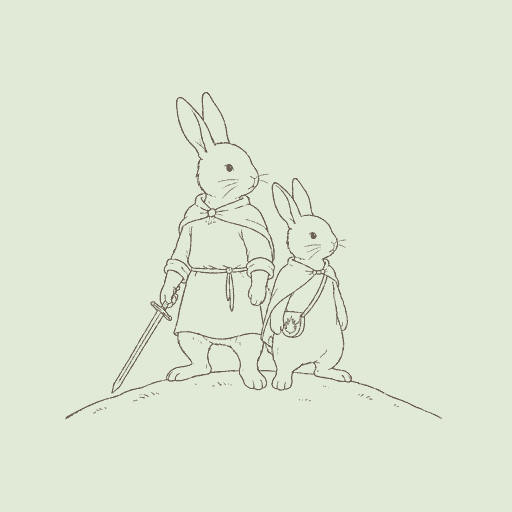
The Green Ember
The Green Ember
A modern alternative to SparkNotes and CliffsNotes, SuperSummary offers high-quality Study Guides with detailed chapter summaries and analysis of major themes, characters, and more.
Summaries & Analyses
Quizzes
NEWReading Tools
Chapters 23-33Chapter Summaries & Analyses
Content Warning: This section of the guide includes discussion of death and physical abuse.
Chapter 23 Summary: “Calling and Community”
While looking at a painting signed “F. S.,” Heather feels a deep longing for her old home and for the Mended Wood, a concept she’s beginning to understand. The next day, she and a still-moody Picket visit King Whitson’s Garden. Emma explains that a nearby building called Lighthall is off limits to them due to the law of initiates, a security measure born from past betrayals.
Emma then leads them into a massive hall where hundreds of rabbits practice various crafts. They witness a “calling ceremony,” a formal ritual where a young apprentice, Gloria Folds, is bound to her “master,” the garden mistress Mrs. Clove Halmond. Afterward, they meet Eefaw Potter, a craftsman who explains that one’s chosen work is usually a lifelong commitment. He tells them that Cloud Mountain is a community where rabbits both create things and are themselves shaped by their work.
Chapter 24 Summary: “A Shame”
As they leave the great hall, Picket trips near a large barrel. A guard aggressively threatens him, declaring that there are traitors in their midst. Emma explains that the barrel contains volatile blastpowder for the community’s defense and that some residents are suspicious of the siblings because they dislike their uncle Wilfred. Picket refuses to apologize to the guard and storms off toward the garden.
Distraught, Heather confides in Emma that she feels like she has lost her brother. Emma comforts her, saying that a wise rabbit named Maggie O’Sage once helped her with her own anger. Meanwhile, Picket finds the door to the garden locked. In a fit of rage, he smashes one of his crutches against it. Guards immediately subdue him at swordpoint just as Smalls arrives on the scene.
Chapter 25 Summary: “The Third Door”
Smalls intervenes, and with Lord Rake’s help, Picket is released. Deeply embarrassed, Picket is escorted back to his room by Smalls, who confronts him about his self-pity and reminds him that he’s not the only one to have suffered loss. While looking at a painting by Finbar Smalls, an emotional Smalls tells Picket that they must simply do their part. Picket is left feeling ashamed.
Meanwhile, Emma leads Heather to a misty, moss-covered porch. There, two painters are each painting a stunning vista of a wide green woodland by squinting into the dense fog and painting what they imagine beyond it. An old woman is also sewing with incredible speed. Emma introduces her as Maggie O’Sage, also known as Mrs. Weaver. Maggie explains that the community at Cloud Mountain exists to anticipate the Mended Wood, which refers to a future, healed version of the Great Wood. While some must fight, their role is to be “heralds” of a peaceful future, preparing for the day when they’re free again.
Chapter 26 Summary: “Bound”
After talking with Maggie, Heather learns from Emma that the weaver is a revered counselor to the whole community. Elsewhere, Picket seeks out the disgraced warrior Helmer the Black and asks to be trained as a fighter. Helmer contemptuously refuses. Picket persists, fueled by a desire for revenge, until he provokes Helmer by calling him a coward. Helmer throws his knife to cut a taut rope, releasing a massive wooden bird headed toward Picket. Helmer then saves him with a kick.
Picket clutches his foot in pain, and when Helmer walks past him, Picket lunges at him from his good foot. Heather, Emma, and Lord Rake arrive. To save face, Picket claims that Helmer was just showing him some training maneuvers. As they’re leaving, Helmer unexpectedly calls out and performs the binding ritual from the calling ceremony, formally accepting Picket as his apprentice. Picket accepts, and they agree to start training the next day.
Chapter 27 Summary: “Questionable Past”
Lord Rake reluctantly approves Picket’s apprenticeship with Helmer on the condition that Picket meets with Maggie daily and attends nightly initiation lessons in Lighthall with Heather. The next morning, after Picket leaves for his first training session, Kyle warns Heather that important figures at Cloud Mountain disapprove of her family’s presence. He also speaks of turmoil among the other centers of resistance, which are known as secret citadels; a lost “Whitson Stone”; and a mysterious “Green Ember.” Emma dismisses Kyle as a liar.
Worried and unsure what to do, Heather goes to King Garden. She sees Smalls inside Lighthall and decides to eavesdrop. She overhears Uncle Wilfred telling Smalls that Harbone Citadel is near collapse because its leaders don’t trust him because he looks just like someone they consider a traitor. Horrified, Heather hears her uncle ask how anyone could trust him or any member of his family. She flees, fearing that her family is hiding a treacherous past.
Chapter 28 Summary: “A Bad Good Day”
After a morning meeting with Maggie, Picket begins his first training session with Helmer. Helmer’s first lesson is that “everything is a weapon” (247), which he demonstrates by pelting Picket with rocks and kicking dirt in his eyes. Though battered, Picket later describes the day as “wonderful.”
Chapter 29 Summary: “Darkness in Lighthall”
Heather is furious at Helmer when she sees her brother’s injuries, but Maggie advises her to let Picket become who he’s meant to be. That evening, Picket is joyful and laughs for the first time in a long while, making Heather realize that Maggie was right about his training.
That night, Heather and Picket go to Lighthall for their initiation lesson with Lord Rake and Uncle Wilfred. The room is lined with magnificent stained-glass windows depicting historical events. They recognize scenes featuring the heroic King Jupiter, including his victory over Garlacks. Heather notices a recurring gray rabbit who appears alongside the king in many of the windows. When she asks who this rabbit is, Wilfred looks at a window showing the king and the gray rabbit envisioning a time of peace. He declares, “Our family betrayed the king” (258).
Chapter 30 Summary: “The Green Ember”
Lord Rake explains the history depicted in the windows. To secure the line of succession, King Walter Good removed the large emerald known as the Green Ember from the center of his royal crown and presented it to Jupiter to symbolize his son’s right to rule. After becoming king, Jupiter restored the emerald to the crown and reigned as a great leader.
Uncle Wilfred then reveals that the gray rabbit in the windows is Garten Longtreader, King Jupiter’s chief ambassador. Picket, misunderstanding, protests that his father is no traitor; Wilfred quickly clarifies that Picket and Heather’s father never betrayed the king, that Garten is his oldest brother, and that Heather and Picket’s father and Wilfred were only Garten’s lieutenants. They carry immense guilt for failing to stop the betrayal. The Longtreader name, once honored, is now a “curse word.” Wilfred then unveils the ninth, previously covered, window.
Chapter 31 Summary: “Jupiter’s Crossing”
The ninth window depicts King Jupiter’s ambush and death at a place now called Jupiter’s Crossing. Uncle Wilfred recounts that he was there, captured and forced to watch as his brother Garten betrayed the king to Morbin Blackhawk, the leader of the Lords of Prey. Before he was killed, King Jupiter prophesied that even if the Great Wood burned, a single “green ember” would remain as the “seed of a new world” that would one day grow into a “Mended Wood” (268).
Devastated by this revelation, Heather and Picket grapple with their family’s legacy of treason. Picket defiantly vows to always use the name “Longtreader” to redeem it. Heather studies the stained-glass scene of Morbin looking down on the king’s body while Garten bends to pick up the fallen crown and notices that the Green Ember is missing from the image. When she asks about the final, cloth-covered 10th window, Lord Rake tells her that it’s “unfinished.”
Chapter 32 Summary: “The Rising”
A week later, Cloud Mountain is tense as lords from other secret citadels arrive for a conference. Heather, ashamed of her family name, has been isolating herself, while Picket has grown stronger through his relentless training with Helmer. Uncle Wilfred warns Heather that tensions are so high that he might have to arrange for her and Picket to flee.
Later, at the dining hall, Heather is publicly accosted by Captain Frye, a visiting soldier from Halfwind Citadel, who calls her family traitors. Kyle defends her and is beaten by Frye before Gort, the cook, breaks up the fight. Shaken, Kyle tells Heather that he hopes they can remain friends and asks if someone who has done bad things can be trusted after they change.
Chapter 33 Summary: “Fights and Facts”
During training, Helmer discovers that Picket has a fear of heights. He tells Picket that they will tackle it tomorrow, as he’s too tired tonight. After the session, Helmer warns Picket that an enemy attack may be imminent. When Picket confidently declares that he will be ready to fight for their victory, Helmer bluntly tells him that they cannot win. He argues that they’re outnumbered and divided and that the Mended Wood is just a story to give false hope. He insists that in the real world, there are no happy endings: The king is dead, they have already lost, and they will continue to lose until they’re all destroyed.
Chapters 23-33 Analysis
The formal “calling ceremony” for Gloria Folds establishes the core philosophy of Cloud Mountain, where one’s vocation is an expression of Hope as the Fuel of Moral Resistance. The ritualized exchange between “master” and apprentice frames a chosen craft as a commitment to both personal formation and communal service. Eefaw Potter articulates this directly when he tells the newcomers, “This is a place where rabbits make and are made. You are what you do” (205). This concept that identity is forged through purposeful work directly informs Maggie’s later explanation of the community’s mission. She describes the artisans as “heralds” who “anticipate the Mended Wood” (220), using the motif to position their crafts as a hopeful assertion of the healed world they intend to build. This framework sharpens Heather’s internal conflict, as her fear of pursuing her own calling as a storyteller reflects a deeper fear of claiming her place in this project of communal hope.
These chapters introduce Maggie and Helmer the Black as dueling mentors who personify the narrative’s central ideological conflict between hope and despair. Maggie, the community’s revered sage, gives counsel rooted in a steadfast faith in a future restoration, embodying the optimistic “noblebright” spirit. In stark contrast, Helmer shows a cynical pragmatism that rejects this vision of hope. He scorns the community’s foundational belief, telling Picket that the concept of the Mended Wood is merely “a child’s motto to keep alive the pathetic hopes of rabbits who just need to face facts” (287). His worldview is grounded in the grim convictions that “the glory is behind [them]” and that “nothing ends well” (287-88). Picket’s apprenticeship places him directly between these two philosophies, forcing him to learn the brutal mechanics of war from someone who believes the war is already lost while simultaneously receiving counsel from a sage who insists on hope as a precondition for survival. This dynamic is a microcosm of the larger literary tension between noblebright optimism and the nihilism of “grimdark” fantasy.
The initiation lesson in Lighthall is a dramatic turning point, revealing the destructive truth of the siblings’ heritage and advancing the theme of Family Legacy as a Moral Burden. The room’s magnificent stained-glass windows serve as a historical record, with one window depicting King Jupiter and Garten Longtreader envisioning a peaceful future just before the great betrayal. Uncle Wilfred’s confession that their “family betrayed the king” shatters this idyllic image and violently recasts the siblings’ identity (258). The Longtreader name, once a mark of honor, is now a “curse word,” providing an explanation for the suspicion and hostility they have faced from guards and visitors like Captain Frye. This revelation externalizes the characters’ internal struggles; Heather’s shame and Picket’s simmering anger are now tied to a shared, inherited guilt. Picket’s immediate vow to “never go by another” name transforms his personal quest for revenge into a larger mission to redeem the Longtreaders’ honor (272), demonstrating his resolve to accept and ultimately overcome the heavy burden of family legacy.
The history unveiled through the stained-glass windows gives concrete form to the narrative’s central motifs, illuminating their importance to the world’s past and future. King Jupiter’s dying prophecy that the Green Ember would remain as the “seed of a new world” cements the emerald’s role as a motif of Hope as the Fuel of Moral Resistance (268). Heather’s observation that the Green Ember is missing from the crown in the window depicting Garten’s treachery transforms the symbol from a historical artifact into an active mystery and a tangible objective for the resistance. Likewise, Jupiter’s Crossing is established as a motif of Family Legacy as a Moral Burden because Garten’s treachery led to the rabbits’ “evilest hour.” The final, cloth-covered, and unfinished 10th window suggests that this history is not yet complete, leaving both narrative and symbolic space for the prophesied Mended Wood to be realized.
While Lighthall reveals the historical roots of the conflict, events throughout Cloud Mountain demonstrate that the community’s social fabric is actively fraying under the weight of this past. The law of initiates, the guards’ intense paranoia surrounding the barrel of blastpowder, and the general suspicion directed at Wilfred all point to a society deeply scarred by past betrayals. This internal fragility is dangerously exacerbated by the arrival of the lords from other citadels. The public confrontation where Frye accosts Heather and beats Kyle is a symptom of deep-seated political divisions that threaten to create a war within the sanctuary itself. Kyle’s defense of Heather, followed by his moving question about whether someone who has done bad things can be trusted after changing, hints at his own complex history and positions him as an ethically ambiguous figure amid these rising tensions. This tense atmosphere shows that the physical and political security of Cloud Mountain is threatened as much by its own fractured history and mistrust as it is by the external enemy.

Get in-depth, chapter-by-chapter summaries and analysis from our literary experts.
- Grasp challenging concepts with clear, comprehensive explanations
- Revisit key plot points and ideas without rereading the book
- Share impressive insights in classes and book clubs